
Loading, please wait...
_900x900.jpg "Greek Style Bronze Helmet")
_200x200.jpg "Greek Style Bronze Helmet")
.jpg "Greek Style Bronze Helmet")
LOT 1444
Greek Style Bronze Helmet
20TH CENTURY A.D.
12 in. (1.5 kg, 30.5 cm high).
Featuring hammered helmet detailing together with mythical creatures and coiled snakes.
ProvenanceAcquired 1990s-early 2000s.
East Anglian private collection.
On original Pseudo-Corinthian or Apulo-Corinthian helmets see Bottini, A., ‘Apulo-Korintische Helme’, in Bottini, A., Egg, M., Von Hase, F. W., Pflug, H., Schaaf, U., Schauer, P., Waurick, G., Antike Helme, Sammlung Lipperheide und andere Bestände des Antikenmuseums Berlin, Mainz, 1988, pp.107-136.
FootnotesThe helmet is modelled upon the pseudo-Corinthian models of antiquity. The gryphon represented refers to the wars between these mythological creatures and the Arimaspes.
CONDITIONTimeLine Auctions follows a vetting process to ensure the authenticity and legality of all items, reinforcing our commitment to integrity and responsible trading. Each antiquity, antique, and coin lot undergoes thorough examination by a vetting committee of at least ten external specialists, professional trade association members, scientists, and archaeologists: Our Vetting Process
AUCTIONS:
TimeLine is a leading auction house specialising in antiquities, ancient art, collectables, natural history, coins, medals, and books. Our auctions offer museums, collectors, historians, and enthusiasts the opportunity to acquire unique and historically significant pieces.
-
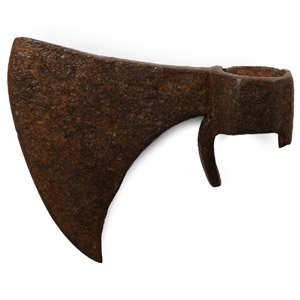
Tudor Period Iron Axehead with Octagonal Socket
16th-17th century A.D.Sold for (Inc. bp): £91
With curved triangular blade, octagonal socket with languets. 246 grams, 11.9 cm
Private collection, UK, formed 1980s-1990s. -
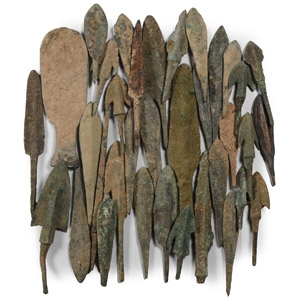
Mesopotamian Bronze Arrowhead Collection
Circa 1800-900 B.C.Sold for (Inc. bp): £234
Including triangular-section, barbed, paddle-shaped, and other types. 353 grams total, 4-12 cm
Ex London, UK, collection, 1990s.
Paddle-shaped arrowheads with a flat, comparatively wide mid-rib and the blade shaped to a point were typical of Old Babylonian Empire. The shoulders were pronounced and the arrowhead had a rectangular-section tapering tang. They are the majority in this group, which comprises also barbed triangular arrowheads of type V from Marlik-Luristan, and one interesting specimen of trilobate arrowhead. -
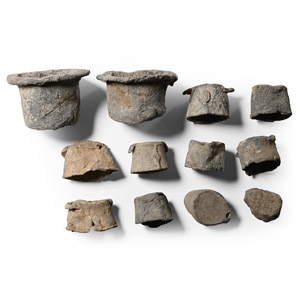
Jacobean 'Published' Musket and Pistol Powder Measure Collection
17th century A.D.Sold for (Inc. bp): £13
Including larger types with everted rim and smaller drum-shaped types. 331 grams total, 23-48 mm
Found Hertford End, Essex, UK. From the collection of the famous author, writer and speaker, Gordon Bailey, Essex, UK; formed since 1968.
