
Loading, please wait...
LOT 1097
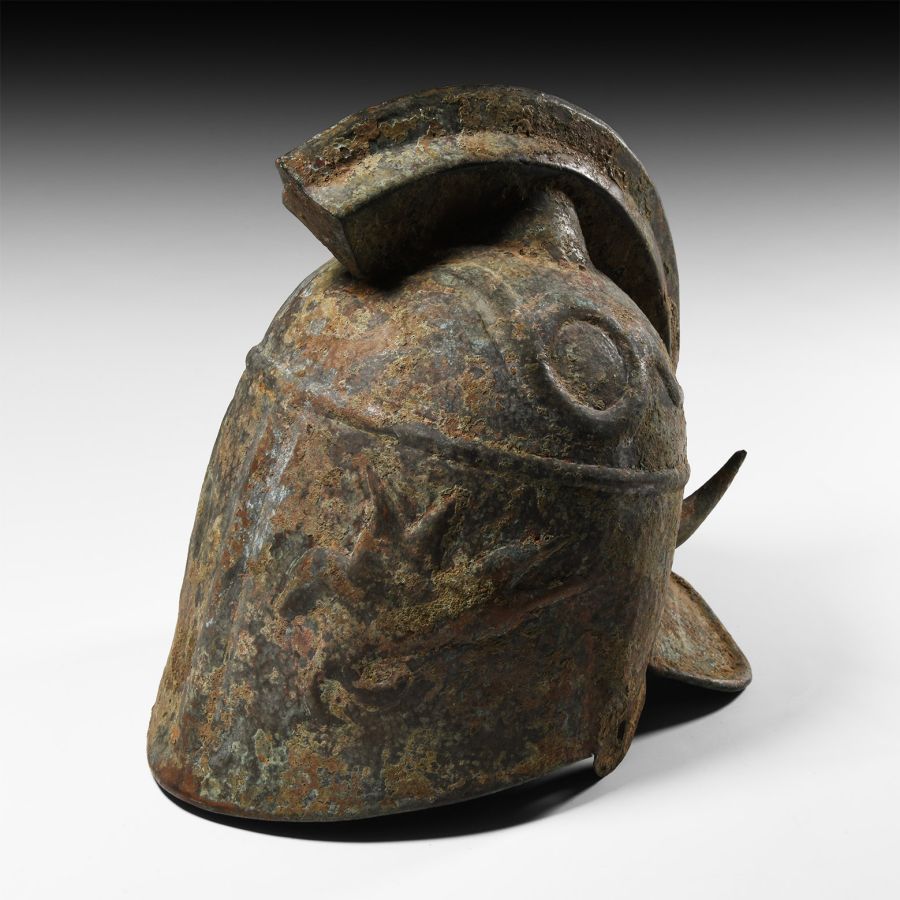
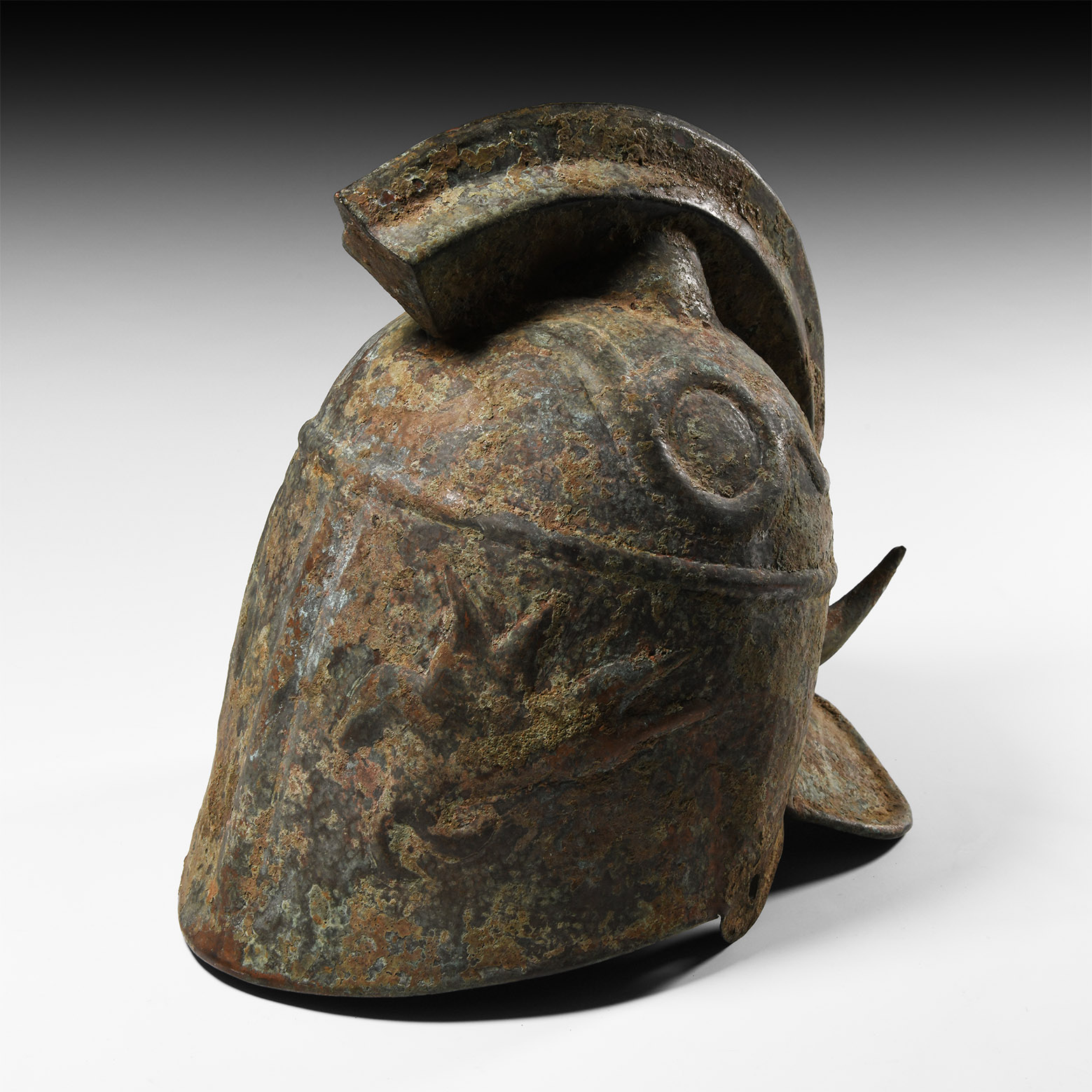
Greek Style Bronze Helmet
20TH CENTURY A.D.
12 in. (1.5 kg, 30.5 cm high).
Featuring hammered helmet detailing together with mythical creatures and coiled snakes.
ProvenanceAcquired 1990s-early 2000s.
East Anglian private collection.
On original Pseudo-Corinthian or Apulo-Corinthian helmets see Bottini, A., ‘Apulo-Korintische Helme’, in Bottini, A., Egg, M., Von Hase, F. W., Pflug, H., Schaaf, U., Schauer, P., Waurick, G., Antike Helme, Sammlung Lipperheide und andere Bestände des Antikenmuseums Berlin, Mainz, 1988, pp.107-136.
FootnotesThe helmet is modelled upon the pseudo-Corinthian models of antiquity. The gryphon represented refers to the wars between these mythological creatures and the Arimaspes.
CONDITIONTimeLine Auctions follows a vetting process to ensure the authenticity and legality of all items, reinforcing our commitment to integrity and responsible trading. Each antiquity, antique, and coin lot undergoes thorough examination by a vetting committee of at least ten external specialists, professional trade association members, scientists, and archaeologists: Our Vetting Process
AUCTIONS:
TimeLine is a leading auction house specialising in antiquities, ancient art, collectables, natural history, coins, medals, and books. Our auctions offer museums, collectors, historians, and enthusiasts the opportunity to acquire unique and historically significant pieces.
-
.jpg)
Roman Bronze Armour Double Fastening Hooks
Circa 1st century A.D.Estimate: £150 - 200 (+bp*)
Opening Bid: £75
Each a scrolled bar formed as a serpent or other animal with stylised geometric detailing; attachment perforations to both terminals. 19.6 grams total, 64-66 mm
Acquired on the London art market, 1980s-1990s.
In the 1st century B.C.-1st century A.D., the Celtic fastening system of the ring mail armour (gallica, lorica ferro aspera) became the standard in the Imperial Roman army, with a pivot attached to the breast and hinged to the edges of the humeralia (shoulder guards). The chest fastener had various different designs. The double hooks, S-shaped and usually with snake-head terminals, were secured by a central rivet on the chest. The system allowed excellent freedom of movement, giving greater protection to the shoulders and the arms. Similar fasteners for infantry mail have been found on the Kalkriese battlefield, some of them also decorated with niello and inscribed with the name of the soldier. -
.jpg)
Roman Bronze Armour Squama Scales Group
2nd-3rd century A.D.Sold for (Inc. bp): £715
Mixed group of semi-rigid bronze scales with scalloped lower edges, pierced for attachment; together with two small panels of articulated lamina scales. 30 grams total, 10-65 mm
Acquired in the late 1980s. The Kusmirek Collection, UK.
A new form of rigid scale-armour, typified by pieces found in Britannia (Corbridge, Carlisle), Pannonia (Musov), Moesia (Iron Gates) and in various other provinces of the empire, was introduced earlier in the Antonine Period, and continued for all of the 3rd and 4th centuries A.D. The new body protection was realised with scales attached by wire to each of their four neighbouring scales. These new scales tended to be not only very small, but also long and slender and needed to be carefully shaped around the neck. -
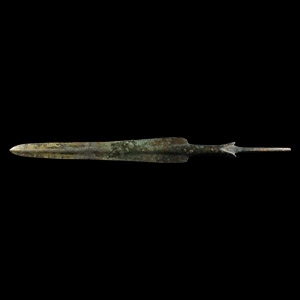
Amlash Type Spearhead
12th-11th century B.C.Sold for (Inc. bp): £182
Long, parallel-sided with deep midrib, broad tip, round-section neck with V-shaped recess to each face and thick square-section tang. 468 grams, 47 cm
Ex German collection, Cologne, 1980-1990s.
This weapon belongs to the type 1 of the spear-head classification of Khorasani, mainly from Marlik or Amlash areas. Similar pieces have been dated by Stutzinger to 1200-1100 BC.
