
Loading, please wait...

LOT 0063
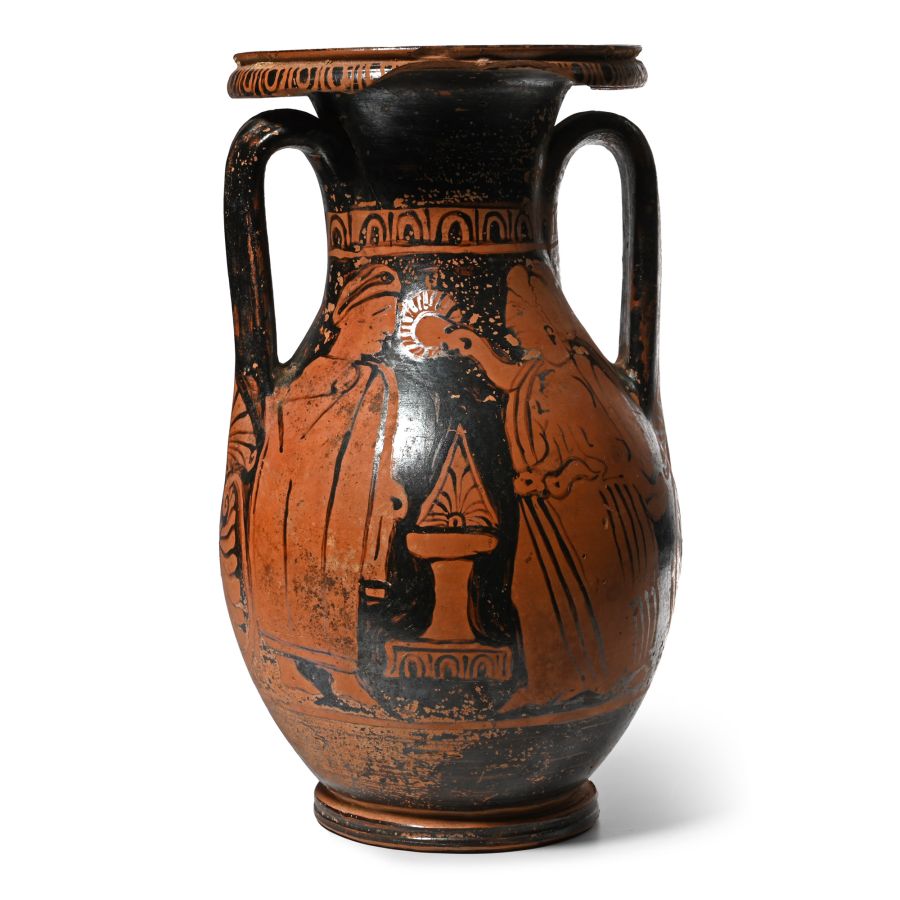
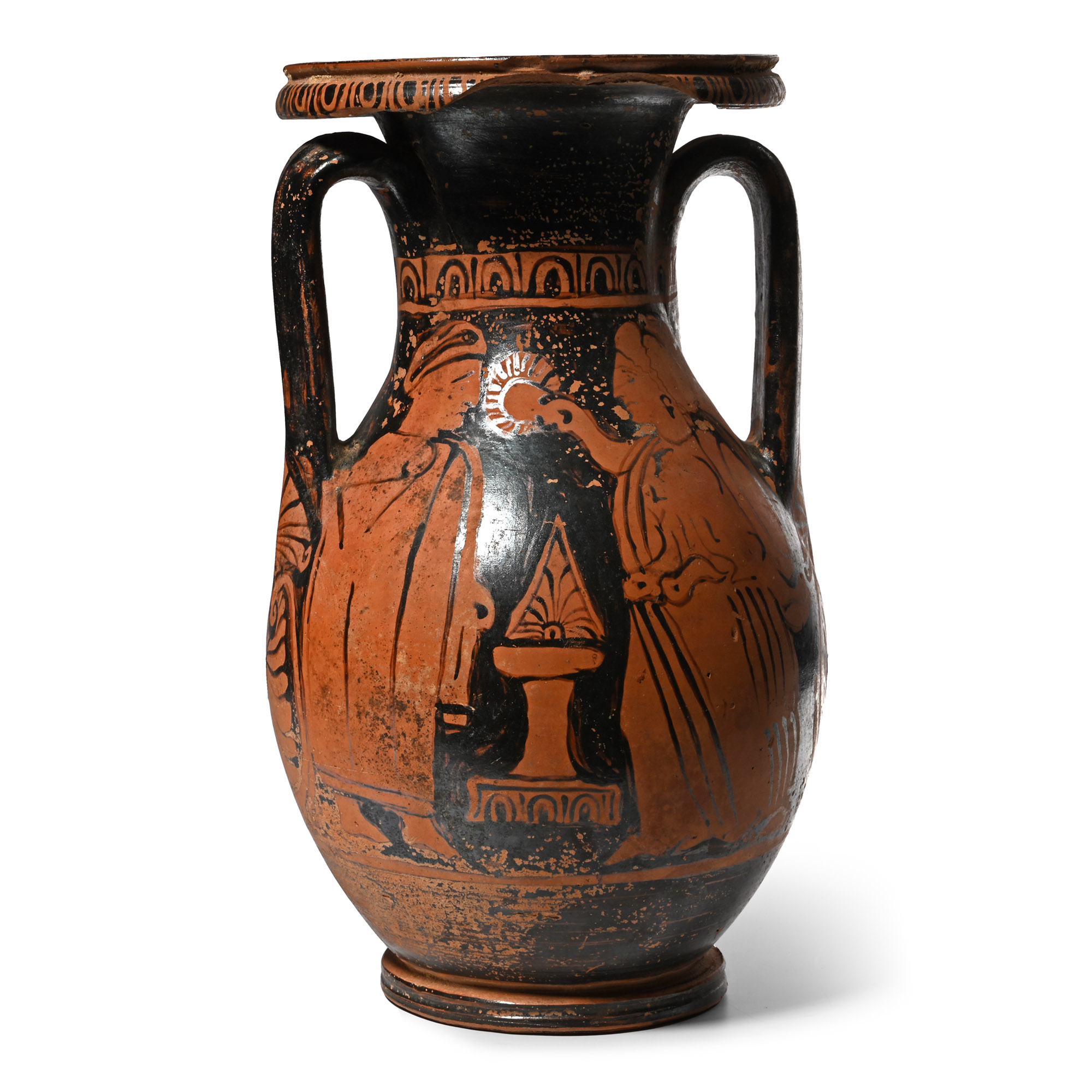
Greek South Italian Red-Figure Pelike with Presentation Scene
5TH-4TH CENTURY B.C.
10 in. (969 grams, 25.2 cm).
Comprising a pedestal base, mastoid body, lateral strap handles and funicular neck, broad mouth with stepped rim; the neck and rim decorated with a band of egg-and-dart; both faces of the body decorated with a figural scene with a standing male on the left with close-fitting cap, long cloak or mantle reaching from shoulder to knee and clasped at his right shoulder with a disc brooch, holding in his left hand a key-shaped object; to his right, a chest-high structure with palmette at the top, waisted shaft and arcaded base; to the right, a female standing facing the male, wearing a crested helmet or headdress, peplos dress gathered at her waist and extending to the floor, holding in her right hand a diadem or wreath towards the male; palmettes below the handles, the base with red and black banding; the strap handles undecorated; likely Campanian workmanship.
ProvenanceAcquired in Münich in 2012.
European private collection
Accompanied by an academic report by Dr Raffaele D’Amato.
This lot has been checked against the Interpol Database of stolen works of art and is accompanied by search certificate number no.12190-222344.
Cf. for similar pottery (Attic prototype) in Görkay, K., ‘Corinthian, Attic Black figure and red figure pottery from Sinope’, in Anadolu/Anatolia, 2020, no.46, p.446, no.87; a similar Campanian pelike in British Museum inventory no.1867,0508.1157, in Pryce, F.N., Corpus Vasorum Antiquorum: Great Britain 10, British Museum 7, London, 1932, pl.1,6; cf. also Mayo, E.M., Vases from Magna Graecia, Virginia Museum of Fine Arts, 1983, for discussion and similar examples.
FootnotesDuring the late 5th century B.C., Attic imports ceased as the Spartans blockaded trade routes during the Peloponnesian War (431-404 B.C.). In response, five areas in southern Italy, Campania, Paestum, Apulia, Lucania, and Sicily began to produce red-figure vases. The decoration offered a remarkable range of subjects associated not only with mythological images, but with representations the local life, costumes and customs. The simple, single figure compositions decorating each side of this vase were also characteristic of the style, which tended to avoid complex mythological scenes often found on much larger vessels like volute craters, favouring representation of the daily life of south Italic Hellenised peoples.
CONDITIONTimeLine Auctions follows a vetting process to ensure the authenticity and legality of all items, reinforcing our commitment to integrity and responsible trading. Each antiquity, antique, and coin lot undergoes thorough examination by a vetting committee of at least ten external specialists, professional trade association members, scientists, and archaeologists: Our Vetting Process
AUCTIONS:
TimeLine is a leading auction house specialising in antiquities, ancient art, collectables, natural history, coins, medals, and books. Our auctions offer museums, collectors, historians, and enthusiasts the opportunity to acquire unique and historically significant pieces.
LOT 0063
Greek South Italian Red-Figure Pelike with Presentation Scene
Sold for (Inc. bp): £1,560
-
Greek Marble Head of a Youth
Early 5th century B.C.Estimate: £2,500 - 3,500 (‡+bp*)
Opening Bid: £1,200
Carved in the round; semi-naturalistic anatomic and facial detailing, hair gathered loosely at the neck and tied with a taenia knotted at the nape of the neck; mounted on a custom-made display base. 879 grams total, 18 cm high including stand
Ex old European private property, by inheritance to the previous owner. Ex Schuler Auktionen, Zürich, 10 December 2020, no.1211. Accompanied by an academic report by Dr Raffaele D’Amato. This lot has been checked against the Interpol Database of stolen works of art and is accompanied by search certificate number no.11817-206512.
The small statuette to which the head belonged was probably that of a naked youth, the so-called kouros, typical of archaic Greek sculpture from the 7th century B.C. onwards. -
Greek Gold and Garnet Earrings
Circa 4th-3rd century B.C.Sold for (Inc. bp): £247
Crescent-shaped with coiled ends, applied ellipsoid cell with stepped profile and inset garnet cabochon. 0.93 grams total, 13-16 mm
Ex property of a late Japanese collector, 1970s-2000s. -
Greek Black-Glazed Cup
South Italian, 5th-4th century B.C.Estimate: £180 - 240 (‡+bp*)
Opening Bid: £100
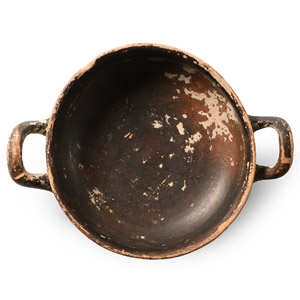
Broad and squat with carination below the rim, two lateral loop handles, basal ring. 36 grams, 10.2 cm wide
Acquired in Münich in 2012. European private collection.
