
Loading, please wait...
_900x900.jpg "Greek Silver Medical Implement with Snake Handle")
_200x200.jpg "Greek Silver Medical Implement with Snake Handle")
.jpg "Greek Silver Medical Implement with Snake Handle")
LOT 0615
Greek Silver Medical Implement with Snake Handle
4TH-3RD CENTURY B.C.
10 in. (68 grams, 25 cm long).
A silver and copper-alloy medical instrument, oval in shape, the handle formed as a snake with shallow hatched pattern on the body representing scales, stylised rendering of the snake's head.
ProvenanceAcquired mid 1980s to early 1990s.
Private family collection formed in London, UK.
Accompanied by a metal test assessment number 182971/HM1456 from an Oxford specialist.
Cf. Milne, J.S., Surgical Instruments in Greek and Roman times, Oxford, 1907, pl.XI,4, for a spatula with a similar snake handle.
FootnotesThe use of this spatula (probe) for medical assessment can be confirmed by its snake-shaped handle, evidently a reference to the god Asklepios, whose symbol was a staff with a serpent wrapped around it. Such implements, called 'ἀπυρομήλη', were used in the Graeco-Persian world. The survival of the handle in this example makes it a rare find.
CONDITIONTimeLine Auctions follows a vetting process to ensure the authenticity and legality of all items, reinforcing our commitment to integrity and responsible trading. Each antiquity, antique, and coin lot undergoes thorough examination by a vetting committee of at least ten external specialists, professional trade association members, scientists, and archaeologists: Our Vetting Process
AUCTIONS:
TimeLine is a leading auction house specialising in antiquities, ancient art, collectables, natural history, coins, medals, and books. Our auctions offer museums, collectors, historians, and enthusiasts the opportunity to acquire unique and historically significant pieces.
LOT 0615
Greek Silver Medical Implement with Snake Handle
Estimate £400 - 600€460 - 700 (for guidance only)$540 - 810 (for guidance only)
-
.jpg)
Attic Red-Figure Bell Krater with Drunken Male Revellers Attributed to the Kadmos Painter
5th-4th century B.C.Sold for (Inc. bp): £32,500
With a high foot, laurel wreath encircling the neck, checkerboard and meander patterns alternating around the lower body, roundels of tongue motif to the handles with palmettes and tendrils below; two red-figure scenes to the body: Side a: a high-quality depiction of a kōmos composed of five figures, including a young man holding a torch, a double flute player next to three dancers, all possibly followers of Dionysus; Side b: three draped figures conversing comprising a central female figure between two opposed male figures, one holding a staff; two old labels: one with 3061-133 on the inner rim, and 113/2 (believed to be an old Christie's lot label from the 1960s by Richard Falkiner) on the sidewall, further old accession numbers 321 and 35 under the base. 3.8 kg, 37 cm wide
Thomas Hope (1769-1831), London and the Deepdene, Surrey, Thence by descent to Lord Henry Francis Hope Pelham-Clinton-Hope (1866-1941), the Deepdene. The Celebrated Collection of Greek, Roman and Egyptian Sculpture and Ancient Vases being a portion of The Hope Heirlooms; Christie's, London, 23-24 July 1917, no.113. Private collection, acquired in Paris, 2004. Accompanied by a copy of a thermoluminescence analysis report no.N111j79 from Oxford Authentication. Accompanied by an academic report by Dr Raffaele D’Amato. This lot has been checked against the Interpol Database of stolen works of art and is accompanied by search certificate number no.11786-206517.
The Kadmos Painter was an Athenian red-figure vase painter, whose real name is unknown. His nickname was bestowed by Beazley, naming him after the subject of a famous hydria in Berlin (Antikensammlungen Berlin/Altes Museum, found in Vulci). He illustrated many mythological scenes, sometimes with figures arranged up and down the field, usually on bell craters, vessels used in symposia for mixing wine and water. A komos was a ritualistic drunken procession performed by revellers in ancient Greece. It preceded and/or followed the banquet, whether unbridled in nature with music and games, or serious and philosophical. -
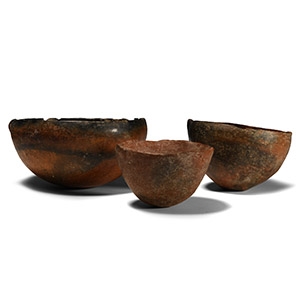
Cypriot Red Polished Ware Bowl Group
Early Bronze Age, circa 2700-1900 B.C.Sold for (Inc. bp): £260
Group of three hemispherical bowls, each with a thick rounded rim, one with lateral spurs to the rim. 700 grams total, 9.1-14.2 cm
From a collection acquired on the UK art market from various auction houses and collections mostly before 2000. From an important Cambridgeshire estate; thence by descent. -
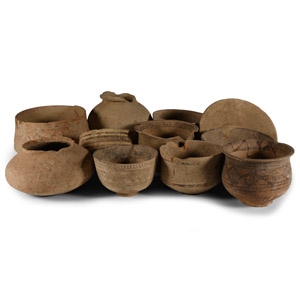
Greek and Other Terracotta Pottery Group
1st millennium B.C. and earlierSold for (Inc. bp): £208
Fragments including carinated bowl with painted frieze to the shoulder, squat jar, cup with everted rim and other types. 2.1 kg total, 9-14 cm
Acquired 1980-2015. Ex Abelita family collection.
