
Loading, please wait...
LOT 0527
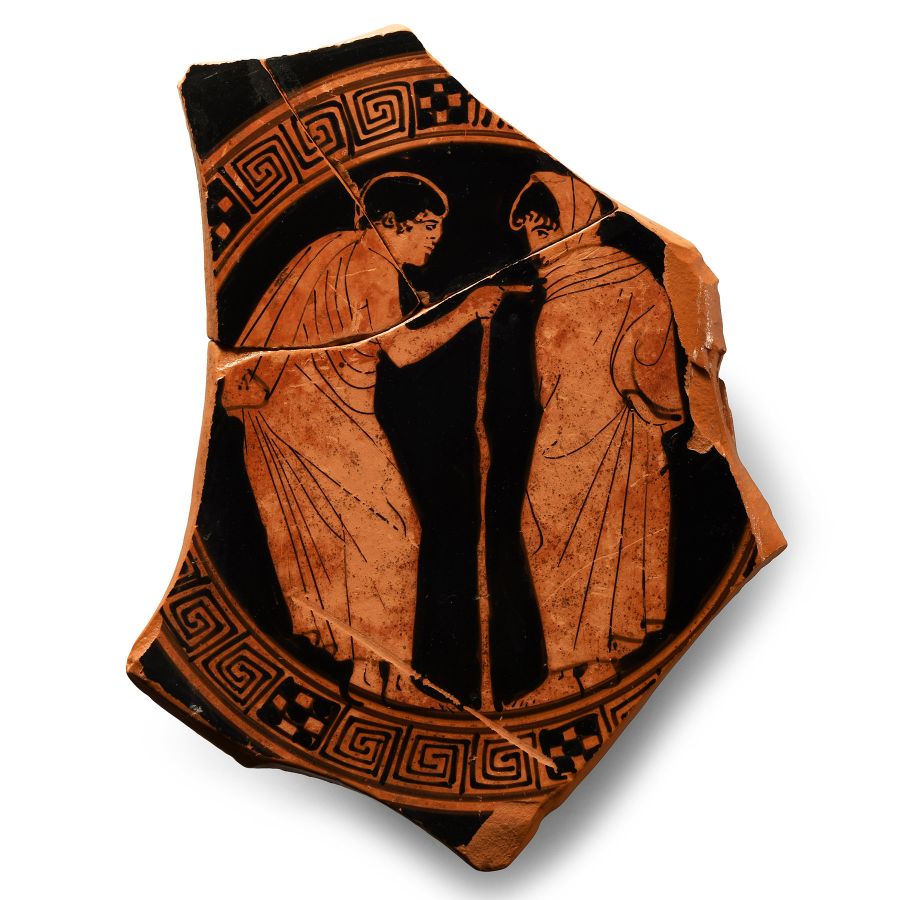
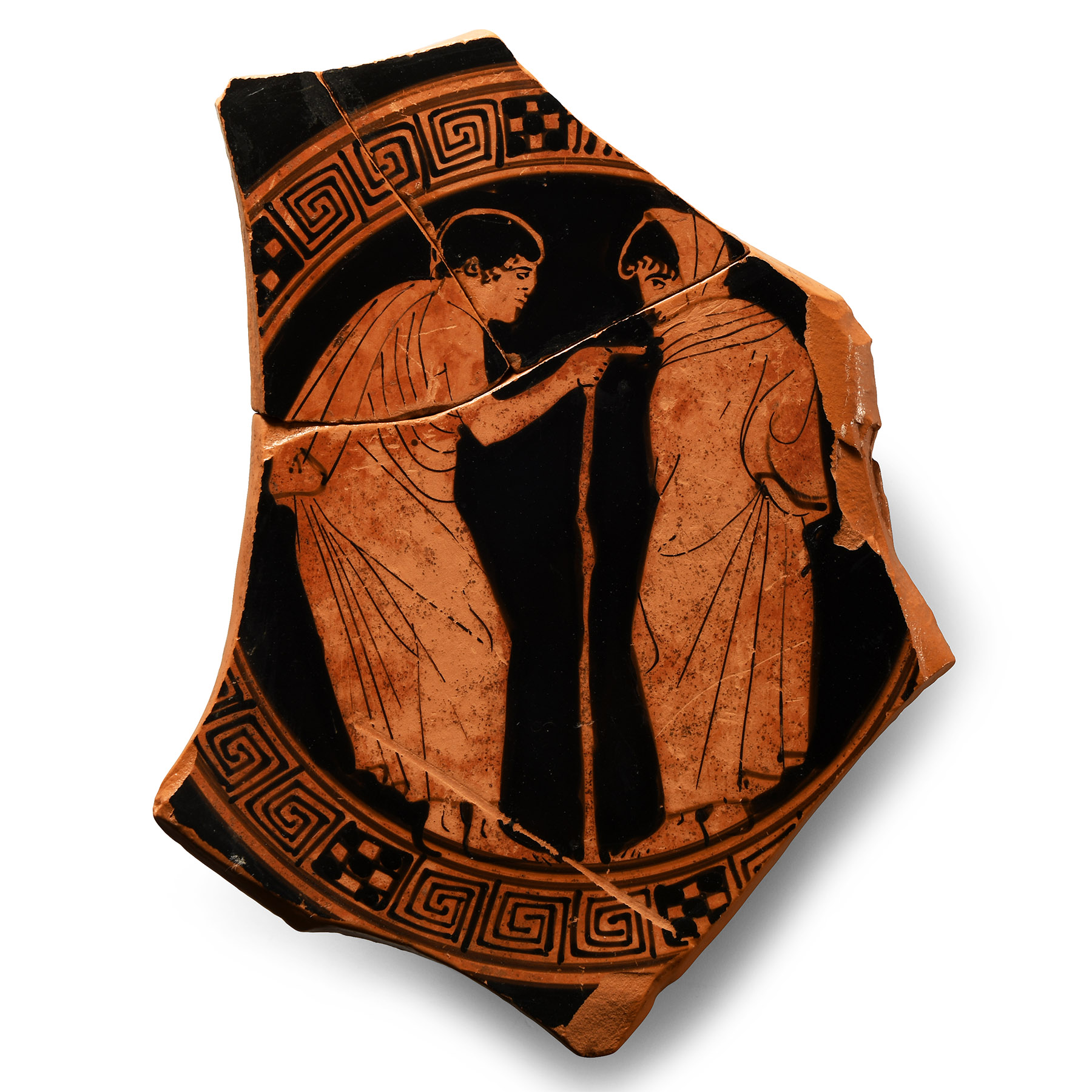
Greek Red-Figure Fragment with Draped Figures
5TH CENTURY B.C.
5 1/8 in. (91 grams, 13 cm).
Depicting a young man dressed in a long cloak, the right hand resting on a staff, facing a young woman wrapped in a long himation, covering her head and leaving the face uncovered; the scene enclosed within a medallion decorated with meanders and chequered squares; remains of the stem to the reverse with painted figures on the edge; repaired.
ProvenanceAcquired before 2005.
Private collection, Europe.
This lot has been checked against the Interpol Database of stolen works of art and is accompanied by search certificate number no.11796-206819.
Cf. The Paul Getty Museum, Greek vases, Molly and Walter Bareiss Collection, Malibu, 1983, nos.36-37.
FootnotesThis red-figure scene once possibly formed part of a kylix, a cup made for drinking. The decoration of the tondo surrounding the figures allows a comparison with some works of the painter Onesimos and the potter Euphronios. In particular the meanders on the medallion, and the working of the figures, seems to recall the work of Onesimos, who preferred to decorate cups, many of them thrown by the famous Euphronios.
CONDITIONTimeLine Auctions follows a vetting process to ensure the authenticity and legality of all items, reinforcing our commitment to integrity and responsible trading. Each antiquity, antique, and coin lot undergoes thorough examination by a vetting committee of at least ten external specialists, professional trade association members, scientists, and archaeologists: Our Vetting Process
AUCTIONS:
TimeLine is a leading auction house specialising in antiquities, ancient art, collectables, natural history, coins, medals, and books. Our auctions offer museums, collectors, historians, and enthusiasts the opportunity to acquire unique and historically significant pieces.
-
.jpg)
Etruscan Gold Filigree Leech Brooch
7th century B.C.Estimate: £2,000 - 3,000 (+bp*)
Opening Bid: £1,000
Hollow-formed bow with applied floral detailing, filigree and granules, double-coiled spring and pin; tongue-shaped foot with dense granule detailing, globe finial with rosette above. 13.86 grams, 69 mm
Acquired in the 1970s. Property of a London lady, part of her family's collection. This lot has been checked against the Interpol Database of stolen works of art and is accompanied by search certificate no.12112-213116. -
.jpg)
Apulian Red-Figure Askos with Panthers
4th century B.C.Estimate: £3,000 - 4,000 (‡+bp*)
Opening Bid: £833
With an arching strap handle and a wide spout; either side of the body painted with a crouching panther, one playing with a ball and the other depicted facing; repaired. 149 grams, 12 cm
Fine condition, some surface rubbing on the black glaze, with metallic gloss, some calcareous deposits on underside of lip and vase, glaze slightly chipped in a few places, repaired.
Acquired from Gallery Gryphos, Munich, 1992. European private collection. Accompanied by an academic report by Dr Raffaele D’Amato. This lot has been checked against the Interpol Database of stolen works of art and is accompanied by a search certificate number no.12001-211879.
Painted askoi in different forms have been produced and been in use in Athens since the middle and second quarter of the 5th century B.C., but they were also made in southern Italy. The askoi painted with a pair of animal figures were realised in Magna Graecia after the Attic continental production of similar models, with the representation of griffins, sphinxes and laconic hounds. The function of the askos as a vessel was clearly linked to wine, and therefore it is not anomalous to see it decorated with panther motifs, an animal connected with Dionysus, the god of wine and drinking. -
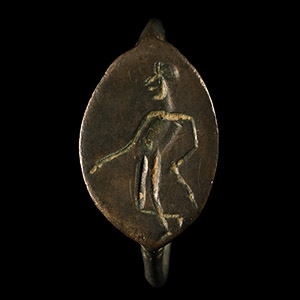
Greek Ring with Standing God
5th-4th century B.C.Sold for (Inc. bp): £195
Scaphoid bezel with intaglio figure of Mars with helmet and sword. 3.38 grams, 22.28 mm overall, 17.72 x 20.25 mm internal diameter (approximate size British P 1/2, USA 7 3/4, Europe 16.86, Japan 16)
UK private collection before 2000. UK art market. Property of a London gentleman.
