
Loading, please wait...
LOT 0530
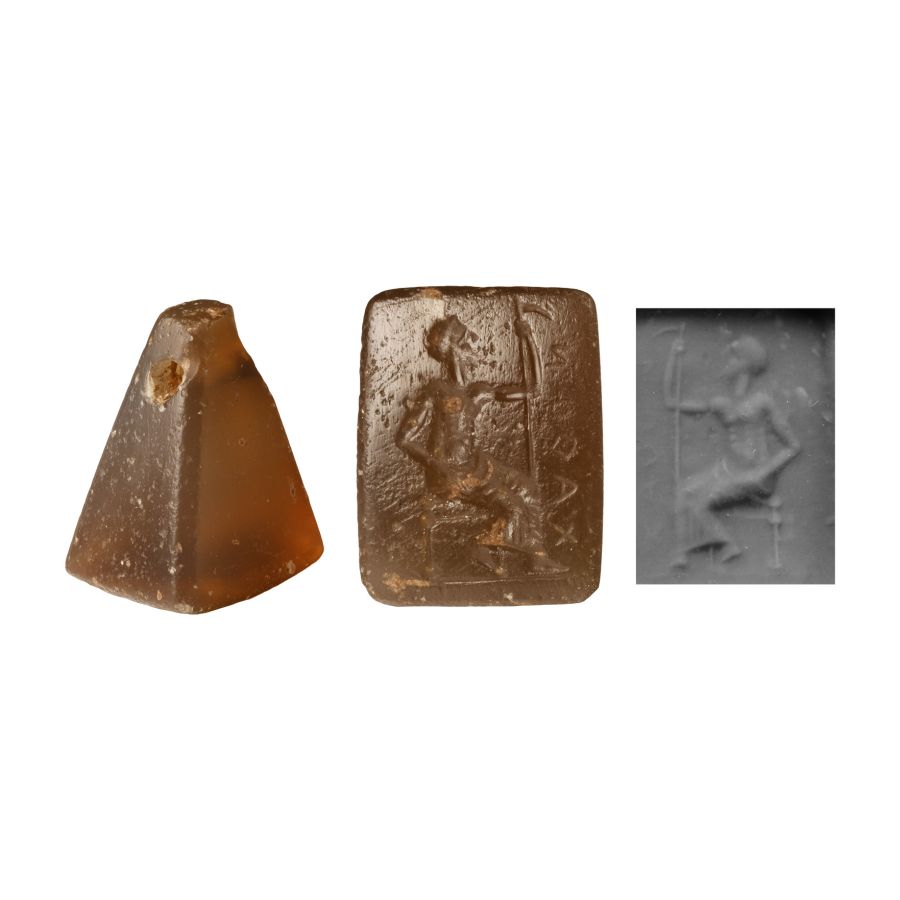
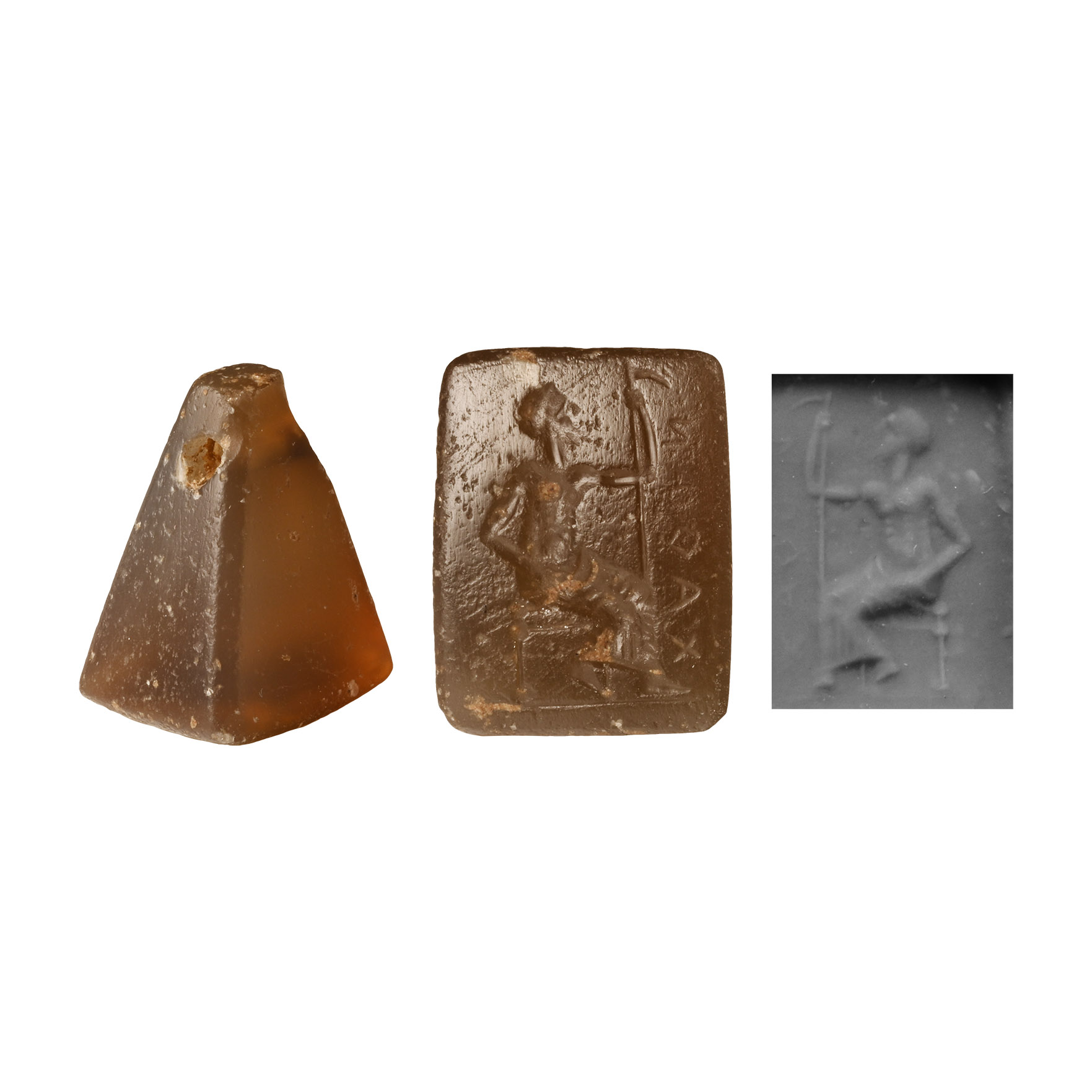
Greek Pyramid Seal with Inscription
CIRCA 5TH CENTURY B.C.
3/4 in. (5.02 grams, 20 mm).
With incuse Zeus seated on a stool, holding the shaft of a sceptre topped by an eagle, legend to the side 'XAΡOΝ'; supplied with a museum-quality impression.
ProvenanceFrom the property of late Mr SM, London, UK, 1969-1999.
LiteratureCf. Boardman, J., Greek Gems and finger rings, Early Bronze Age to Late Classical, London, 2001, no.1037, p.392, for similar.
FootnotesThe seal bears a classical representation of seated Zeus with his eagle-headed sceptre. The inscribed name (Charon) is probably the one of the owner, according to the interpretation of Boardman. The parallel of the image on this seal can be seen on a blue chalcedony scaraboid, type A.L.17 preserved in the Getty Museum (inventory 84.AN.I.12).
CONDITIONTimeLine Auctions follows a vetting process to ensure the authenticity and legality of all items, reinforcing our commitment to integrity and responsible trading. Each antiquity, antique, and coin lot undergoes thorough examination by a vetting committee of at least ten external specialists, professional trade association members, scientists, and archaeologists: Our Vetting Process
AUCTIONS:
TimeLine is a leading auction house specialising in antiquities, ancient art, collectables, natural history, coins, medals, and books. Our auctions offer museums, collectors, historians, and enthusiasts the opportunity to acquire unique and historically significant pieces.
-
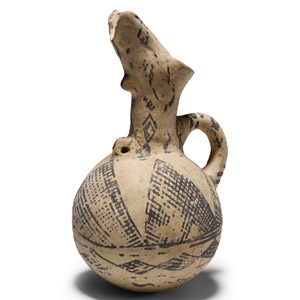
Cypriot White Painted Ware Jug
Middle Bronze Age, circa 1800-1650 B.C.Sold for (Inc. bp): £195
Comprising a spherical body with tall tubular neck and U-section pouring spout, large strap handle to the rear and small loop to the neck; panels of hatched painted ornament. 256 grams, 17.5 cm
From a collection acquired on the UK art market from various auction houses and collections mostly before 2000. From an important Cambridgeshire estate; thence by descent. -
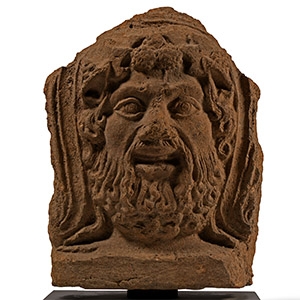
Etruscan Terracotta Satyr Antefix
4th century B.C.Estimate: £3,000 - 4,000 (+bp*)
Opening Bid: £1,500
D-shaped in profile with high-relief mask of a satyr within a looped frame; hanks of curling hair to the brow and temples with berries to the fillet, lentoid eyes, broad nose, curling moustache and beard; ledge below and arched ridge to the reverse; mounted on a custom-made stand. 6.77 kg total, 30 cm including stand
Acquired from Faustus Ancient Art Ltd, London, 1990. Private American collection. with Christie’s, London, 27 October 2009, no 9. Accompanied by copies of the relevant Christie's catalogue pages. Accompanied by an academic report by Dr Raffaele D’Amato. This lot has been checked against the Interpol Database of stolen works of art and is accompanied by a search certificate number no.12062-217441.
The antefix belongs to the typical decorative scheme of alternating maenad and satyr head antefixes that were mainly produced in Cerveteri. Heads were often placed in temples and displayed identifying features such as wavy hair and large, almond-shaped lidded eyes, and were lavishly painted. These typologies of antefixes generally look quite similar and appear to have identical colour schemes with dark red skin, and with darker shade of red applied to the hair below the ears and on top of the head and inside the ears. -
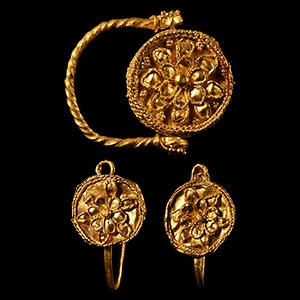
Greek Gold Ring and Earring Set with Rosettes
4th-3rd century B.C.Estimate: £5,000 - 7,000 (+bp*)
Opening Bid: £2,778
Comprising: matched pair of earrings, each a hollow-formed disc with applied rosette motif in filigree; finger ring with twisted rod shank and swivel attachment to a drum-shaped bezel with similar applied rosette, granule clusters to the rim. 14.59 grams total, 22-32 mm
London collection; acquired on the UK art market 1971-1974. This lot has been checked against the Interpol Database of stolen works of art and is accompanied by a search certificate number no.12152-217076.
