
Loading, please wait...


LOT 1447
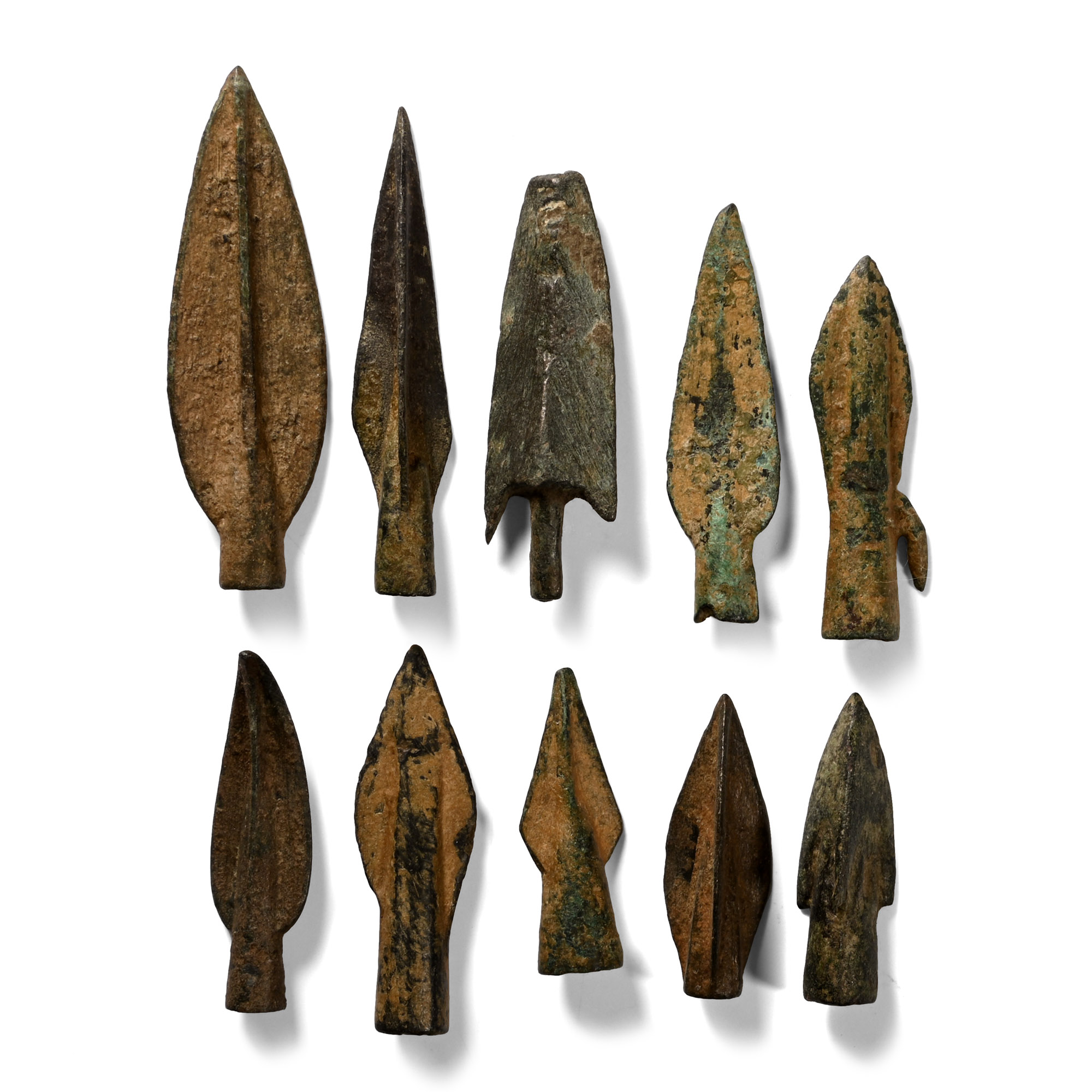
Greek Period High Quality Large Bronze Arrowhead Collection
5TH-3RD CENTURY B.C.
1 1/4 - 1 7/8 in. (49 grams total, 30-47 mm).
Socketted with leaf-shaped, triangular-section, barbed and other types. [10, No Reserve]
ProvenanceFrom an English collection formed before 2000.
This lot is accompanied by an illustrated lot declaration signed by the Head of the Antiquities Department, Dr Raffaele D'Amato.
TimeLine Auctions follows a vetting process to ensure the authenticity and legality of all items, reinforcing our commitment to integrity and responsible trading. Each antiquity, antique, and coin lot undergoes thorough examination by a vetting committee of at least ten external specialists, professional trade association members, scientists, and archaeologists: Our Vetting Process
AUCTIONS:
TimeLine is a leading auction house specialising in antiquities, ancient art, collectables, natural history, coins, medals, and books. Our auctions offer museums, collectors, historians, and enthusiasts the opportunity to acquire unique and historically significant pieces.
LOT 1447
Greek Period High Quality Large Bronze Arrowhead Collection
Sold for (Inc. bp): £104
-
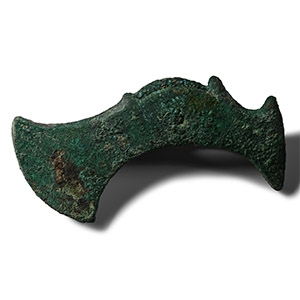
Bactrian Bronze Axehead
3rd-2nd millennium B.C.Estimate: £400 - 600 (‡+bp*)
Opening Bid: £200
With curved flaring cutting edge, characteristic curving shape and narrow socket, blade end squaring off, shaft hole pierced on both sides. 227 grams, 10.6 cm
Acquired in the mid 1980s-1990s. Private collection, Switzerland, thence by descent. Private collection, since the late 1990s. This lot is accompanied by an illustrated lot declaration signed by the Head of the Antiquities Department, Dr Raffaele D'Amato.
These collared axes have the specific feature of being equipped with variously shaped rear extensions. The provenance of this typology is clearer than others: these axes came from Margiana and southern Bactria. Gonur Depe and Susa yielded a rather atypical and probably imported example. P. Amiet suggests that they were an adoption of Elamite material, from conceptual and institutional models. They would have developed from the end of the 3rd and the beginning of the 2nd millennium B.C. -
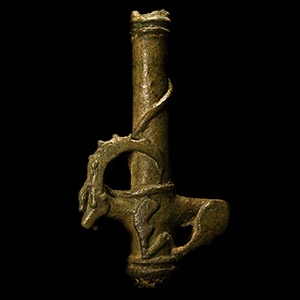
Parthian Bronze Macehead with Ibex
1st-3rd century A.D.Estimate: £2,000 - 3,000 (+bp*)
Opening Bid: £1,000
Tubular in form with ornamental features of a kneeling ibex with a rope coiling around the stem. 1.02 kg, 20 cm
Acquired before 1983. Ex London gallery, 1990s. This lot has been checked against the Interpol Database of stolen works of art and is accompanied by a search certificate number no.12725-236258. This lot has been cleared against the Art Loss Register database, and is accompanied by an illustrated lot declaration signed by the Head of the Antiquities Department, Dr Raffaele D'Amato. -
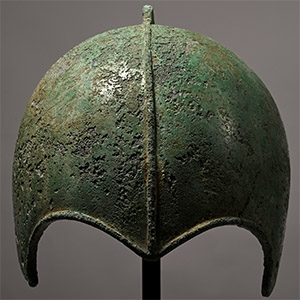
Scythian Bronze 'Kuban' Type Helmet
7th-6th century B.C.Sold for (Inc. bp): £18,200
Raised from a single sheet with rounded skull and semi-circular cut-outs for the eyes with raised rims, raised bar to the front extending to the top with a loop; ten circular perforations to the lower edge; accompanied by a custom-made display stand. 1.47 kg, 23.5 cm wide
Private collection formed in Europe in the 1980s. Westminster collection, central London, UK. Accompanied by an academic report by Dr Raffaele D’Amato. This lot has been checked against the Interpol Database of stolen works of art and is accompanied by search certificate number no.12616-235608. This lot has been cleared against the Art Loss Register database, and is accompanied by an illustrated lot declaration signed by the Head of the Antiquities Department, Dr Raffaele D'Amato.
This war helmet, typical of the Caucasian Scythians, belongs to the so-called Kuban type according to B. Z. Rabinovich, named after the north Caucasian region where the majority of this type of helmets were found. The helmet is almost identical to the helmet found in the 6th century barrow at Kelermes (Stanitsa Kelermeskaya), and in fact many of such helmets have been found in the Northern Caucasus. The helmets were typical of the noblemen fighting on horseback with spear, javelins and especially with bow and arrows.
