Loading, please wait...
Details
LOT 0540
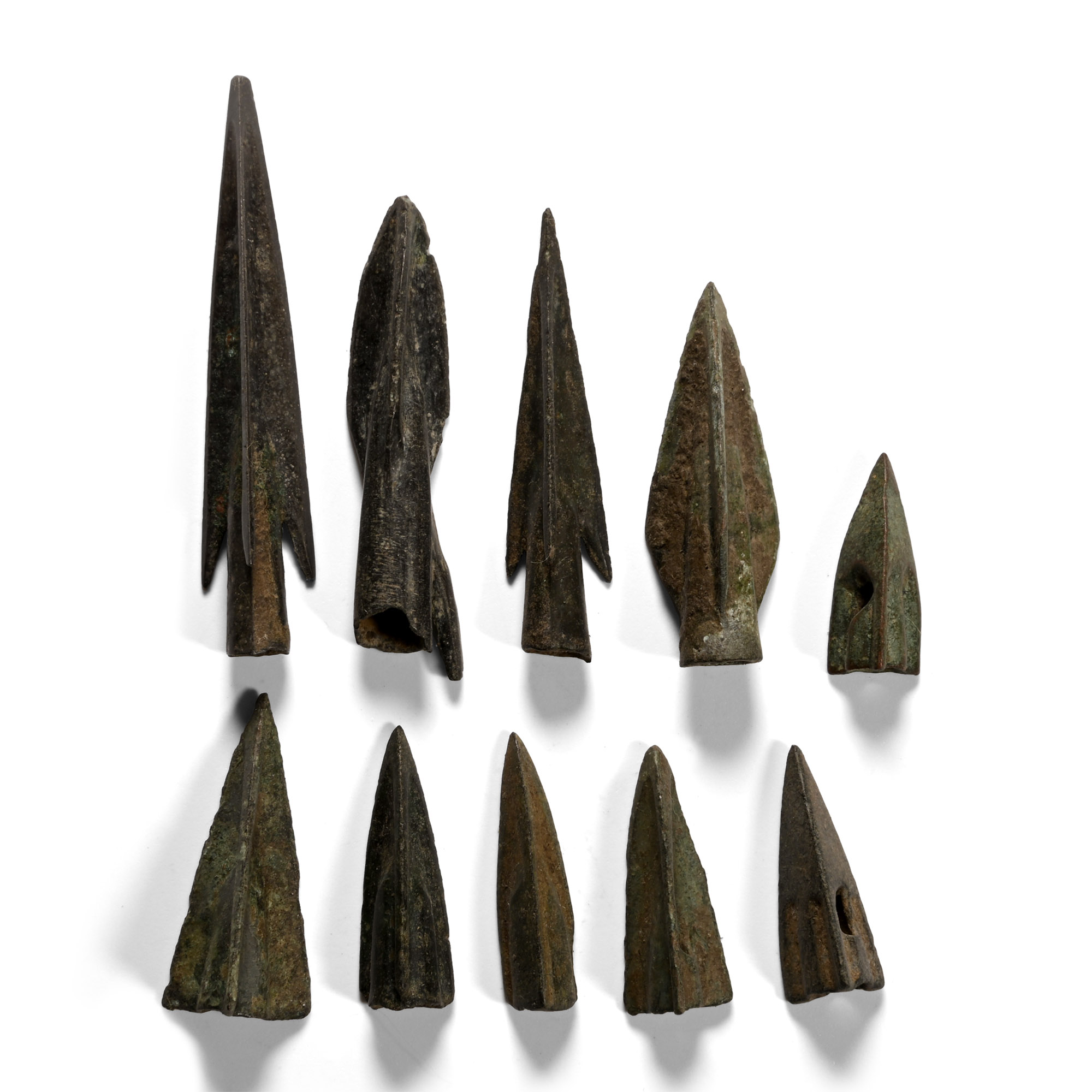
Greek Period High Quality Bronze Arrowhead Collection
5TH-3RD CENTURY B.C.
5/8 - 1 3/4 in. (21 grams total, 17-46 mm).
Mostly triangular-section socketted types. [10, No Reserve]
Provenance
From an English collection formed before 2000.
This lot is accompanied by an illustrated lot declaration signed by the Head of the Antiquities Department, Dr Raffaele D'Amato.
VETTING:
TimeLine Auctions follows a vetting process to ensure the authenticity and legality of all items, reinforcing our commitment to integrity and responsible trading. Each antiquity, antique, and coin lot undergoes thorough examination by a vetting committee of at least ten external specialists, professional trade association members, scientists, and archaeologists: Our Vetting Process
AUCTIONS:
TimeLine is a leading auction house specialising in antiquities, ancient art, collectables, natural history, coins, medals, and books. Our auctions offer museums, collectors, historians, and enthusiasts the opportunity to acquire unique and historically significant pieces.
RELATED LOTS
-
A Cycladic Marble Kandila Vase
Early Cycladic I, circa 3200-2800 B.C.Estimate: £6,000 - 8,000 (‡+bp*)
Opening Bid: £3,333
Carved from fine marble and raised on a tall, conical pedestal foot, supporting a hemispherical body; four prominent evenly spaced elongated vertical lugs, each pierced for suspension. 400 grams, 89 mm high
with Münzen und Medaillen, Weil am Rhein, 1975, Katalog 51, no.9. Private German collection. Private collection, Europe. This lot has been checked against the Interpol Database of stolen works of art and is accompanied by a search certificate number no.12663-236275. This lot has been cleared against the Art Loss Register database, and is accompanied by an illustrated lot declaration signed by the Head of the Antiquities Department, Dr Raffaele D'Amato.
The overall form is both functional and elegantly balanced, characteristic of Early Cycladic craftsmanship. The Cyclades, a group of thirty-nine islands and numerous islets in the southwestern Aegean, formed a cultural ring - kyklades in ancient Greek - around the sacred island of Delos, site of the revered sanctuary of Apollo. By the fourth millennium B.C., a distinctive civilisation had emerged on these islands, flourishing for over two thousand years. The Cycladic culture thrived due to its strategic maritime location and its rich deposits of iron and copper - vital commodities during a period of rapidly developing metallurgy throughout the Mediterranean. While existing alongside the more dominant Minoan and Mycenaean civilisations, the Cycladic people are recognised as one of the three principal Aegean cultures. Vessels such as this, known as kandila, were typically crafted in marble or clay and are believed to have held liquids such as oil or wine. The pierced lugs may have supported suspension cords or secured a lid. Often found in tomb contexts alongside marble figurines, these vessels likely played a role in funerary rituals. Regardless of their original function, kandila vessels remain enduring examples of Cycladic artistry. Their minimalist design, elegant proportions, and subtle detailing reflect a culture that placed equal value on utility and aesthetic form. -
Hellenistic Marble Head of a Goddess
3rd century B.C.Sold for (Inc. bp): £9,750
Carved in the round with flat angled panel to upper and rear of head; stern female features with deep-set eyes and small pursed lips; centre-parted hair dressed in a chignon; each earlobe drilled to accept an earring; some restoration; mounted on a custom-made stand. 20.15 kg total, 51.5 cm including stand
with Sakae Art Gallery, Japan. Acquired by the present owner from the above June 1981. This lot has been checked against the Interpol Database of stolen works of art and is accompanied by a search certificate number no.12658-235196. This lot has been cleared against the Art Loss Register database, and is accompanied by an illustrated lot declaration signed by the Head of the Antiquities Department, Dr Raffaele D'Amato. -
Eastern Greek Gold Necklace Element with Agate Drops
Circa 3rd century B.C.Sold for (Inc. bp): £4,940
Crescentic frontal panel from a necklace or collar; sheet gold band with slight carination, lightly incised leaf and berry detailing; applied filigree band to each end with double-loop attachment points; three applied foil rosettes; eleven banded agate dangles to the lower edge with sheet gold suspension; a marriage of ancient parts. 33.84 grams, 15.2 cm
Acquired in the mid 1980s-1990s. Private collection, Switzerland, thence by descent. Private collection, since the late 1990s. Accompanied by an academic report by Dr Raffaele D’Amato. This lot has been checked against the Interpol Database of stolen works of art and is accompanied by a search certificate number no.12591-232174. This lot has been cleared against the Art Loss Register database, and is accompanied by an illustrated lot declaration signed by the Head of the Antiquities Department, Dr Raffaele D'Amato.
Rosettes were one of the most desired decorations on jewellery. Diadems with rosettes are attested from the archaic period onwards. One of the rosette types was the so-called flower-head from Madytos, which most closely resembled the common wild or dog rose. The rose was, of course, much prized in ancient times for its wonderful scent and as the favoured flower of Aphrodite, the goddess of love: the lyric poet Anakreon called it ‘the perfume of gods, the joy of men’.