
Loading, please wait...
LOT 0613
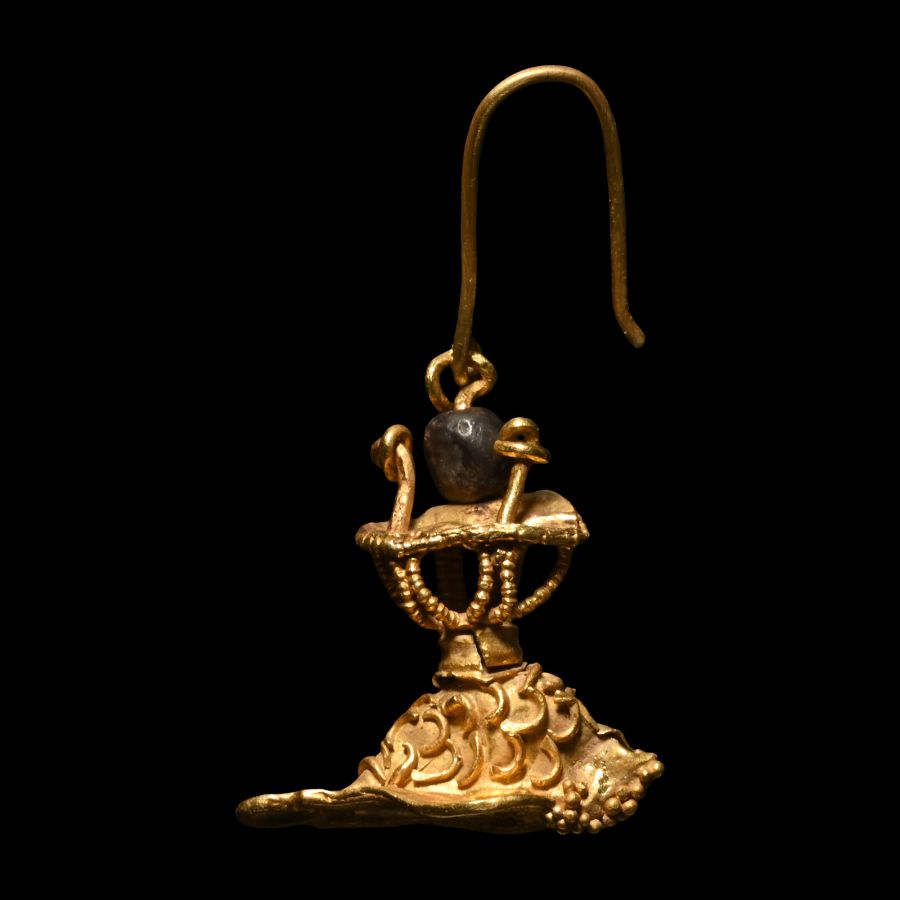
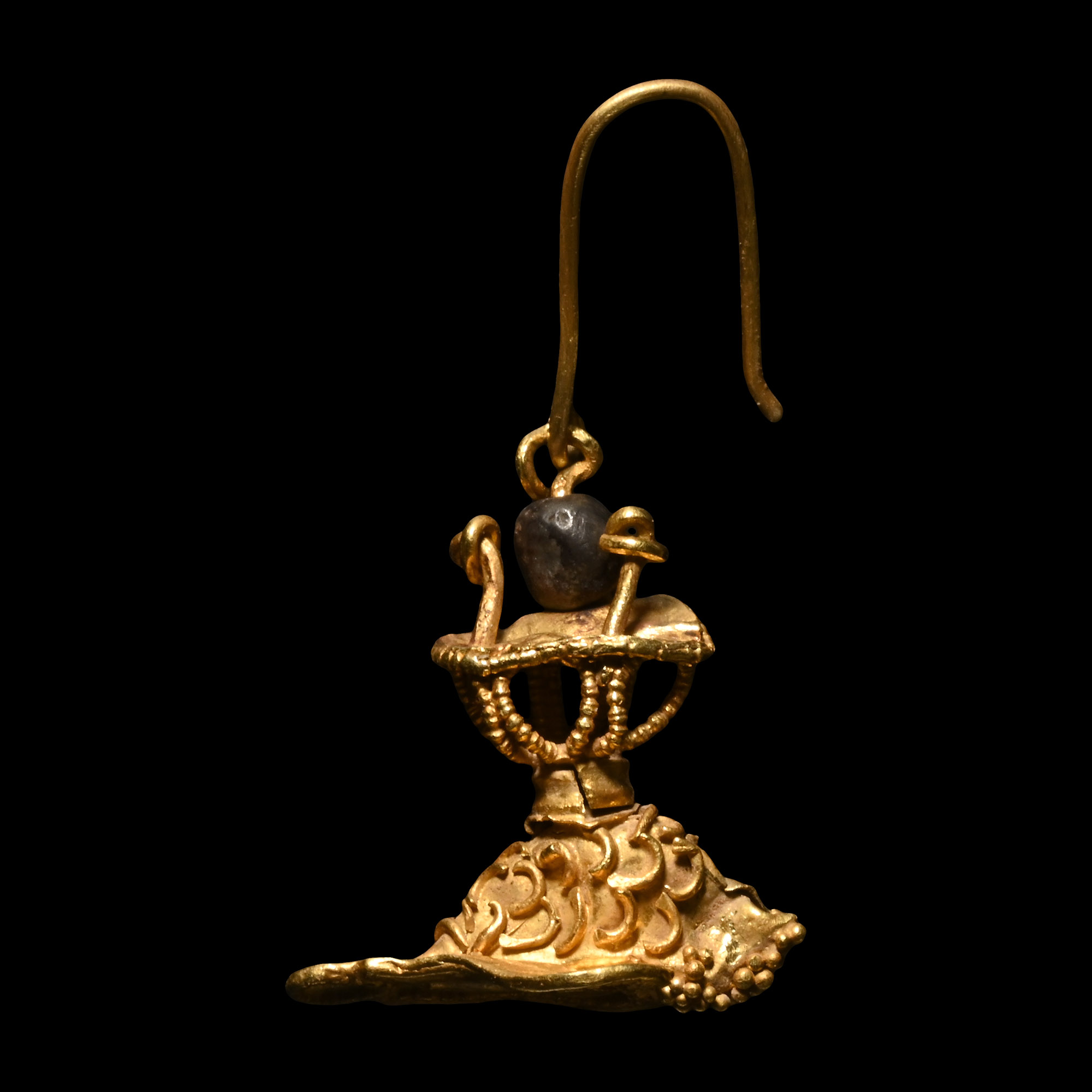
Greek Openwork Gold Earring
CIRCA 5TH-3RD CENTURY B.C.
1 1/4 in. (2.12 grams, 33 mm).
Comprising an openwork caged body with loops for beads, one remaining with a later earring hook, beneath the cage an upside-down bird with open wings and granular decoration on the head.
ProvenanceFrom the collection of a gentleman, acquired on the London art market in the 1990s.
CONDITIONTimeLine Auctions follows a vetting process to ensure the authenticity and legality of all items, reinforcing our commitment to integrity and responsible trading. Each antiquity, antique, and coin lot undergoes thorough examination by a vetting committee of at least ten external specialists, professional trade association members, scientists, and archaeologists: Our Vetting Process
AUCTIONS:
TimeLine is a leading auction house specialising in antiquities, ancient art, collectables, natural history, coins, medals, and books. Our auctions offer museums, collectors, historians, and enthusiasts the opportunity to acquire unique and historically significant pieces.
-
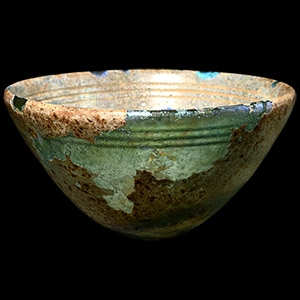
Hellenistic Iridescent Pale Aqua Glass Bowl
Mid 2nd-early 1st century B.C.Estimate: £2,000 - 3,000 (+bp*)
Opening Bid: £1,000
Conical in profile, aqua glass with three incised bands below the rim on the inner face. 374 grams, 15.7 cm wide
Dr Jutaro Kawabe, Nagoya, Japan, his collection formed in the 1960s-1970s. with Hoshigaoka Gallery until the late 1990s. Private collection, London, UK. This lot has been checked against the Interpol Database of stolen works of art and is accompanied by search certificate number no.12949-245243.
On ancient glass, iridescence is the soft play of colour that develops as the surface ages and becomes silica-rich. Minute layers form over time and break light into shifting blues, greens and golds. It is not a modern finish but something time has drawn out of the material itself, so the pattern and palette are unique to each piece. Collectors prize good, stable iridescence because it lifts the form: ribs read more crisply, profiles glow, and simple vessels take on depth and movement. Museums now tend to preserve these surfaces rather than polish them away, recognising both their beauty and what they tell us about an object’s long life (though it is not, by itself, a dating test). For display, iridescent glass performs brilliantly under gentle, directional light, where the colours “turn” as the vessel is moved. Well-preserved, even iridescence of this quality is not common and adds materially to the presence—and desirability—of the piece. -
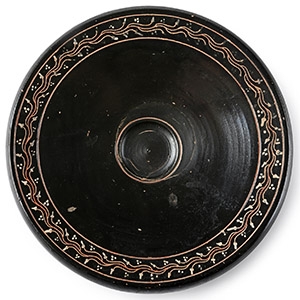
Large Hellenistic Teano-Ware Fish Plate
Early 3rd century B.C.Estimate: £1,500 - 2,000 (+bp*)
Opening Bid: £750
Broad face with incised rings outlining the painted border of running vinescroll in red and white; with a shallow central socket outlined in red, broad carinated rim and low foot. 834 grams, 26.5 cm
Acquired at Auction, London, UK, 1990s, no.233. Private collection, Suffolk, UK. Accompanied by a copy of the relevant catalogue page.
'Teano ware' is a type of ceramic produced in the late 4th century to the early 3rd century BC. Its modern name derives from Teanum Sidicinum, in northern Campania, the main centre of production. White and red pigment was used for the painted decoration on the black surface. It was probably used for votive or funerary purposes. -
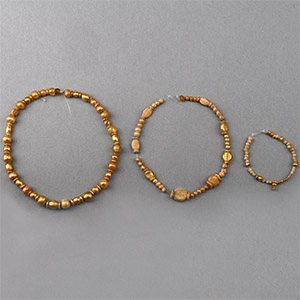
Hellenistic Gold in Glass Bead Group
Circa 100 B.C.-200 A.D. and laterSold for (Inc. bp): £715
Comprising beads encasing gold foil beneath a transparent glass layer, strung in three separate strands of various lengths. 19.74 grams total, 10-26.5 cm
Prince collection, 1990s-2014. Ex private collection 1970s-1990s.
