
Loading, please wait...
_900x900.jpg "Greek Marble Head of Dionysus")
_200x200.jpg "Greek Marble Head of Dionysus")
.jpg "Greek Marble Head of Dionysus")
LOT 0059
Greek Marble Head of Dionysus
3RD-1ST CENTURY B.C.
7 3/8 in. (1.59 kg total, 18.7 cm high including stand).
Carved in the half-round in three-quarter view, youthful male head with stern features, hair gathered in a browband, horns to the brow; from a frieze or relief; mounted on a custom-made stand.
ProvenancePrivate European collection.
Acquired on the Swiss art market, October 2013.
European private collection.
Accompanied by a copy of the 2013 invoice.
Accompanied by an academic report by Dr Raffaele D'Amato.
This lot has been checked against the Interpol Database of stolen works of art and is accompanied by a search certificate number no.12085-218192.
For similar examples, cf. the marble heads of Dionysus in Smith, R.R.R., Hellenistic sculpture, Oxford, 1991, figs.77-80; for the iconography of young Dionysus see Reinach, S., Repertoire de la statuarie Grecque et Romaine, Paris, 1930,figs. pp.112-124.
CONDITIONTimeLine Auctions follows a vetting process to ensure the authenticity and legality of all items, reinforcing our commitment to integrity and responsible trading. Each antiquity, antique, and coin lot undergoes thorough examination by a vetting committee of at least ten external specialists, professional trade association members, scientists, and archaeologists: Our Vetting Process
AUCTIONS:
TimeLine is a leading auction house specialising in antiquities, ancient art, collectables, natural history, coins, medals, and books. Our auctions offer museums, collectors, historians, and enthusiasts the opportunity to acquire unique and historically significant pieces.
-
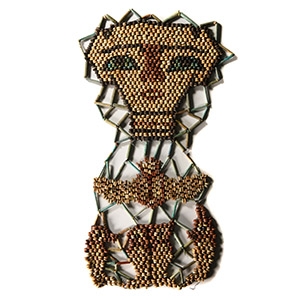
Large Egyptian Faience Beaded Mummy Mask with Sons of Horus
Ptolemaic Period, 332-30 B.C.Sold for (Inc. bp): £351
Restrung netted beadwork panel of annular and tubular glazed composition beads in blues, greens, black, cream and red-brown colours, depicting a mummy face mask with false beard, a scarab with extended wings below, the 'Four Sons of Horus’ beneath the scarab, joined together with areas of open netting of tubular beads; restrung with some later beads. 123 grams, 30 cm
Ex Mariaud de Serres, Paris, France, 1980-1990s. From a London, UK, collection.
The Four Sons of Horus were deities responsible for protecting the internal organs of the deceased. The human-headed Imsety protected the liver, the baboon-headed Hapy protected the lungs, the jackal-headed Duamutef protected the stomach, and the falcon-headed Qebehsenuef protected the intestines. -
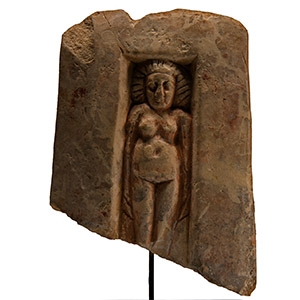
Egyptian Female Fertility Figurine Plaque
Late Period-Ptolemaic Period, 664-31 B.C.Estimate: £1,200 - 1,700 (+bp*)
Opening Bid: £600
Carved rectangular plaque with central recess, carved image of a nude female modelled in the half-round with a deeply striated bag wig, arms by her side; traces of red and black pigment on the body; mounted on a custom-made stand. 502 grams total, 17.1 cm including stand
From a central London collection, formed 1980-2000. From the private collection of Mr David Barker, London, UK; thence by descent.
The rectangular limestone plaque almost certainly represents a shrine. Such plaques first appeared in Lower Egypt and became widespread in the Late Period and Ptolemaic era. They may have developed from earlier female figurines depicted on beds and are usually associated with the female goddesses Isis and Hathor, both powerful protectors of women and childbirth and associated with fertility. -
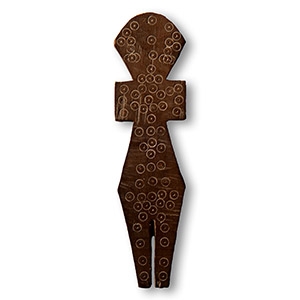
Egyptian Wooden Doll with Circular Decorations
Coptic, 7th-11th centuries A.D. or laterSold for (Inc. bp): £117
Flat anthropomorphic panel with incised ring-and-dot ornament to obverse, single central ring-and-dot to the reverse. 16 grams, 12.4 cm
Acquired on the German art market, 1989-1995. with The Museum Gallery, 19 Bury Place, London, WC1A 2JB, 1998-2003. Property of a London based academic, 2003-present.
In the late Roman Egypt or early Islamic period (7th–11th century A.D.) a new type of figurine appeared in the archaeological record: small, crudely crafted human figures made of bone. Some researchers considered them as toys meant to prepare girls for motherhood; others saw them as fertility figurines. They are mostly referred to as early Christian or “Coptic dolls”. In Egypt and Palestine they seem to appear suddenly in the 7th century, coinciding with the Arab conquests, but they might have existed earlier. With the new Muslim empire bridging former Roman and Sassanian lands, these dolls found their way to Egypt and Palestine where they were reproduced in huge numbers, becoming popular in all levels of society of the 8th and 9th century. By the end of the 11th century they disappeared as quickly as they appeared, probably because of restrictions placed on their production by Islamic laws.
