
Loading, please wait...
LOT 0087
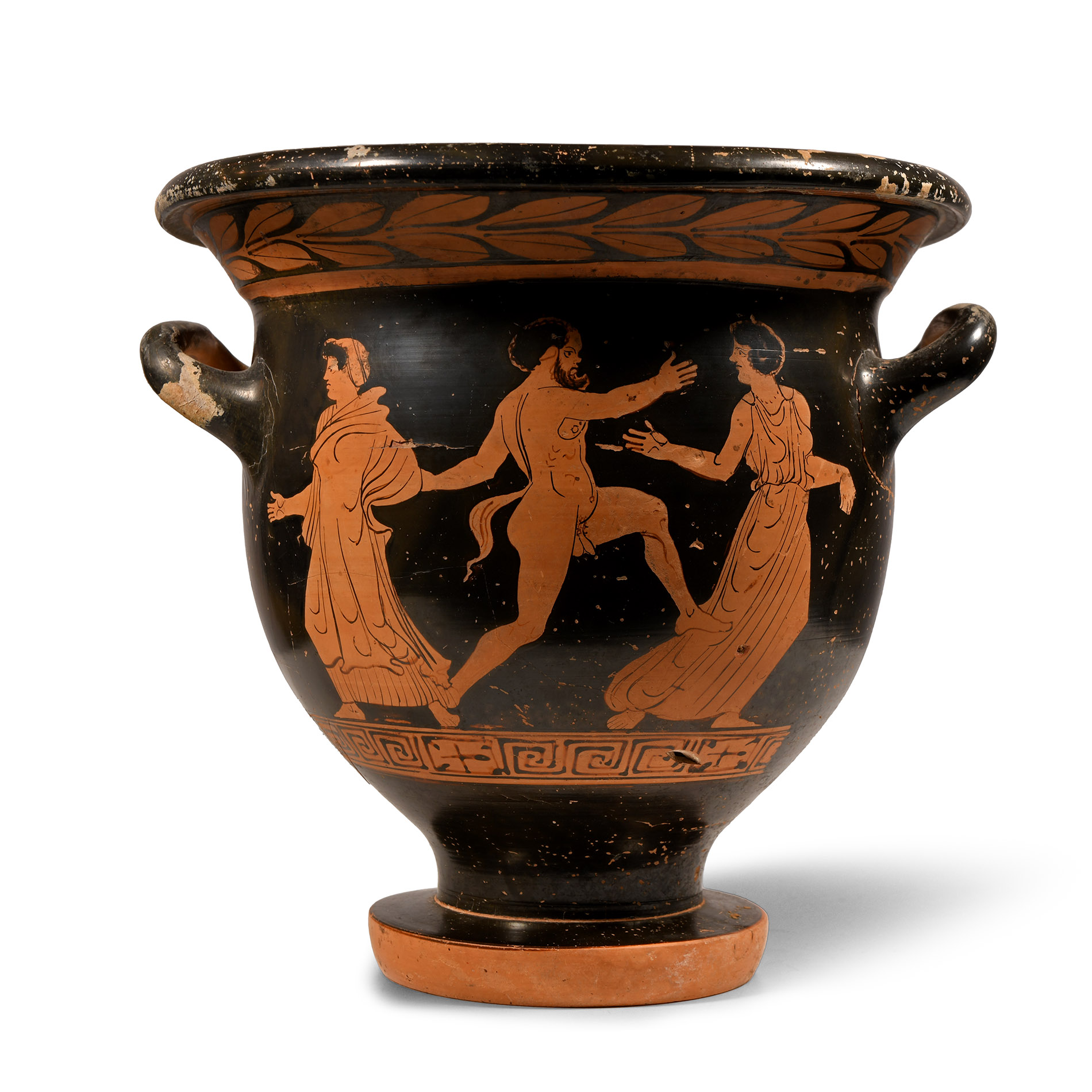
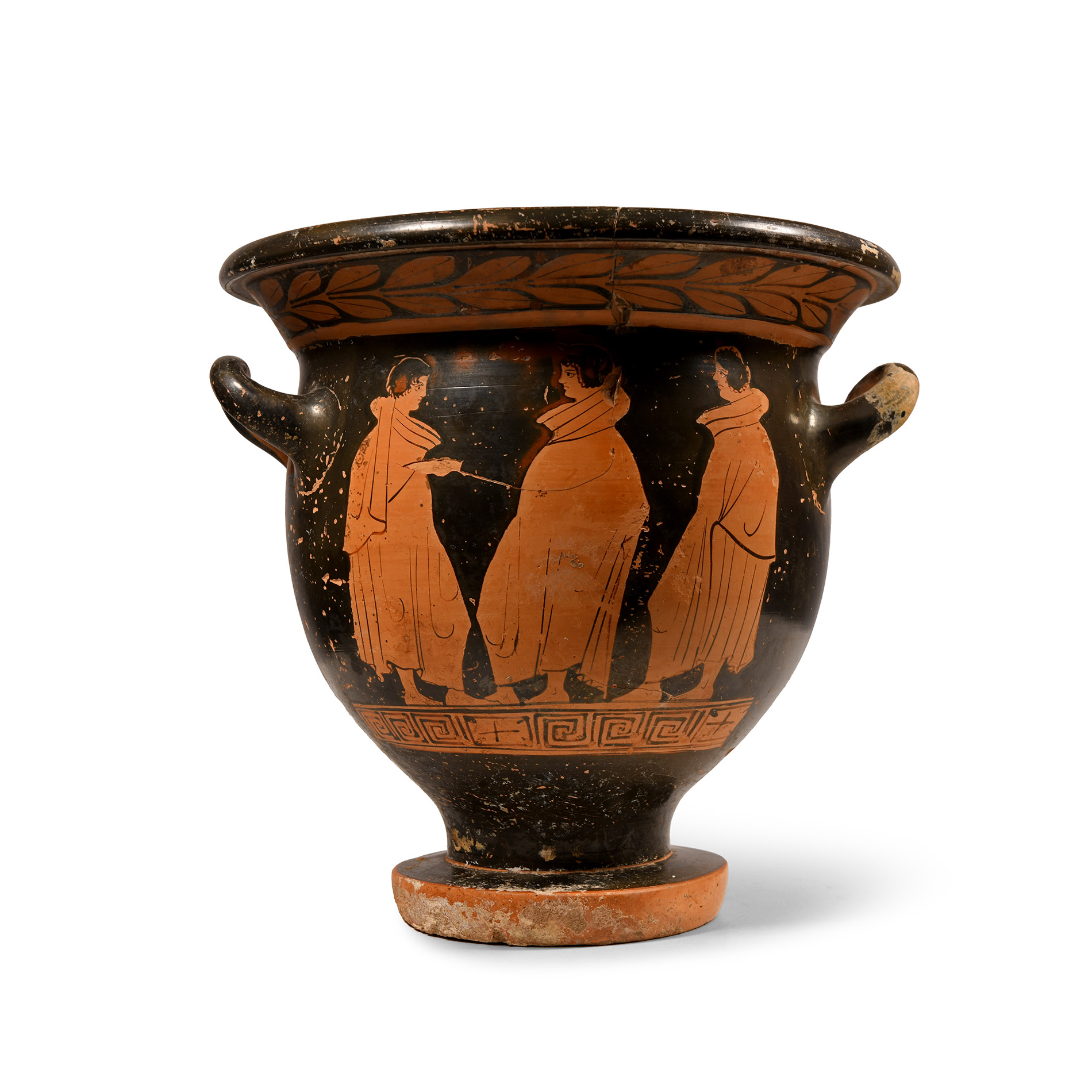
Greek Lucanian Red-Figure Bell-Krater
CIRCA 380-370 B.C.
11 3/8 in. (2.1 kg, 29 cm wide).
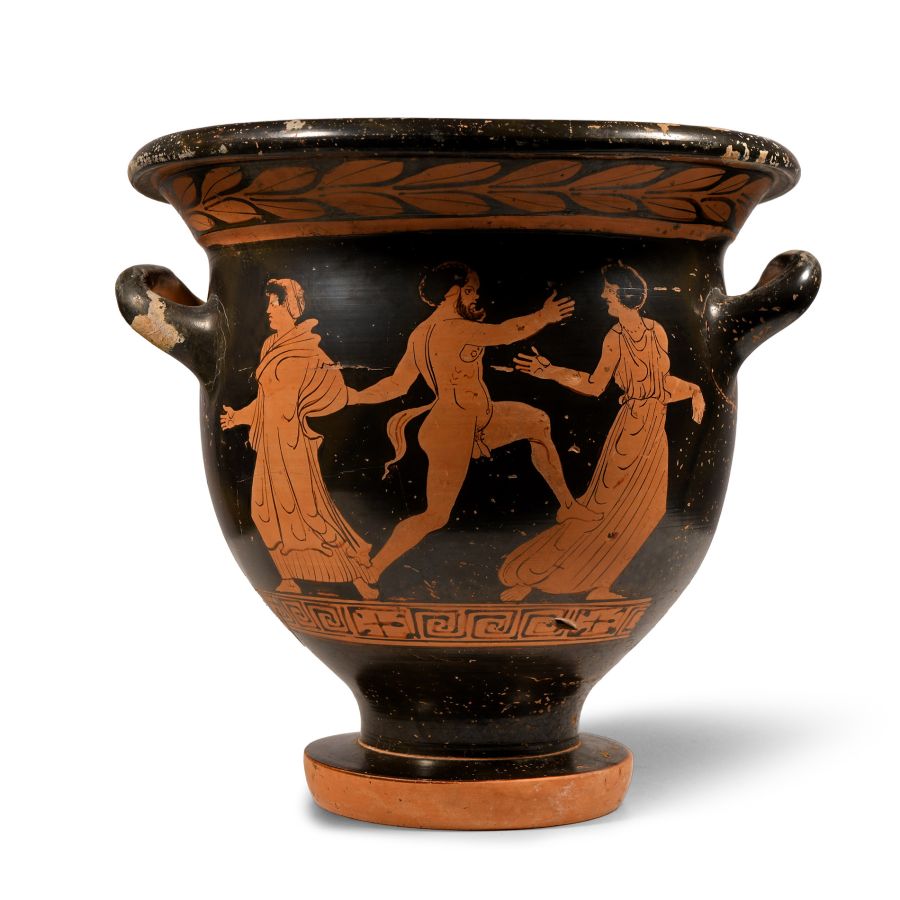
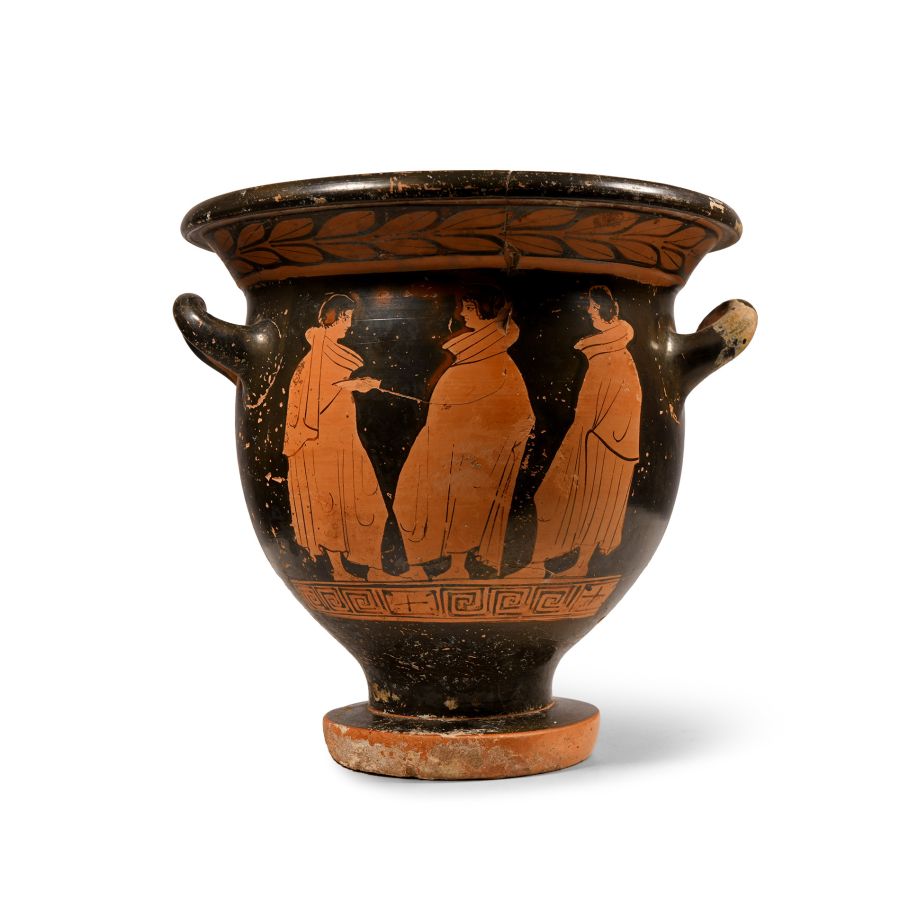
Decorated with a meander with saltire squares below the figural scenes, and a laurel below the rim; Side A: a nude gesticulating satyr with short curly hair and long beard, running to the right with his left leg raised and his arms outstretched, characteristic pointed ears and pug nose, towards a maenad moving right and looking back at him, her hair short and curly, her body draped in a chiton, with another maenad standing behind him, facing left, draped in a himation over a chiton; Side B: three youths in draped cloaks with hoods thrown back; professionally restored.
ProvenanceBelgian private collection, 1950s.
with Christie's, New York, 4 June 2008, no.190.
Private central European collection.
Accompanied by a copy of the relevant Christie's catalogue pages.
Accompanied by an academic report by Dr Raffaele D’Amato.
This lot has been checked against the Interpol Database of stolen works of art and is accompanied by a search certificate number no.12067-218141.
Cf. The Metropolitan Museum, New York, accession numbers 1984.323.2 and 16.140, for similar specimens, in Richter, G. M. A., ‘Recent Accessions of Greek Vases’ in Bulletin of the Metropolitan Museum of Art, 11(12), New York, 1916, pp.255-56, figs.6-7; Metropolitan Museum of Art, ‘One Hundred Fifteenth Annual report of the Trustees for the Fiscal Year July 1, 1984 through June 30, 1985’ in Annual Report of the Trustees of the Metropolitan Museum of Art, New York, 1985, no.115, p.38; see also Robinson, E.G.D., Carpenter, T., Lynch, K.M., The Italic People of Ancient Apulia: New Evidence from Pottery for Workshops, Markets, and Customs, Cambridge, 2014, figs.5.2, 6.1.
FootnotesThe style allows us to attribute this vase to an unknown artist of Lucanian origin: it is in ancient Lucania (a region which is located between present-day Calabria and Basilicata, in Southern Italy and between the Tyrrhenian Sea and the Ionian Sea, with Metaponto as a well-known city) that the first Italic style of red-figure painting developed.
CONDITIONTimeLine Auctions follows a vetting process to ensure the authenticity and legality of all items, reinforcing our commitment to integrity and responsible trading. Each antiquity, antique, and coin lot undergoes thorough examination by a vetting committee of at least ten external specialists, professional trade association members, scientists, and archaeologists: Our Vetting Process
AUCTIONS:
TimeLine is a leading auction house specialising in antiquities, ancient art, collectables, natural history, coins, medals, and books. Our auctions offer museums, collectors, historians, and enthusiasts the opportunity to acquire unique and historically significant pieces.
LOT 0087
Greek Lucanian Red-Figure Bell-Krater
Estimate £10,000 - 14,000€11,600 - 16,240 (for guidance only)$13,500 - 18,900 (for guidance only)
-
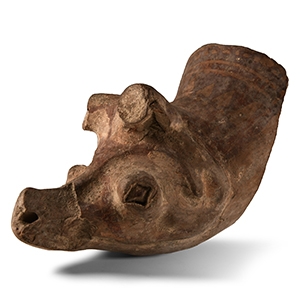
Greek Painted Terracotta Rhyton Fragment
Circa 4th-2nd century B.C.Sold for (Inc. bp): £111
Finial from a rhyton with stylised zoomorphic detailing: elongated snout, applied lozengiform eyes in lobe protrusions, horns or antlers above; curved conical body with tiered inner face, applied red pigment detailing. 442 grams, 15.5 cm
From a collection acquired on the UK art market from various auction houses and collections mostly before 2000. From an important Cambridgeshire estate; thence by descent. -
.jpg)
Minoan Stone Vessel
2nd millennium B.C.Estimate: £1,800 - 2,400 (‡+bp*)
Opening Bid: £750
Of conical profile with raised ropework detailing to the broad shoulder. 1.48 kg, 14.6 cm wide
Private European collection, 1992. Thence by descent. This lot has been checked against the Interpol Database of stolen works of art and is accompanied by a search certificate number no.12086-218214. -
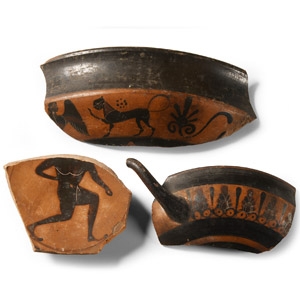
Greek Terracotta Attic Black Figure Vessel Fragment Group
6th century B.C.Sold for (Inc. bp): £546
Comprising: carinated rim fragment from a bowl with reserved siren, panther, rosette and other ornament; bowl base with reserved advancing nude male or satyr on a red field, sgraffito detailing; skyphos rim fragment with part of the handle, reserved egg-and-dart band. 106 grams total, 7.4-13 cm
From an early 20th century collection. By descent the property of a UK lady. Ian Wilkinson collection, Nottinghamshire, UK, formed since 1985. Accompanied by a previous handwritten note including provenance.
The body of the panther resembles the style of the school of Sophilos, an Attic painter active circa 580-560 B.C. The naked image (a dancing satyr?) recalls the Attic black figure depictions of ithyphallic satyrs, with torso, arms, legs and incision for internal details in white paint, made around 500 B.C.
