
Loading, please wait...
_900x900.jpg "Greek Lead Slingshot")
_200x200.jpg "Greek Lead Slingshot")
.jpg "Greek Lead Slingshot")
LOT 1388
Greek Lead Slingshot
3RD-1ST CENTURY B.C.
1 1/4 in. (29.4 grams, 30 mm).
Biconical in profile with casting seam and reserved legend 'ΑΛ[EXANΔΡΟ]Υ.', the club of Herakles on the other side. [No Reserve]
ProvenanceAcquired on the German art market before 2000.
Private collection, Munich, Germany.
See Akat Özenir, S., ‘Some Inscribed Lead Sling Bullets from Miletos’ in Epigraphica Anatolica 50 (2017), pp. 167–178, nos.19-21, for similar.
FootnotesThe presence of the club of Hercules connects the slingshot with ruling dynasty of Macedonia. Similar slingshots were found in Miletos.
CONDITIONTimeLine Auctions follows a vetting process to ensure the authenticity and legality of all items, reinforcing our commitment to integrity and responsible trading. Each antiquity, antique, and coin lot undergoes thorough examination by a vetting committee of at least ten external specialists, professional trade association members, scientists, and archaeologists: Our Vetting Process
AUCTIONS:
TimeLine is a leading auction house specialising in antiquities, ancient art, collectables, natural history, coins, medals, and books. Our auctions offer museums, collectors, historians, and enthusiasts the opportunity to acquire unique and historically significant pieces.
-
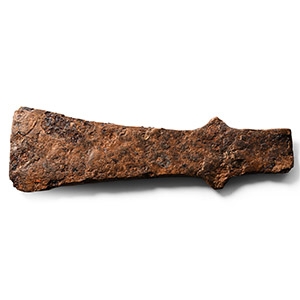
Graeco-Scythian Iron Flat Axehead
5th-3rd century B.C.Sold for (Inc. bp): £46
Flat in section and trapezoidal in plan with two lateral spurs, straight edge. 175 grams, 15.7 cm
From a private East European collection. From the property of a late Lincolnshire, UK, gentleman. -
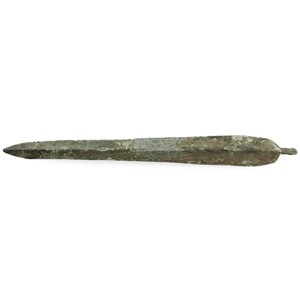
Luristan Bronze Spearhead
1st millennium B.C.Sold for (Inc. bp): £72
With lentoid-section blade, median rib and curved shoulders, tapering towards the end, rectangular stub tang. 262 grams, 36 cm
English private collection, late 1970s-early 1980s. From the property of a late Lincolnshire, UK, gentleman. -
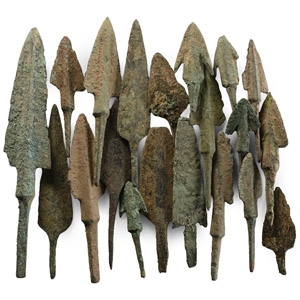
Greek and Luristan Bronze Arrowhead Collection
2nd-1st millennium B.C.Sold for (Inc. bp): £117
Mainly triangular-headed barbed and tanged types with midrib. 156 grams total, 3.7-11 cm
Ex London, UK, collection, 1990s.
