
Loading, please wait...
LOT 1459
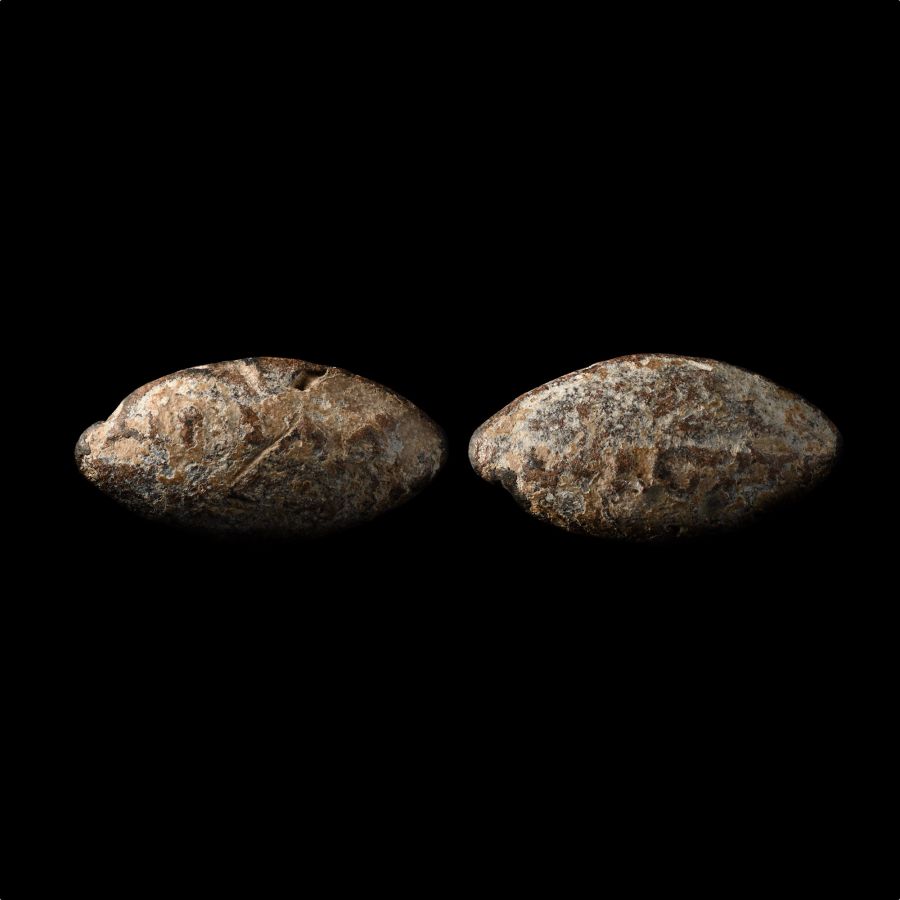
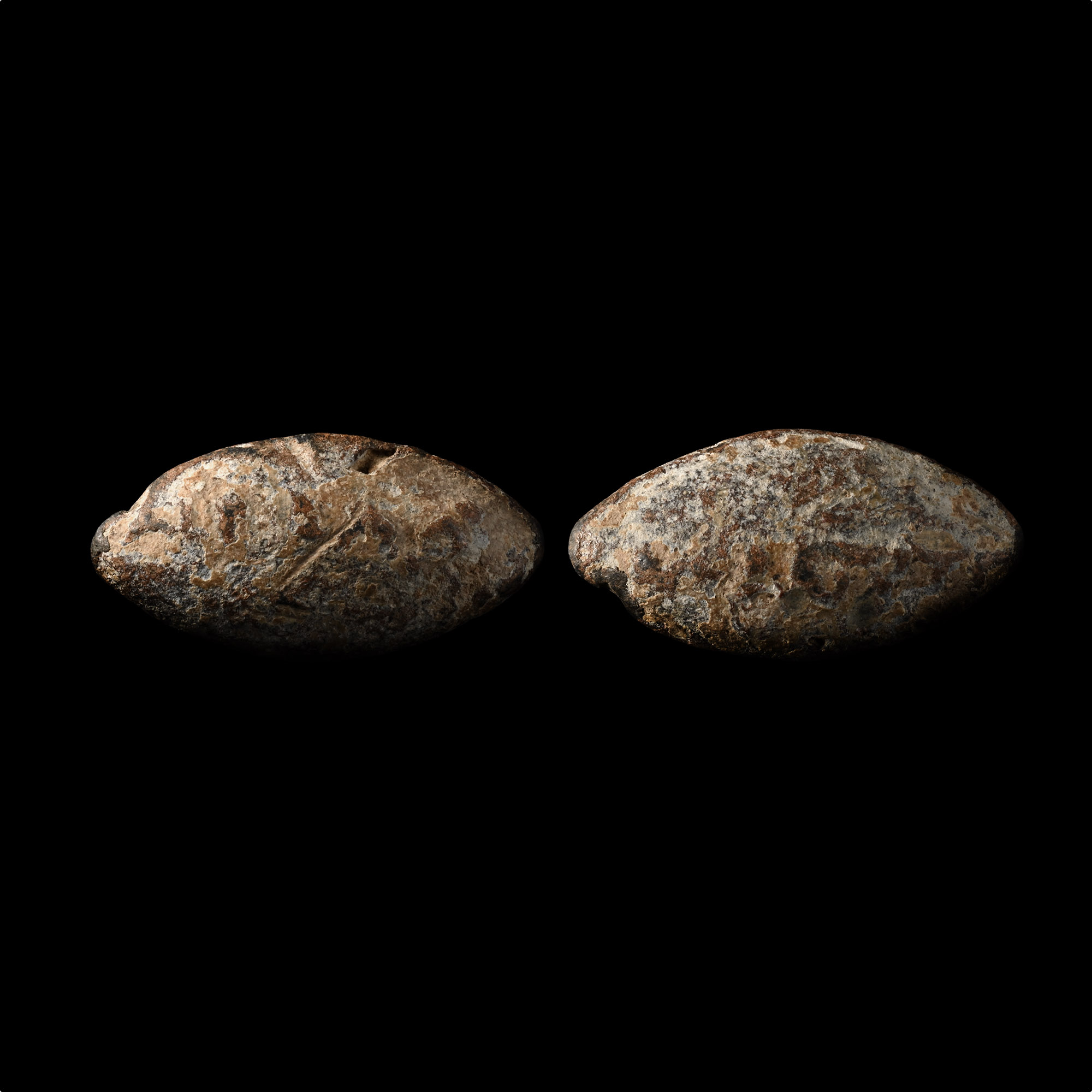
Greek Lead Slingshot
3RD-1ST CENTURY B.C.
1 1/4 in. (25.6 grams, 31 mm).
Biconical in profile with casting seam and reserved legend 'ΛY-P-N' = maybe ΛYKOΦ-PONO = Lykophronos (name). [No Reserve]
ProvenanceAcquired on the German art market before 2000.
Private collection, Munich, Germany.
See Schinco, G., Small, A.M., 'A previously unknown siege of Botromagno/Silvium: the evidence of slingshots from Gravina in Puglia (Provincia di Bari, Puglia)' in Papers of the British School at Rome, 2019, pp.1-52, fig.37, type iib of Volling, for similar.
FootnotesThe leaden bullets, which were thrown from slings, were called in Greek molivdainai (μολύβδαιναι), and in Latin glandes; the former indicating the material ‘lead’, the latter the shape ‘acorns’. These bullets were cast in a mould and bore letters or devices, or both, on two sides or on only one. In form they were more like an almond than an acorn, but many are pointed at both ends.
CONDITIONTimeLine Auctions follows a vetting process to ensure the authenticity and legality of all items, reinforcing our commitment to integrity and responsible trading. Each antiquity, antique, and coin lot undergoes thorough examination by a vetting committee of at least ten external specialists, professional trade association members, scientists, and archaeologists: Our Vetting Process
AUCTIONS:
TimeLine is a leading auction house specialising in antiquities, ancient art, collectables, natural history, coins, medals, and books. Our auctions offer museums, collectors, historians, and enthusiasts the opportunity to acquire unique and historically significant pieces.
-
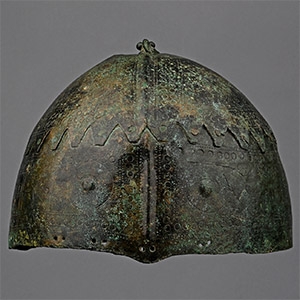
Highly Decorated Caucasian Bronze Helmet
6th century B.C.Estimate: £40,000 - 60,000 (+bp*)
Opening Bid: £20,000
Formed as a domed bowl with a rivetted overlay on the top, a bird of prey finial at the crown with a raised vertical ridge before the beak; extensive decoration on the body comprising annulets, lines, ring-and-dot motifs and pointillé borders, a circumferential border of rectangular panels on the lower part of the helmet, each rectangle divided into four triangular panels with herringbone and ring-and-dot decoration; a short nose-guard beneath the raised ridge, four raised bosses flanking the ridge, depicting apotropaic eyes; the lower rim pierced for the attachment of internal lining. 650 grams, 21 cm wide
Ex German private collection, M.B., Mainz, 1980s. Acquired from the above by the current owner. Accompanied by an academic report by Dr Raffaele D’Amato. This lot has been checked against the Interpol Database of stolen works of art and is accompanied by search certificate number no.12902-242697.
The helmet belongs to a limited series of helmets found in the Caucasus, discovered in archaeological complexes of the Colchis-Koban Culture, adding another chapter to the history of a series of important Caucasian helmets. Its decoration rivals that of a helmet of the Krasnodar Museum, until now the most complete and decorated in this category. All the helmets of this typology were decorated according to a certain scheme, but the present helmet and the one from Krasnodar are richer in terms of symbols and ornaments. The decoration and similarity with other helmets in this series suggest that the present helmet could have been made for the military elite of the North-West Caucasus in Central Caucasian workshops. Most likely, the owner was part of the elite of the local tribes of the North-West Caucasus of the Maeotic circle. -
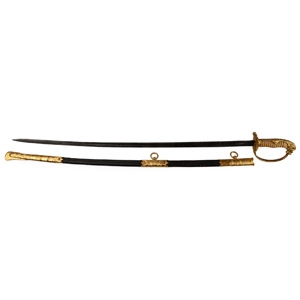
Kriegsmarine WWI German Naval Officer's Sword and Scabbard
Early 20th century A.D.Sold for (Inc. bp): £286
Comprising a slender single-edged blade with etched designs; the hilt composed of a wire-bound ribbed bone handle, a lion-head pommel with inset eyes, and an ornate guard with folding edges, one side with a socket for securing the scabbard; accompanied a leather scabbard with ornate metal fittings. 778 grams total, 91 cm
From the private collection of author and historian Dr DeWitt Bailey, one of the global authorities on the confederate army in the US civil war; thence by descent to his grandson. -
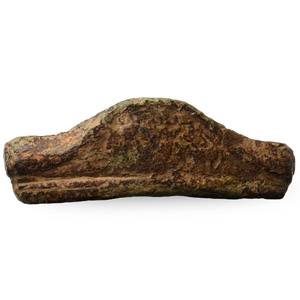
Roman 'Crown Type' Sword Hilt Guard
1st century B.C.-1st century A.D.Sold for (Inc. bp): £52
Ellipsoid in section with central slot to accept the tang; scooped 'cocked hat' profile to the broad faces, with horizontal rounded band to the lower edge. 17.6 grams, 47 mm
Found Tuesday 1st April 2025 in Wenham Parva, Babergh, Suffolk, UK. Accompanied by a copy of the British Museum's Portable Antiquities Scheme (PAS) report no.SF-92FBDC.
