
Loading, please wait...

LOT 2001
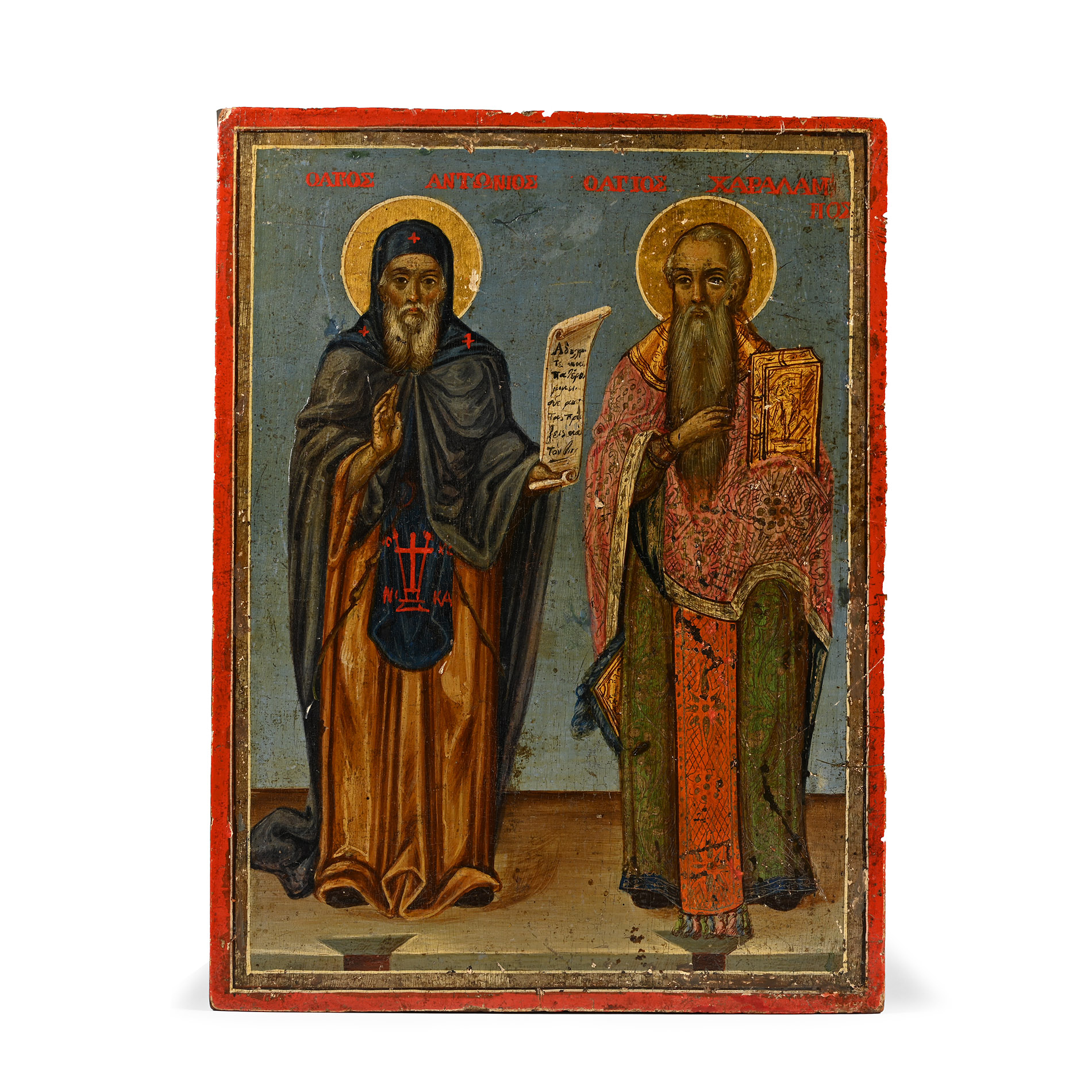
Greek Icon with Saint Anthony the Abbot and Saint Charalambos
EARLY 19TH CENTURY A.D.
9 7/8 x 7 1/4 in. (558 grams, 25 x 18.6 cm).
Saint Anthony the Great on the left, represented in monastic dress holding a scroll of holy writings with his left hand; Saint Charalambos dressed as a bishop, with a green sticharion embroidered in gold, covered by a pink gold embroidered phelonion, a gold embroidered square epigonation with blue edges, and a long orange gold embroidered epitrachelion, holding a gold covered gospel with the image of Christ's resurrection with his left hand; tempera on wood.
ProvenanceAcquired from Portobello Road, London, in the 1990s.
Property of a London, UK, gentleman collector.
This lot is accompanied by an illustrated lot declaration signed by the Head of the Antiquities Department, Dr Raffaele D'Amato.
Cf. Matthieson, S., Morrison, G., Heavenly Beings, Icons of the Christian Orthodox World, Auckland, 2022, p.192, for icons of Saint Charalambos; for an icon of Saint Anthony the Great see the prototype of his icons made by Michail Damaskinos, in Chatzidakis, M., Musee Byzantin d'Athenes, Icons, Athens, 1979, icon no.15.
FootnotesSaint Anthony the Great, who lived in the 3rd-4th century A.D., was the father of Eastern Monachism. According to the tradition, Saint Charalambos was martyred in 202 A.D. He is the protector of prosperity and health.
CONDITIONTimeLine Auctions follows a vetting process to ensure the authenticity and legality of all items, reinforcing our commitment to integrity and responsible trading. Each antiquity, antique, and coin lot undergoes thorough examination by a vetting committee of at least ten external specialists, professional trade association members, scientists, and archaeologists: Our Vetting Process
AUCTIONS:
TimeLine is a leading auction house specialising in antiquities, ancient art, collectables, natural history, coins, medals, and books. Our auctions offer museums, collectors, historians, and enthusiasts the opportunity to acquire unique and historically significant pieces.
LOT 2001
Greek Icon with Saint Anthony the Abbot and Saint Charalambos
Sold for (Inc. bp): £598
-
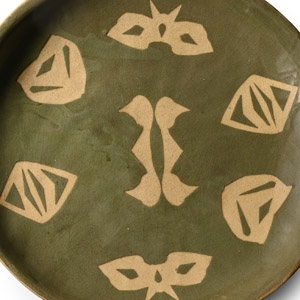
Abstract Green and Buff Glazed Dish
20th century A.D.Sold for (Inc. bp): £20
Broad dish with interrupted basal ring. sage-green field with reserved cream hatched lozenges and other motifs. 897 grams, 24.6 cm
Acquired from older English collections via the UK art market since the mid 1970s. From the private collection of Peran Dachinger, thence by descent. From the family collection of a Maidervale lady, UK. This lot is accompanied by an illustrated lot declaration signed by the Head of the Antiquities Department, Dr Raffaele D'Amato. -
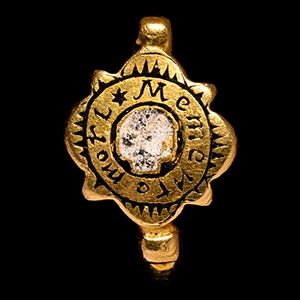
Tudor Period Enamelled Gold Memento Mori Ring with Skull
16th-17th century A.D.Sold for (Inc. bp): £6,500
Comprising a plain D-section hoop, discoid bezel with radiating spurs, central enamelled skull motif surrounded by a ring with legend '*MEMENTO*mori'. 3.84 grams, 19.30 mm overall, 16.87 mm internal diameter (approximate size British M, USA 6, Europe 12.46, Japan 12)
Private collection, UK. This lot has been checked against the Interpol Database of stolen works of art and is accompanied by a search certificate number no.12740-235714. This lot has been cleared against the Art Loss Register database, and is accompanied by an illustrated lot declaration signed by the Head of the Antiquities Department, Dr Raffaele D'Amato. -
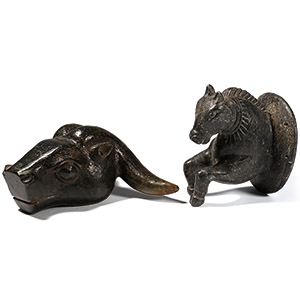
Western Asiatic Style Carved Stone Animal Group
20th century A.D.Sold for (Inc. bp): £52
Comprising: a horse protome modelled as the foreparts of a leaping horse; a bull's head with large curving horns. 1.94 kg total, 12-18 cm
From the family collection of a Hampstead gentleman; formerly acquired in the 1980s. This lot is accompanied by an illustrated lot declaration signed by the Head of the Antiquities Department, Dr Raffaele D'Amato.
