
Loading, please wait...
LOT 0088
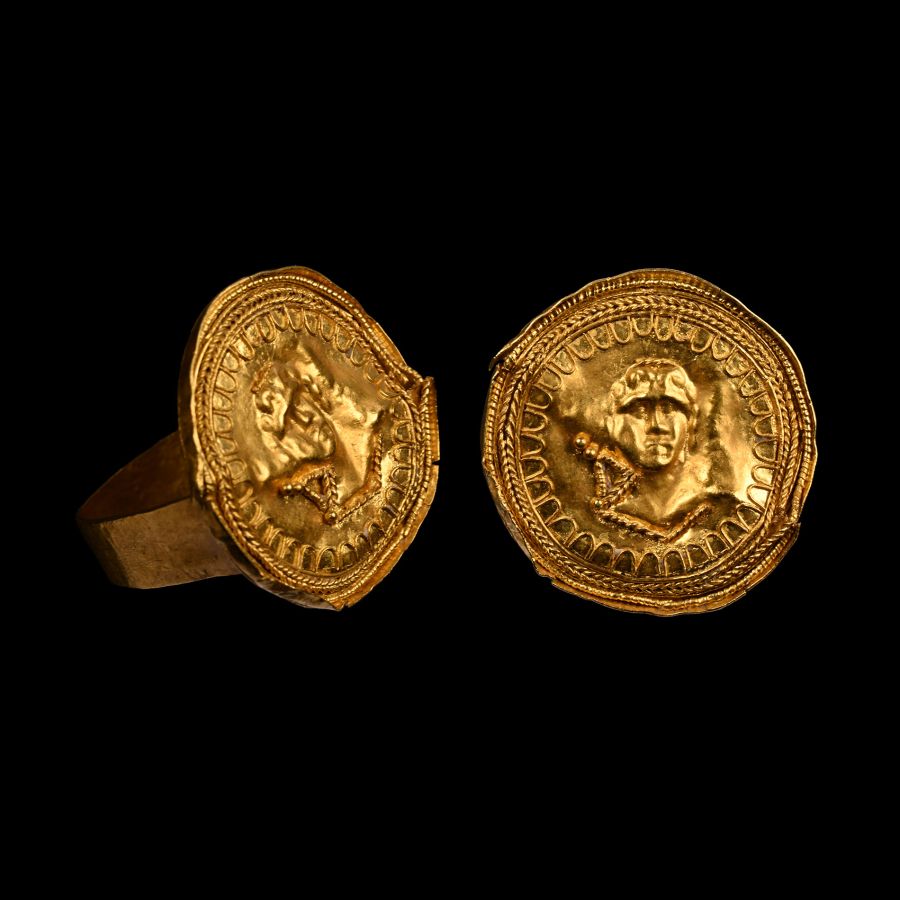
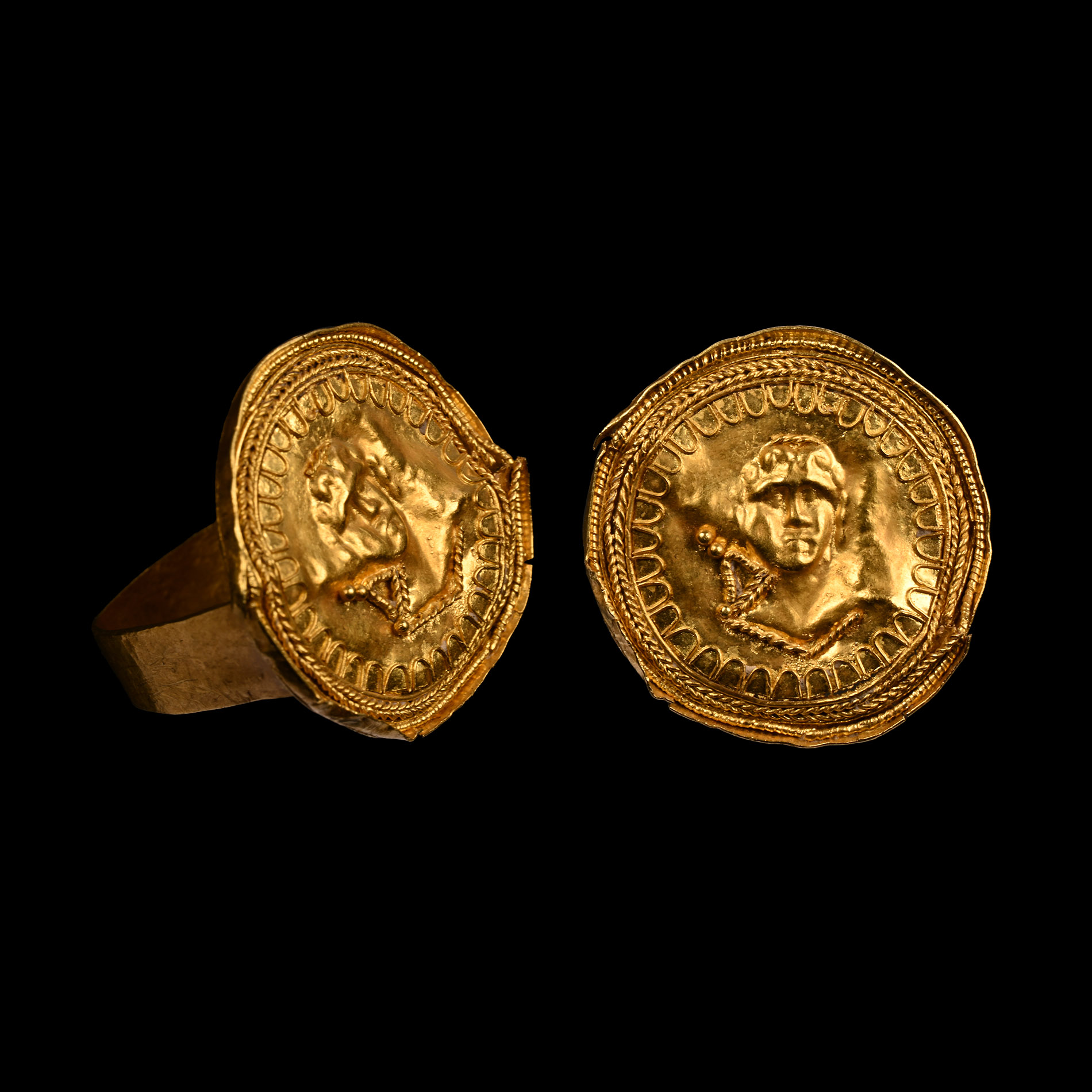
Greek Gold Ring with Roundel
HELLENISTIC, 3RD-1ST CENTURY B.C.
1 in. (4.14 grams, 23.21 mm overall, 18.15 x 16.08 mm internal diameter (approximate size British N, USA 6 1/2, Europe 13.72, Japan 13)).
Flat-section hoop and discoid cell with inset panel, filigree ropework border enclosing band of U-shaped filigree and repoussé central motif of a facing bust with applied granule detailing.
ProvenancePrivate collection, Germany.
with Artemis Gallery, Munich, 1990s.
Private European collection, 2001.
This lot has been checked against the Interpol Database of stolen works of art and is accompanied by a search certificate number no.12091-218184.
Cf. Chadour, A.B., Rings. The Alice and Louis Koch Collection, volume I, Leeds, 1994, item 78, for type.
CONDITIONTimeLine Auctions follows a vetting process to ensure the authenticity and legality of all items, reinforcing our commitment to integrity and responsible trading. Each antiquity, antique, and coin lot undergoes thorough examination by a vetting committee of at least ten external specialists, professional trade association members, scientists, and archaeologists: Our Vetting Process
AUCTIONS:
TimeLine is a leading auction house specialising in antiquities, ancient art, collectables, natural history, coins, medals, and books. Our auctions offer museums, collectors, historians, and enthusiasts the opportunity to acquire unique and historically significant pieces.
LOT 0088
Greek Gold Ring with Roundel
Estimate £1,800 - 2,400€2,090 - 2,780 (for guidance only)$2,430 - 3,240 (for guidance only)
-
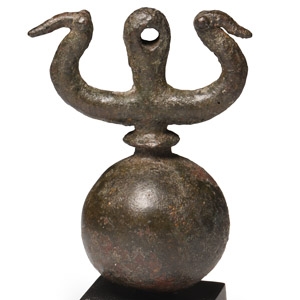
Etruscan Globular Pendant with Birds' Heads
Circa 8th-7th century B.C.Sold for (Inc. bp): £104
Comprising a spherical body with biconvex collar, lateral arms ending in stylised bird-heads, pierced lobe above; mounted on a custom-made display stand. 113 grams total, 69 mm including stand
From a collection acquired on the UK art market from various auction houses and collections mostly before 2000. From an important Cambridgeshire estate; thence by descent.
These globular pendants surmounted by two opposed birds heads belong to the early Iron Age phase of the Etruscan-Villanovan culture. The heads are those of aquatic birds, whose motif is often repeated on the embossed belt-cuirasses decorating the waists of high-status men and women. -
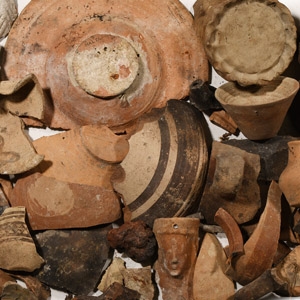
Greek and Other Pottery Fragment Group
Circa 1st millennium B.C.Sold for (Inc. bp): £312
Including flange-rimmed bowl, piecrust-based bowl, amphora and other types. 2.9 kg total, 3.5-25.5 cm
From a collection acquired on the UK art market from various auction houses and collections mostly before 2000. From an important Cambridgeshire estate; thence by descent. -
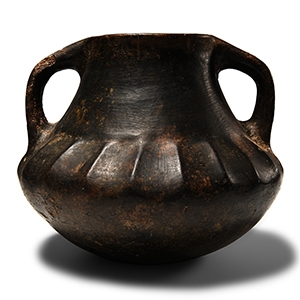
Villanovan Impasto Amphora
Circa 10th-8th century B.C.Sold for (Inc. bp): £364
With a scalloped design on the body and twin symmetrical handles rising from the shoulder; restored. 790 grams, 18.5 cm wide
From the Rempte collection, Upstate New York, USA; acquired before 1980. Ex Artemis Gallery, Colorado, USA, 4 August 2016, lot 10. with a Chicago, USA, collection. Ex Harlan J. Berk Ltd, Chicago, USA. Acquired from Palmyra Heritage Gallery, New York, 27 April 2020, lot 2. Property of a South Australian private collector, with collection reference 20.22. Accompanied by detailed collector's catalogue pages including description and photograph.
The terracotta has a distinctive shape, characterised by vertical grooves and frequently incised double spirals. The style was indigenous to Italy. The handles were thin and flat, while their sharp curves imply that the vessel’s shape originated from metallic prototypes, like shown by silver examples with gold handles found in the Regolini-Galassi Tomb in Caere (modern Cerveteri).
