
Loading, please wait...

LOT 0547
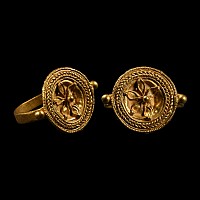
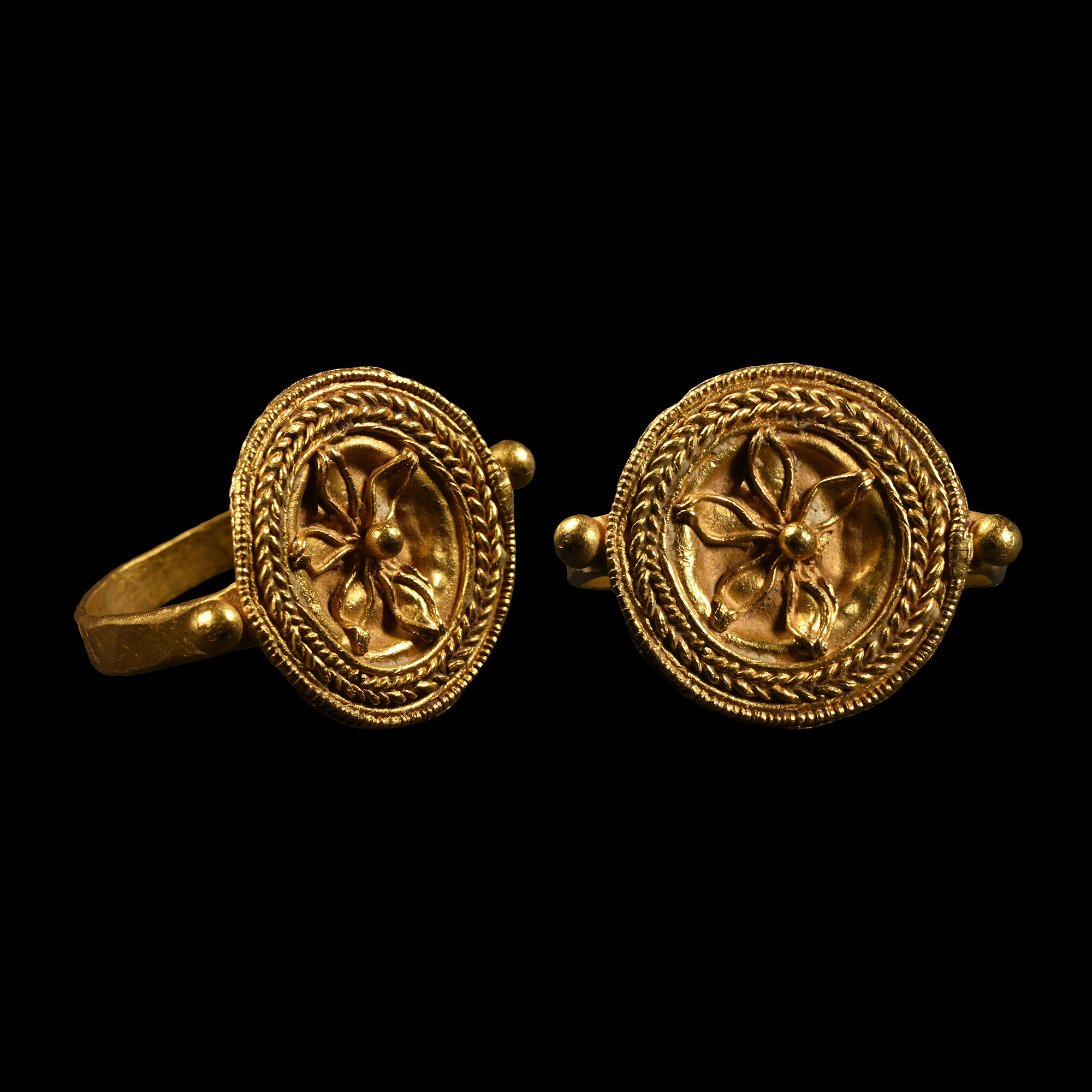
Greek Gold Ring with Rosette and Filigree
5TH-4TH CENTURY B.C.
1 in. (6.37 grams, 25.62 mm overall, 22.66 mm internal diameter (approximate size British R 1/2, USA 8 3/4, Europe 19.38, Japan 18)).
With granule to each shoulder, discoid bezel with beaded wire rim, ropework band and central cinquefoil motif.
ProvenanceAcquired in the mid 1980s-1990s.
Private collection, Switzerland, thence by descent.
Private collection, since the late 1990s.
This lot has been checked against the Interpol Database of stolen works of art and is accompanied by a search certificate number no.12388-226931.
This lot has been cleared against the Art Loss Register database, and is accompanied by an illustrated lot declaration signed by the Head of the Antiquities Department, Dr Raffaele D'Amato.
Cf. Chadour, A.B., Rings. The Alice and Louis Koch Collection, volume I, Leeds, 1994, item 66.
CONDITIONTimeLine Auctions follows a vetting process to ensure the authenticity and legality of all items, reinforcing our commitment to integrity and responsible trading. Each antiquity, antique, and coin lot undergoes thorough examination by a vetting committee of at least ten external specialists, professional trade association members, scientists, and archaeologists: Our Vetting Process
AUCTIONS:
TimeLine is a leading auction house specialising in antiquities, ancient art, collectables, natural history, coins, medals, and books. Our auctions offer museums, collectors, historians, and enthusiasts the opportunity to acquire unique and historically significant pieces.
LOT 0547
Greek Gold Ring with Rosette and Filigree
Estimate £1,800 - 2,400€2,090 - 2,780 (for guidance only)$2,430 - 3,240 (for guidance only)
-
Greek Attic Terracotta Black Figure Painted Lekythos Attributed to the Athena Painter
Circa 490 B.C.Estimate: £8,000 - 10,000 (‡+bp*)
Opening Bid: £4,000
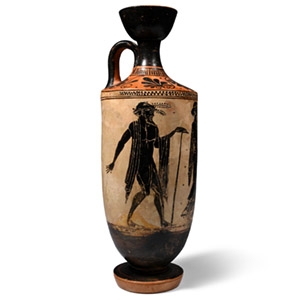
Nearly cylindrical body with a slightly sloping shoulder with five palmettes and eight dots in between; main image showing a Dionysian procession with two advancing nude satyrs facing a young male playing a double pipe, each of the satyrs leaning on a walking stick and having a long garment draped over their shoulders and wearing a fillet and a large wreath on their heads. 649 grams, 29.2 cm
Münzen und Medaillen A.G., H. Cahn, Basel, 24 April 1989. Private collection, Bern, Switzerland. This lot has been checked against the Interpol Database of stolen works of art and is accompanied by a search certificate number no.12641-236375. This lot has been cleared against the Art Loss Register database, and is accompanied by an illustrated lot declaration signed by the Head of the Antiquities Department, Dr Raffaele D'Amato. -
Greek Gold Diadem with Glass Gem
1st millennium B.C.Sold for (Inc. bp): £936
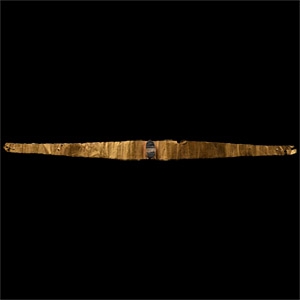
Sheet-gold with tapering finials, central raised cell set with a two-tone glass insert imitating banded agate; mounted on perspex backing. 76.87 grams total, 30 cm (36 cm including stand)
with Galerie Rhéa, Zurich, Switzerland. This lot is accompanied by an illustrated lot declaration signed by the Head of the Antiquities Department, Dr Raffaele D'Amato. -
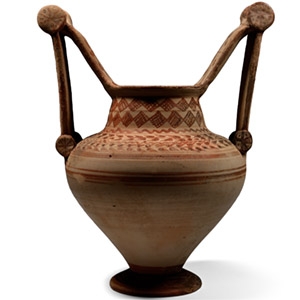
Messapian Painted Terracotta Trozella
6th century B.C.Sold for (Inc. bp): £5,460
With piriform body resting on a delineated foot, tubular neck with everted, inward sloping rim; two large handles projecting from the shoulder and descend towards the rim in a steep angle, rosette medallions embellishing the angles and base; chequerboard motif on the neck with bands of vegetal motifs on the shoulder, the handles with ivy leaves and linear decoration. 1.78 kg, 32.7 cm
From the estate of the prominent Swiss painter Max Gubler (1898-1973), acquired in 1936. with Galerie Rhéa, Zurich, Switzerland. This lot has been checked against the Interpol Database of stolen works of art and is accompanied by a search certificate number no.12646-236461. This lot has been cleared against the Art Loss Register database, and is accompanied by an illustrated lot declaration signed by the Head of the Antiquities Department, Dr Raffaele D'Amato.
