
Loading, please wait...
LOT 0523
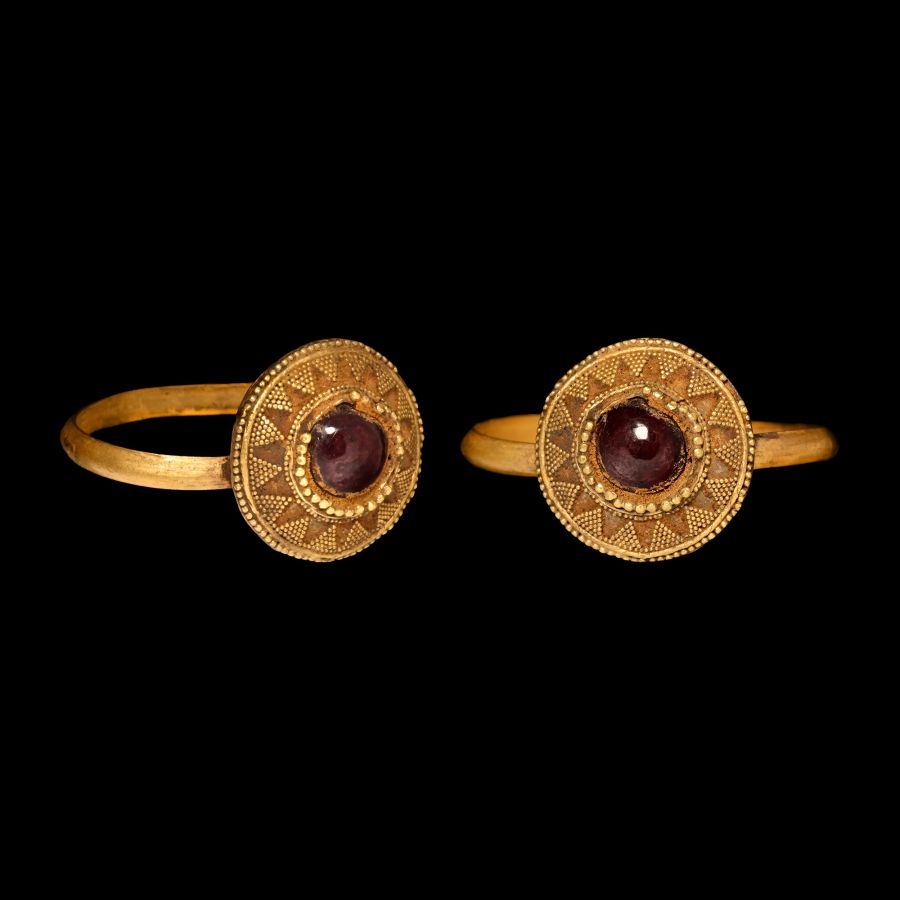
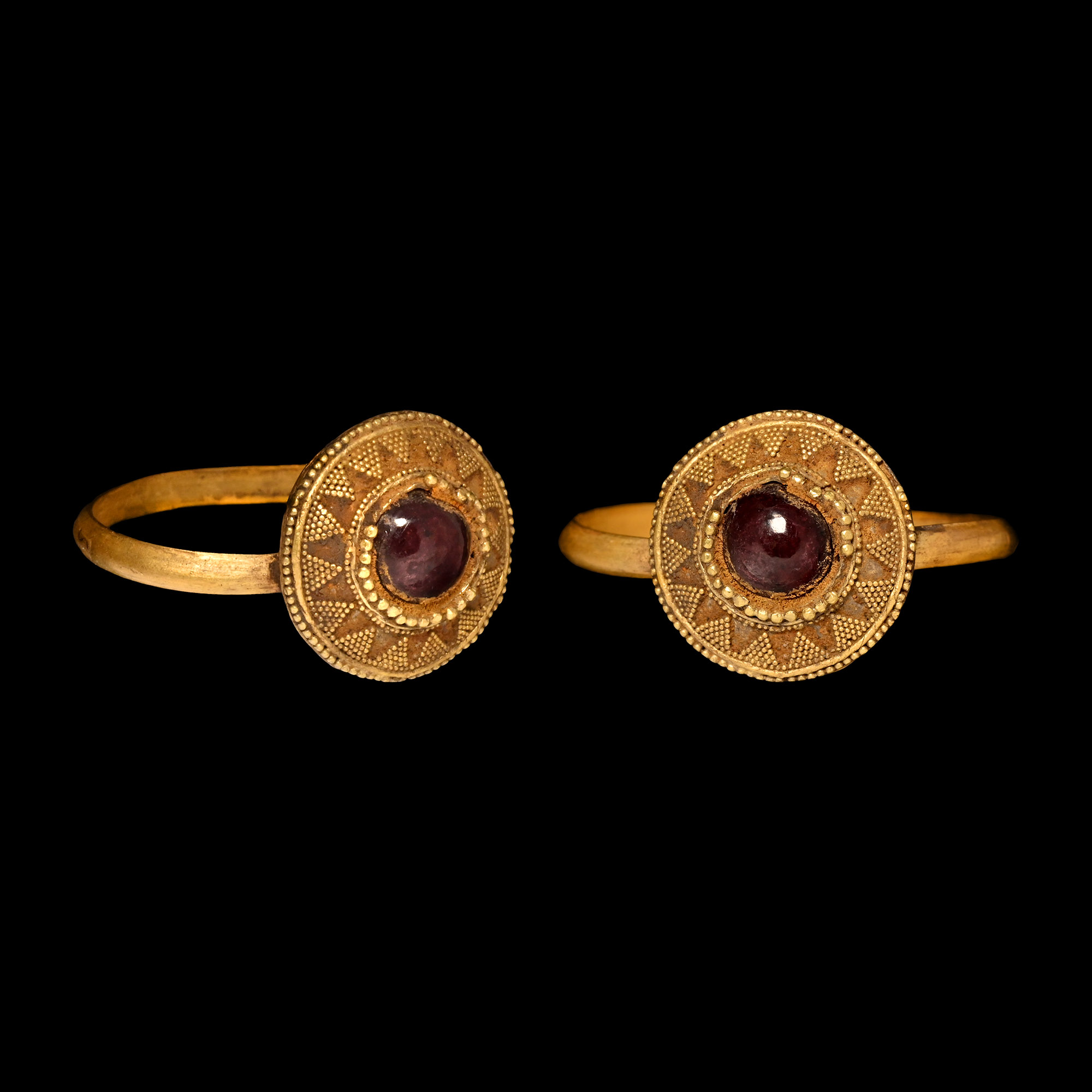
Greek Gold Ring with Garnet Cabochon
5TH-3RD CENTURY B.C.
3/4 in. (2.80 grams, 21.53 mm overall, 19.67 mm internal diameter (approximate size British L, USA 5 3/4, Europe 11.24, Japan 10)).
Comprising a slender hoop and an applied granulated bezel set with a garnet cabochon, the granules forming a radiating star motif around the cabochon.
ProvenanceEx German art market, 2000s.
Acquired from an EU collector living in London.
From the collection of a Surrey, UK, gentleman.
This lot is accompanied by an illustrated lot declaration signed by the Head of the Antiquities Department, Dr Raffaele D'Amato.
TimeLine Auctions follows a vetting process to ensure the authenticity and legality of all items, reinforcing our commitment to integrity and responsible trading. Each antiquity, antique, and coin lot undergoes thorough examination by a vetting committee of at least ten external specialists, professional trade association members, scientists, and archaeologists: Our Vetting Process
AUCTIONS:
TimeLine is a leading auction house specialising in antiquities, ancient art, collectables, natural history, coins, medals, and books. Our auctions offer museums, collectors, historians, and enthusiasts the opportunity to acquire unique and historically significant pieces.
-
.jpg)
Iberian Bronze Statuette
6th-4th century B.C.Estimate: £4,000 - 6,000 (‡+bp*)
Opening Bid: £1,800
Youthful male standing wearing a belted tunic with apron, arms spread wide, barefoot, bare-headed with short textured hair; mounted on a custom-made base. 215 grams total, 11.8 cm high including stand
Private collection, Paris, France, assembled in the 1950s-1960s. with Tessier-Sarrou & Associés, Paris, 2015. European private collection. Accompanied by a copy of an Art Loss Register certificate, no.S00107108. Accompanied by a copy of French cultural export passport no.167803. This lot has been checked against the Interpol Database of stolen works of art and is accompanied by a search certificate number no.12650-264612. This lot has been cleared against the Art Loss Register database, and is accompanied by an illustrated lot declaration signed by the Head of the Antiquities Department, Dr Raffaele D'Amato. -
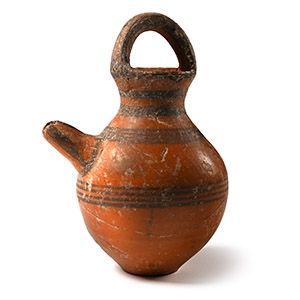
Cypriot Terracotta Vessel
Cypro-Archaic, 750-600 B.C.Sold for (Inc. bp): £286
Miniature ewer with tapering spout to the shoulder, flared neck and rounded rim with applied loop handle; painted decorative bands. 51 grams, 88 mm
Acquired in the mid 1980s-1990s. Private collection, Switzerland, thence by descent. Private collection, since the late 1990s. This lot is accompanied by an illustrated lot declaration signed by the Head of the Antiquities Department, Dr Raffaele D'Amato. -
.jpg)
Large Attic Greek Terracotta Statue of Kore with Sea Encrustations
5th century B.C.Sold for (Inc. bp): £3,510
Hollow-form and standing on a pedestal with her right knee slightly bent, both hands holding the edges of her flowing peplos, wearing a polos crown, naturalistic detailing to face; traces of pigment remaining, a rectangular cut-out on her back. 604 grams, 31.5 cm
From the collection of Pierre and Claude Vérité, Paris, France, acquired between 1930 and 1960. with Christie's, Paris, Collection Pierre et Claude Vérité, 20 December 2011, no.121 (part). Ex Galerie Günter Puhze GmbH, Germany, 2012. Private collection, Bern, Switzerland. Accompanied by copies of the relevant Christie's catalogue pages. This lot has been checked against the Interpol Database of stolen works of art and is accompanied by a search certificate number no.12664-236370. This lot has been cleared against the Art Loss Register database, and is accompanied by an illustrated lot declaration signed by the Head of the Antiquities Department, Dr Raffaele D'Amato.
