
Loading, please wait...
_900x900.jpg "Greek Gold Floral Diadem")
_200x200.jpg "Greek Gold Floral Diadem")
.jpg "Greek Gold Floral Diadem")
LOT 0076
Greek Gold Floral Diadem
2ND CENTURY B.C.
5 7/8 in. (7 in.) (45.56 grams total, 15 cm wide (18 cm wide including stand)).
A triangular sheet-gold panel with repoussé flowers and tendrils; mounted on perspex backing.
ProvenanceFrom the estate of Dr Jacob Hirsch.
Acquired by Galerie Rhéa, Zurich, from the above in 1999.
This lot is accompanied by an illustrated lot declaration signed by the Head of the Antiquities Department, Dr Raffaele D'Amato.
TimeLine Auctions follows a vetting process to ensure the authenticity and legality of all items, reinforcing our commitment to integrity and responsible trading. Each antiquity, antique, and coin lot undergoes thorough examination by a vetting committee of at least ten external specialists, professional trade association members, scientists, and archaeologists: Our Vetting Process
AUCTIONS:
TimeLine is a leading auction house specialising in antiquities, ancient art, collectables, natural history, coins, medals, and books. Our auctions offer museums, collectors, historians, and enthusiasts the opportunity to acquire unique and historically significant pieces.
-
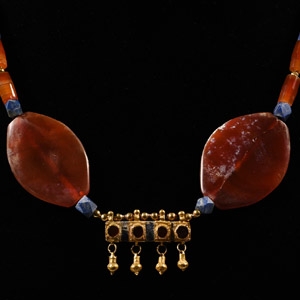
Hellenistic Carnelian and Gold Pendant Necklace
1st century B.C. and laterSold for (Inc. bp): £468
Restrung necklace of carnelian and lapis lazuli tubular and polyhedral beads; centrepiece a gold block with inset cloisons and gold spherical beads. 51 grams, 50 cm
Private collection of a London, UK, gentleman, acquired between 1965-2020. This lot is accompanied by an illustrated lot declaration signed by the Head of the Antiquities Department, Dr Raffaele D'Amato. -
.jpg)
Hellenistic Floral Gold Pendant with Garnet
2nd-1st century B.C.Estimate: £400 - 600 (+bp*)
Opening Bid: £200
Sheet-gold disc with integral loop, repoussé design of twelve radiating petals, pellets to the rim and loop, central cell with inset garnet bead. 0.92 grams, 25 mm
Formerly with Lyon & Turnbull, UK. Ex Surrey, UK, collection, 2000s. This lot is accompanied by an illustrated lot declaration signed by the Head of the Antiquities Department, Dr Raffaele D'Amato. -
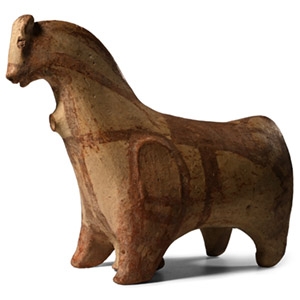
Parthian Ceramic Horse Rhyton
2nd century B.C.-2nd century A.D.Sold for (Inc. bp): £2,470
Hollow-formed horse figure with spout to the chest and filler hole beneath the chest; painted saddle and bridle detailing. 1.61 kg, 27 cm
Ex Zackary, Los Angeles, USA, 1960s. with Christie's, 13 October 2008, no.156. Accompanied by a copy of a thermoluminescence analysis report and photograph by Oxford Authentication with sample no.108u46. Accompanied by copies of the relevant Christie's catalogue pages. This lot has been checked against the Interpol Database of stolen works of art and is accompanied by a search certificate number no.12655-235194. This lot has been cleared against the Art Loss Register database, and is accompanied by an illustrated lot declaration signed by the Head of the Antiquities Department, Dr Raffaele D'Amato.
