
Loading, please wait...
_900x900.jpg "Greek Gold Eros Holding a Turtle Pendant")
_200x200.jpg "Greek Gold Eros Holding a Turtle Pendant")
_900x900.jpg "Greek Gold Eros Holding a Turtle Pendant")
_200x200.jpg "Greek Gold Eros Holding a Turtle Pendant")
.jpg "Greek Gold Eros Holding a Turtle Pendant")
.jpg "Greek Gold Eros Holding a Turtle Pendant")
LOT 0113
Greek Gold Eros Holding a Turtle Pendant
4TH CENTURY B.C.
1/2 in. (1.41 grams, 13 mm).
A delicately crafted pendant depicting a seated Eros with spread wings, holding a small turtle with his left hand and his right hand raised, feather detailing to wings and carefully modelled face with a smiling expression; a double suspension loop underneath and a single loop above; likely from an earring.
ProvenanceSolothurn exhibition catalogue 1967, no.421.
Notable Swiss private scholarly collection.
with Galerie Rhéa, Zurich, Switzerland.
This lot has been checked against the Interpol Database of stolen works of art and is accompanied by a search certificate number no.12671-236392.
This lot has been cleared against the Art Loss Register database, and is accompanied by an illustrated lot declaration signed by the Head of the Antiquities Department, Dr Raffaele D'Amato.
Cf. Marshall, BMCJ, no.1858-1916, pl.32f.
CONDITIONTimeLine Auctions follows a vetting process to ensure the authenticity and legality of all items, reinforcing our commitment to integrity and responsible trading. Each antiquity, antique, and coin lot undergoes thorough examination by a vetting committee of at least ten external specialists, professional trade association members, scientists, and archaeologists: Our Vetting Process
AUCTIONS:
TimeLine is a leading auction house specialising in antiquities, ancient art, collectables, natural history, coins, medals, and books. Our auctions offer museums, collectors, historians, and enthusiasts the opportunity to acquire unique and historically significant pieces.
-
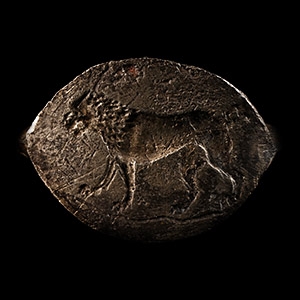
Large Greek Silver Ring with Advancing Lion
5th century B.C.Sold for (Inc. bp): £4,680
With round-section hoop and scaphoid plaque, incuse advancing lion in profile on a baseline. 16.12 grams, 30.64 mm overall, 19.55 x 22.66 mm internal diameter (approximate size British V 1/2, USA 10 3/4, Europe 24.4, Japan 23)
with Artemis Gallery, Munich, 1990s. Acquired from Artemis Gallery, 8 February 2006. European private collection. This lot has been checked against the Interpol Database of stolen works of art and is accompanied by a search certificate number no.12659-234646. This lot has been cleared against the Art Loss Register database, and is accompanied by an illustrated lot declaration signed by the Head of the Antiquities Department, Dr Raffaele D'Amato. -
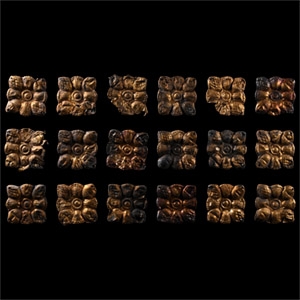
Greek Gold Applique Group
7th-5th century B.C.Estimate: £1,500 - 2,000 (‡+bp*)
Opening Bid: £750
Comprising eighteen repoussé plaques, each with a central boss and a flower bud to each side, the corners with alternating pinecones and acorns, pierced through the corners; mounted on a perspex backing. 91 grams total, 22 mm each
From the estate of Dr Jacob Hirsch. Acquired by Galerie Rhéa, Zurich, from the above in 1999. This lot has been cleared against the Art Loss Register database, and is accompanied by an illustrated lot declaration signed by the Head of the Antiquities Department, Dr Raffaele D'Amato. -
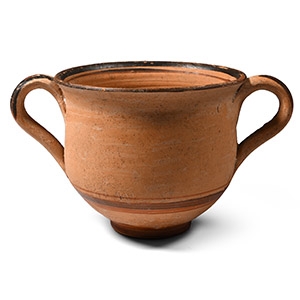
Daunian Terracotta Twin-Handled Cup
5th-4th century B.C.Estimate: £500 - 700 (‡+bp*)
Opening Bid: £250
Comprising a bell-shaped thin-walled body with two strap handles and an everted rim, dark lip with a thin circumferential band below; each handle with a lentoid motif; narrow foot with two circumferential bands above. 206 grams, 16 cm wide
From the estate of a Swiss gentleman, Ticino, before 1970. with Galerie Rhéa, Zurich, Switzerland. This lot is accompanied by an illustrated lot declaration signed by the Head of the Antiquities Department, Dr Raffaele D'Amato.
Daunian pottery is characterised by unique shapes and decorative motifs, which include geometric patterns, plant and animal motifs, and human figures. The pottery is typically made from a coarse clay, and it is decorated with black or dark brown slip, a type of liquid clay that is applied to the surface of the pottery before firing.
