
Loading, please wait...
LOT 0562
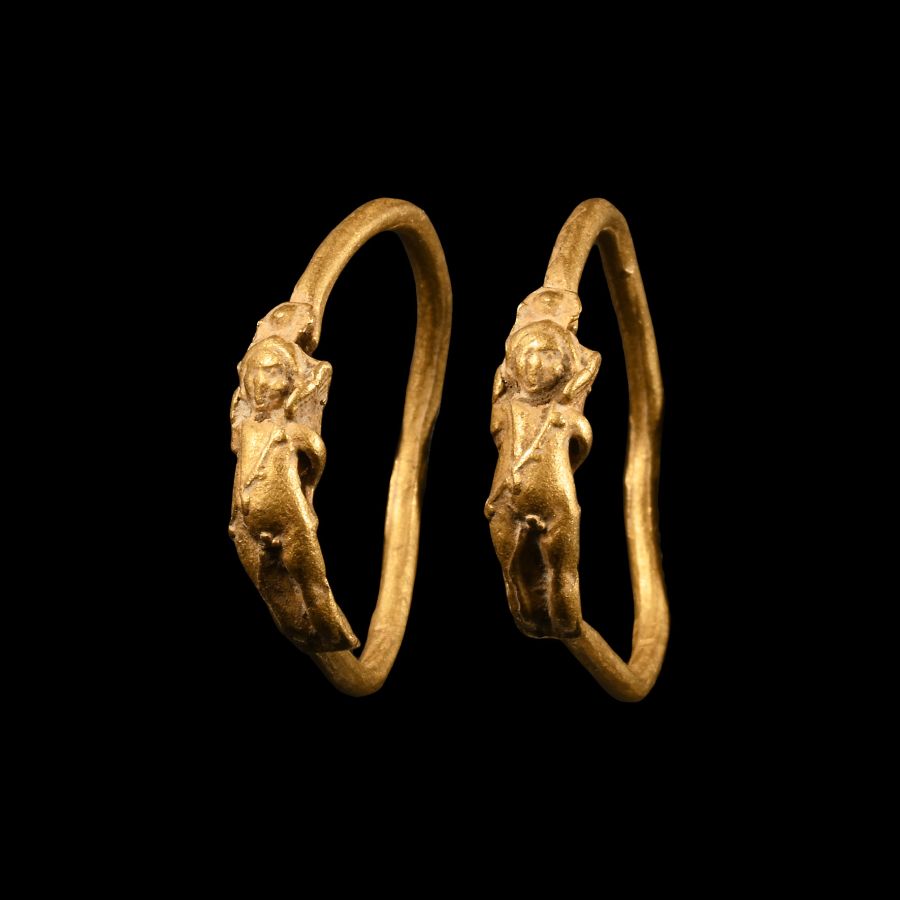
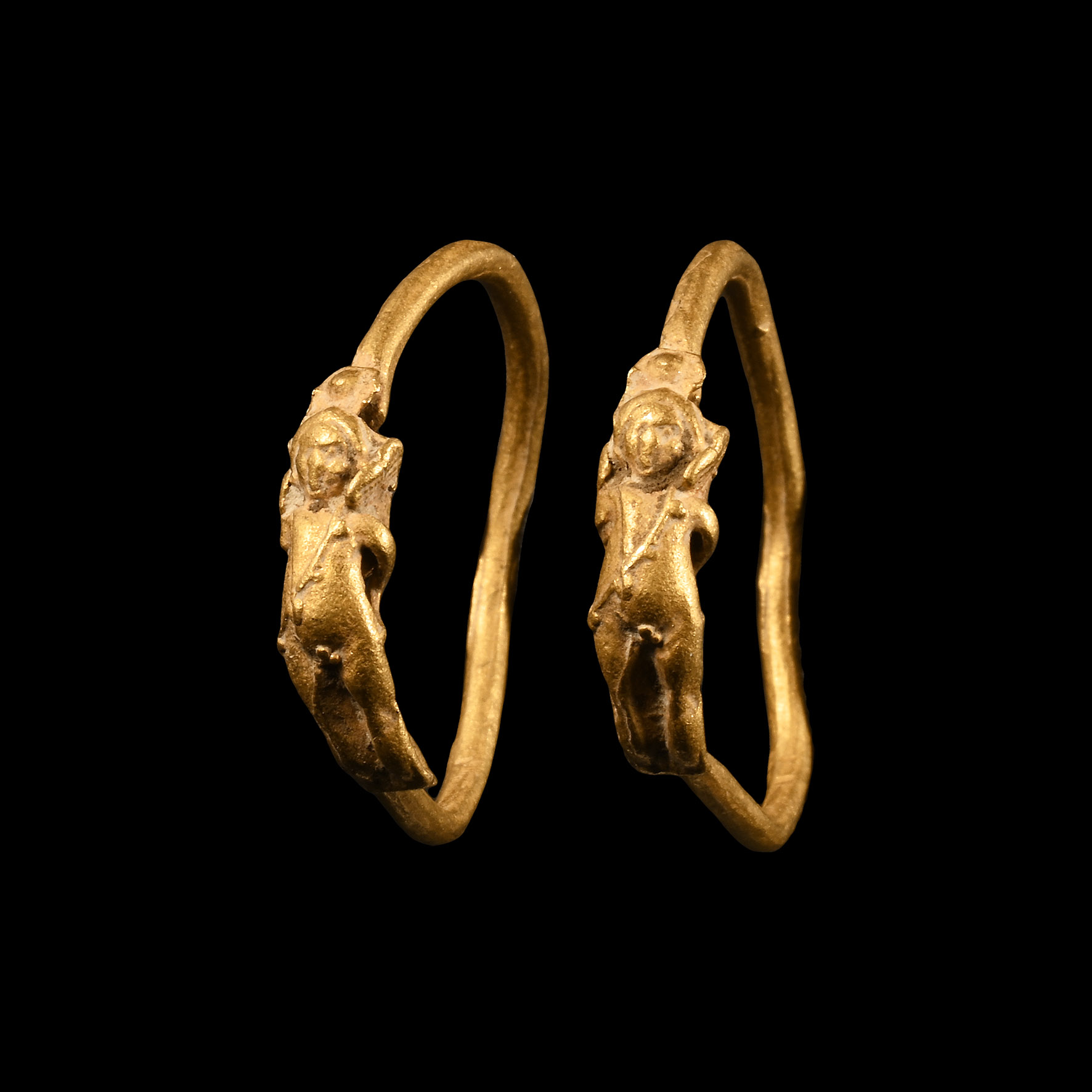
Greek Gold Eros Earrings
CIRCA 3RD-2ND CENTURY B.C.
3/4 in. (3.91 grams total, 20-21 mm).
Each composed of a slender wire hoop and a winged Eros plaque with detailing to the body, face and hair; closure loop to reverse. [2]
ProvenanceAcquired 1980-2015.
Ex Abelita family collection.
Cf. The Metropolitan Museum, accession number 74.51.3506, for similar.
CONDITIONTimeLine Auctions follows a vetting process to ensure the authenticity and legality of all items, reinforcing our commitment to integrity and responsible trading. Each antiquity, antique, and coin lot undergoes thorough examination by a vetting committee of at least ten external specialists, professional trade association members, scientists, and archaeologists: Our Vetting Process
AUCTIONS:
TimeLine is a leading auction house specialising in antiquities, ancient art, collectables, natural history, coins, medals, and books. Our auctions offer museums, collectors, historians, and enthusiasts the opportunity to acquire unique and historically significant pieces.
-
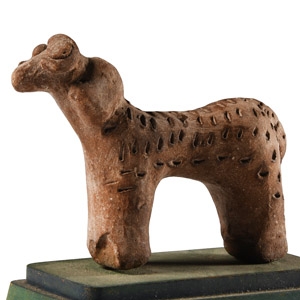
Cypriot Terracotta Ram
Early Bronze Age, circa 2500-2000 B.C.Sold for (Inc. bp): £247
Modelled in the round with fleece texture to the back and rump, applied eyes and horns; mounted on a display base with old collector's labels to the underside: 'Cyprus / Early bronze age, 250-2000 BC. / Ram, red clay, once attached to the rim of a vessel.' and '2517-14/3'. 204 grams total, 11 cm wide including stand
Ex Professor Karl Lunde collection (1931-2009). From a collection acquired on the UK art market from various auction houses and collections mostly before 2000. From an important Cambridgeshire estate; thence by descent. With old label to the base and accompanied by the remains of an old identification tag. -
.jpg)
Minoan Bronze Double Axehead
Circa 2000 B.C.Sold for (Inc. bp): £975
Substantial labrys with flared and curved edges, elliptoid socket to the centre. 973 grams, 17.5 cm
Gifted to the previous owner's husband by his grandfather prior to 1919 while in Crete. Taken to Paris and brought to the UK before 1985. Acquired from Bonhams, London, 20 October 2005, no.124. From an important Cambridgeshire estate; thence by descent. Accompanied by copies of the relevant Bonhams catalogue pages.
The double axe was both a tool, weapon and one of the main religious symbol in Minoan Crete. It was as significant and as important in Minoan religious practice as the ritual horn and the pillar. -
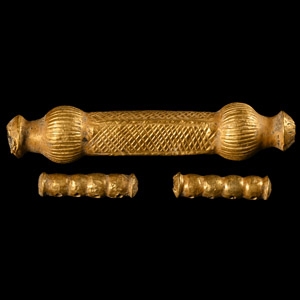
Gold Pendant Bead Group
1st millennium B.C.Sold for (Inc. bp): £572
Comprising two Hellenistic or Mesopotamian ribbed tubular beads and a larger bead with hatched sides, ribbed bulb to each end. 5.74 grams total, 17-52 mm
From a late Japanese specialist collector, 1970-2000s.
