
Loading, please wait...

LOT 0109
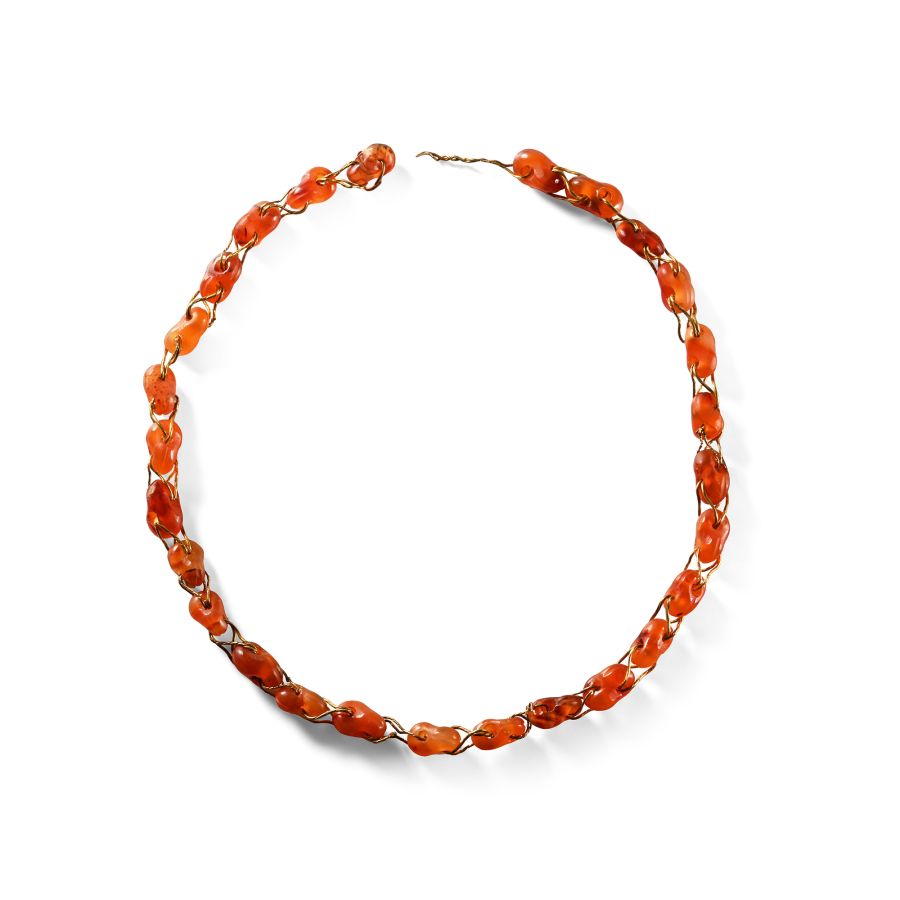
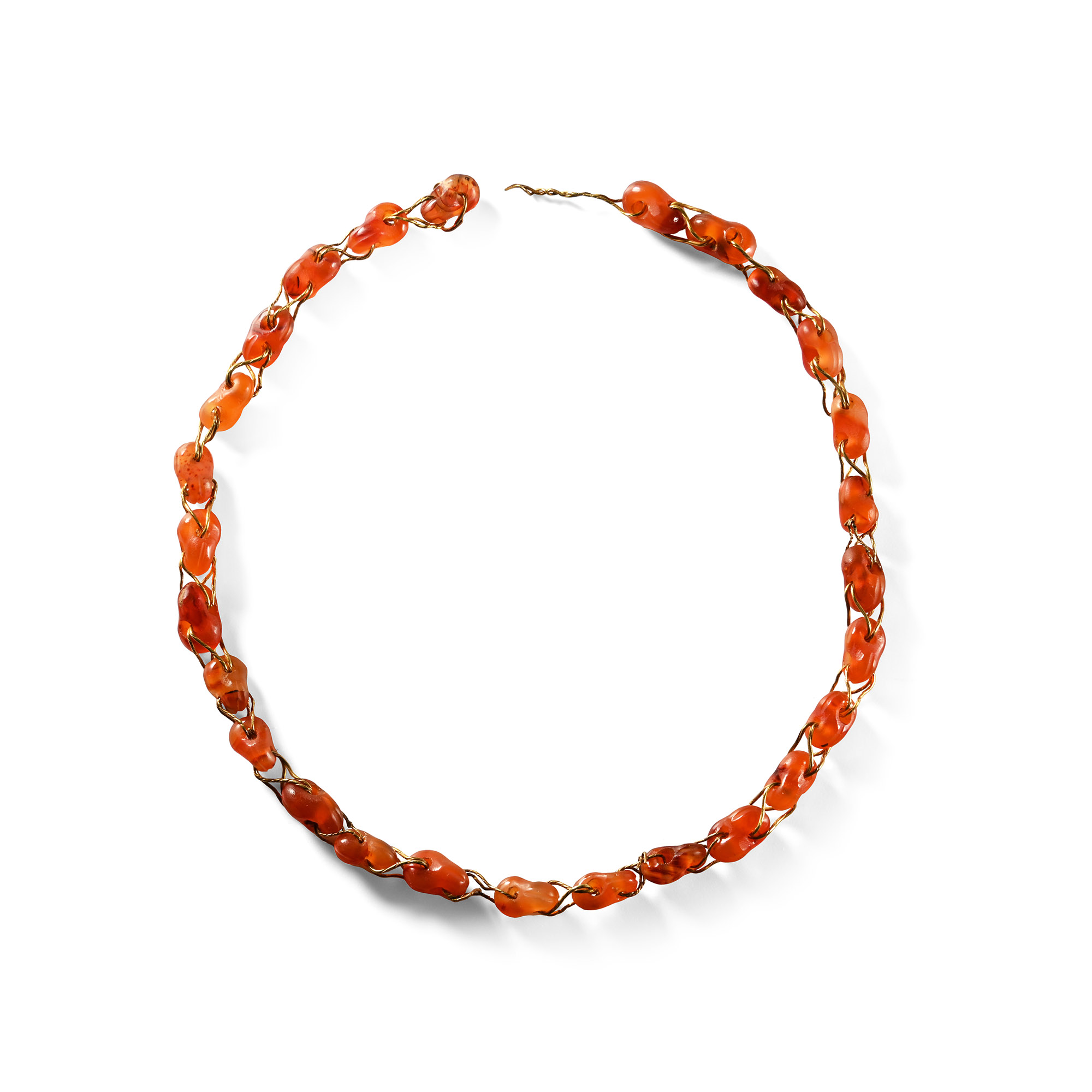
Greek Gold and Carnelian Necklace
1ST CENTURY B.C.-1ST CENTURY A.D.
10 1/4 in. (8.16 grams, 26 cm long).
A section of a necklace of carnelian drop-shaped beads, each pierced in two planes and linked loop-in-loop with thin twisted gold wires, possibly later.
ProvenanceThe Gans collection, Hebling Dec, Berlin, 1929.
with Christie's, New York, 8 December 1999, lot 51.
Accompanied by a copy of the relevant Christie's catalogue pages.
This lot has been checked against the Interpol Database of stolen works of art and is accompanied by search certificate no.11608-198969.
This lot has been cleared against the Art Loss Register database, and is accompanied by an illustrated lot declaration signed by the Head of the Antiquities Department, Dr Raffaele D'Amato.
Cf. Jaeger, R., Die Sammlung Eduard Gans, Berlin, 1928, no. 97.
CONDITIONTimeLine Auctions follows a vetting process to ensure the authenticity and legality of all items, reinforcing our commitment to integrity and responsible trading. Each antiquity, antique, and coin lot undergoes thorough examination by a vetting committee of at least ten external specialists, professional trade association members, scientists, and archaeologists: Our Vetting Process
AUCTIONS:
TimeLine is a leading auction house specialising in antiquities, ancient art, collectables, natural history, coins, medals, and books. Our auctions offer museums, collectors, historians, and enthusiasts the opportunity to acquire unique and historically significant pieces.
-
Greek Gold and Carnelian Necklace
1st century B.C.-1st century A.D.Sold for (Inc. bp): £1,895
A section of a necklace of carnelian drop-shaped beads, each pierced in two planes and linked loop-in-loop with thin twisted gold wires, possibly later. 8.16 grams, 26 cm long
The Gans collection, Hebling Dec, Berlin, 1929. with Christie's, New York, 8 December 1999, lot 51. Accompanied by a copy of the relevant Christie's catalogue pages. This lot has been checked against the Interpol Database of stolen works of art and is accompanied by search certificate no.11608-198969. This lot has been cleared against the Art Loss Register database, and is accompanied by an illustrated lot declaration signed by the Head of the Antiquities Department, Dr Raffaele D'Amato. -
Parthian Ceramic Horse Rhyton
2nd century B.C.-2nd century A.D.Sold for (Inc. bp): £2,470
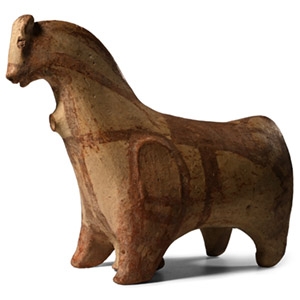
Hollow-formed horse figure with spout to the chest and filler hole beneath the chest; painted saddle and bridle detailing. 1.61 kg, 27 cm
Ex Zackary, Los Angeles, USA, 1960s. with Christie's, 13 October 2008, no.156. Accompanied by a copy of a thermoluminescence analysis report and photograph by Oxford Authentication with sample no.108u46. Accompanied by copies of the relevant Christie's catalogue pages. This lot has been checked against the Interpol Database of stolen works of art and is accompanied by a search certificate number no.12655-235194. This lot has been cleared against the Art Loss Register database, and is accompanied by an illustrated lot declaration signed by the Head of the Antiquities Department, Dr Raffaele D'Amato. -
.jpg)
Etruscan Impasto 'Spiral' Amphora
7th century B.C.Sold for (Inc. bp): £715
Comprising a bulbous body and a short neck with everted rim, two strap handles with incised striations continuing in an inverted V-shape beneath the handles; on each side of the body a large double spiral flanked by five curving lines, a stylised bird above. 343 grams, 16.5 cm
Ex Fortuna, Gallery for Ancient Art (Zurich, Kirchgasse 31) Basel, 7 April 1984. Private collection, Bern, Switzerland. This lot is accompanied by an illustrated lot declaration signed by the Head of the Antiquities Department, Dr Raffaele D'Amato.
With the arrival of the Greeks (775 B.C. at Pithekoussai, 750 B.C. at Cumae), a clear technical advancement in ceramic production was observed: impasto vessels began to show more varied patterns, were fired at higher temperatures, and were eventually replaced by wheel-made pottery in the Greek style. Despite growing populations, there remained a significant demand for this more 'old-fashioned' yet technically refined pottery. Note on the term impasto (Italian): in painting, it refers to the thick application of paint (a textured, paste-like technique). In ceramics, it refers to a thick layer of slip (a watered suspension of purified clay) applied before firing, which results in a homogenous, matte-glossy surface after firing.
