
Loading, please wait...
LOT 0033
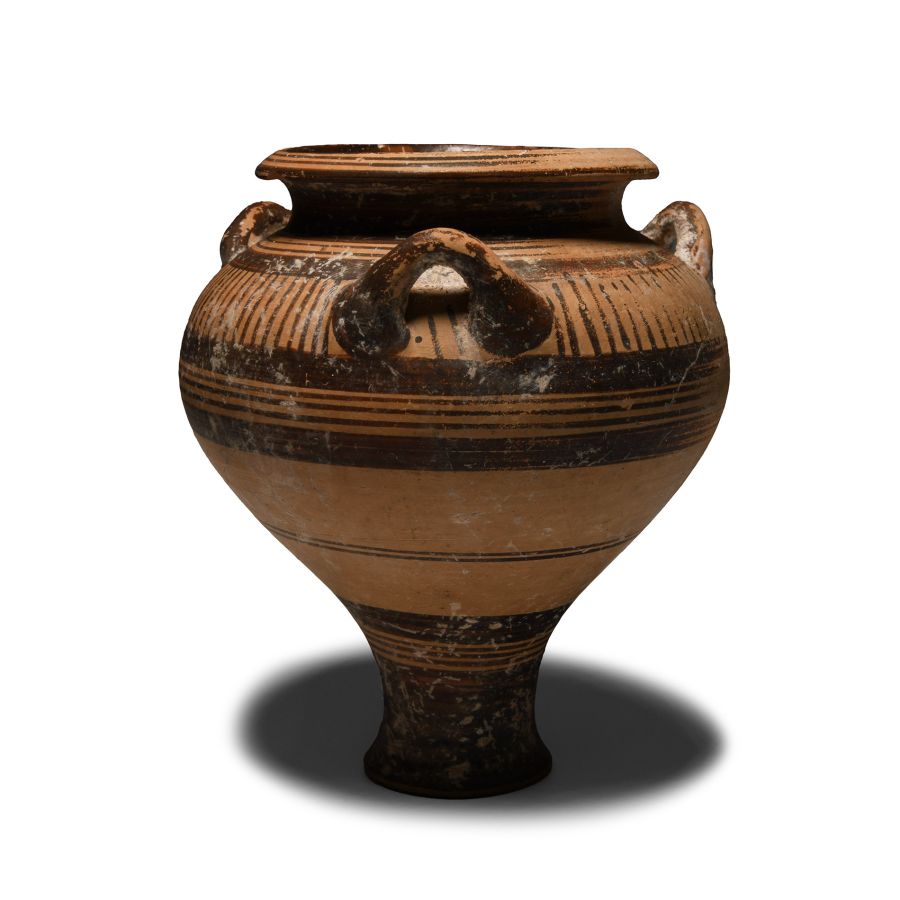
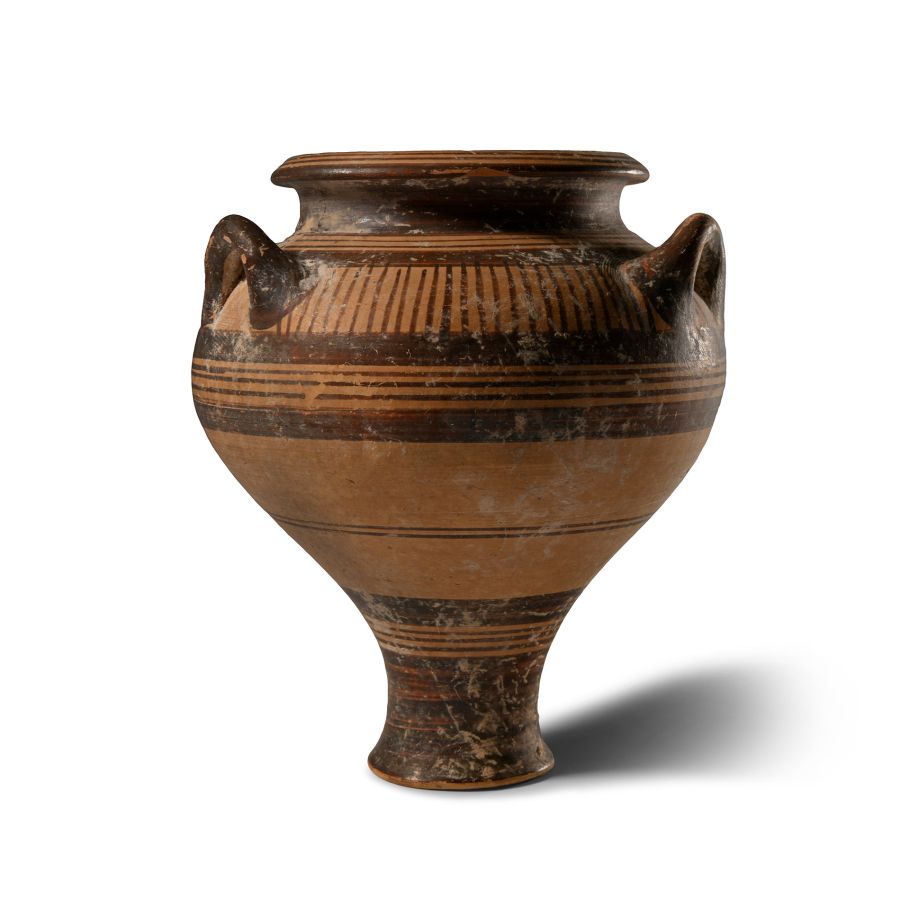
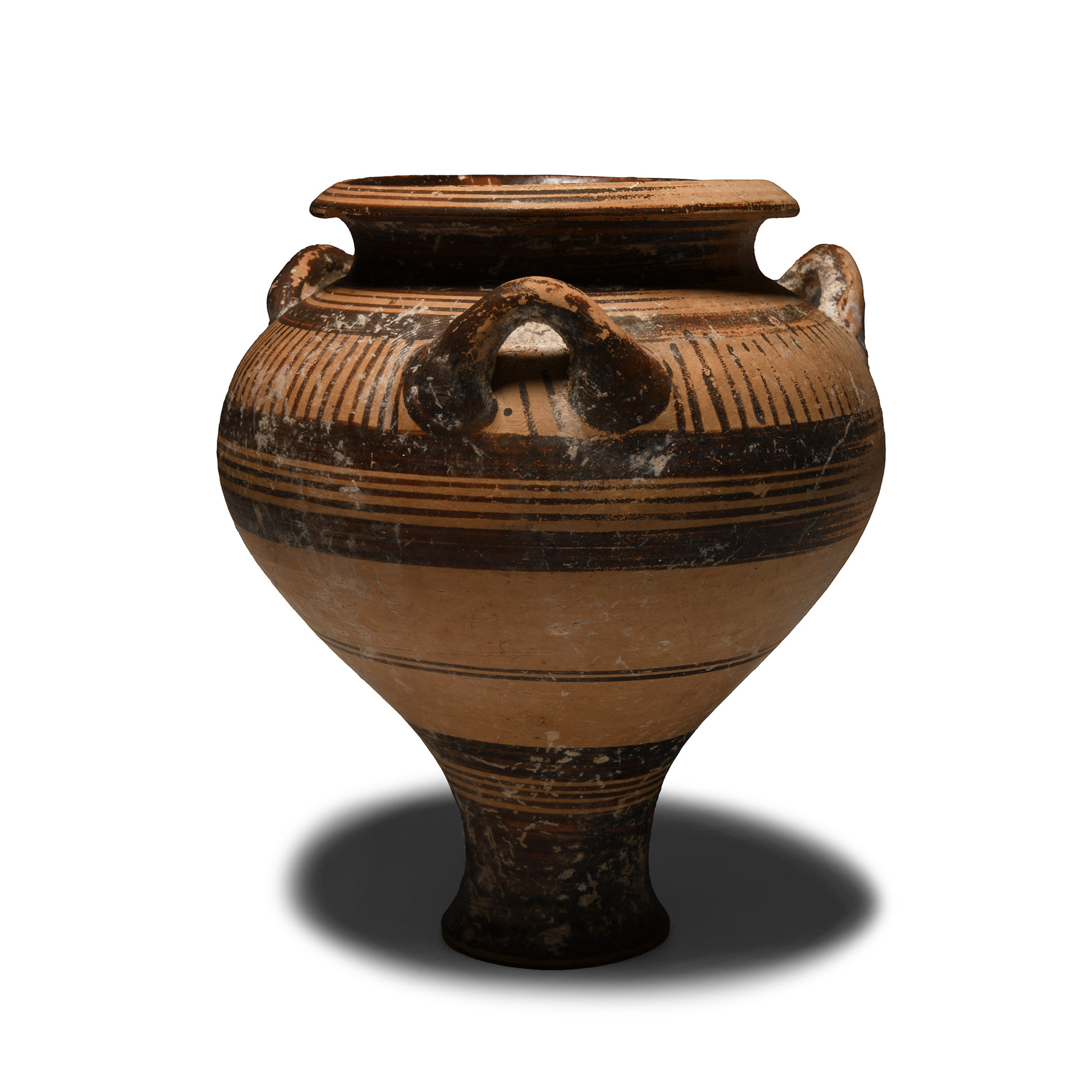
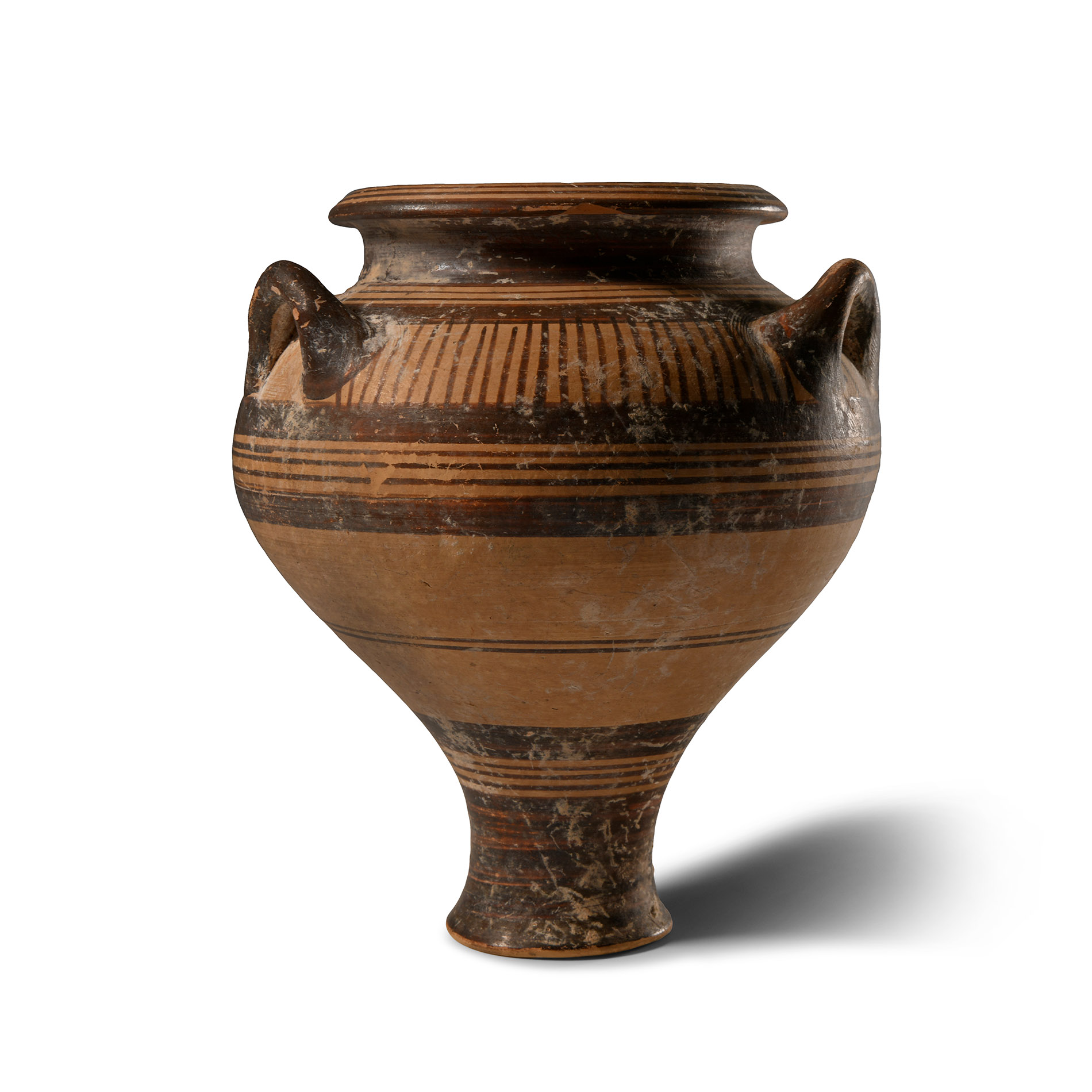
Greek Geometric Terracotta Piriform Jar with Handles
LATE HELLADIC IIIB, 1300-1200 B.C.
5 7/8 in. (280 grams, 15 cm).
With small flared foot, broad body and rounded shoulder, everted rim and two loop handles to the shoulder; painted bands of linear ornament.
ProvenanceAcquired from Gallery Gryphos, Munich, 2000s.
European private collection.
Cf. Biers, W.R., The archaeology of Greece: an introduction, Ithaca-London, 1987, p.84, for identical piriform jar.
FootnotesDeposits from Mycenae, Korakou and Nichoria are relatively rich in painted jugs, small stirrup and piriform jars. The pattern usually employed on piriform jars preserves a rim decoration of short strokes, neck being solidly painted. Following an usual syntax, a line group appears on the upper shoulder below the neck. Bases are solidly painted, except for an occasional thin reserved area on the lower base edge.
CONDITIONTimeLine Auctions follows a vetting process to ensure the authenticity and legality of all items, reinforcing our commitment to integrity and responsible trading. Each antiquity, antique, and coin lot undergoes thorough examination by a vetting committee of at least ten external specialists, professional trade association members, scientists, and archaeologists: Our Vetting Process
AUCTIONS:
TimeLine is a leading auction house specialising in antiquities, ancient art, collectables, natural history, coins, medals, and books. Our auctions offer museums, collectors, historians, and enthusiasts the opportunity to acquire unique and historically significant pieces.
-
Greek Terracotta Vessel Collection
Circa 4th century B.C.Estimate: £800 - 1,000 (+bp*)
Opening Bid: £400
Mixed group comprising: blackware footed jug with loop handle, high-relief mask of Apollo, old collector's label inside the foot 'Carnac 1846'; blackware amphora with strap handles (one absent), band of rosettes to the neck, old collector's labels 'Carnac 1846' to base and body; amphora with marine encrustation, old collector's label (illegible). 526 grams total, 98-120 mm
Collected circa 1846. From a 19th century collection. Acquired by a previous vendor's father in the 1930s-1940s. Ex property of a North London, UK, gallery. -
.jpg)
Etruscan Bronze Statuette of Hercle
Circa 4th-3rd century B.C.Sold for (Inc. bp): £845
Modelled in the round figure of Hercle (Roman Hercules, Greek Herakles) standing nude with the lionskin mantle draped over his extended left forearm, the right arm bent and fist raised (originally holding a club); the hair cut short and radiating from the crown of the head, lentoid eyes flanking a snub nose; mounted on a custom-made stand. 87 grams total, 77 mm (10.2 cm high including stand)
From the estate of Eldert Bontekoe (1954-2020). Ex Ann Arbor, Michigan, USA, acquired before 2000. with Artemis Gallery, Colorado, USA, 26 December 2020, no.8. Property of a South Australian private collector, with collection reference 20.38. Accompanied by an original Artemis Gallery certificate of authenticity dated 27 January 2021. Accompanied by detailed collector's catalogue pages including description and photograph. -
Cypriot Terracotta Figure Head Collection
Circa 1000 B.C.Sold for (Inc. bp): £468
Group of terracotta heads from figurines, one with moulded facial detailing, the others pinched. 476 grams total, 4.5-10.5 cm
One with antique tag: 'CYPRUS / C.1000 BC / Terracotta Fragment of / Mother-Goddess.' From a collection acquired on the UK art market from various auction houses and collections mostly before 2000. From an important Cambridgeshire estate; thence by descent.
