
Loading, please wait...
LOT 0081
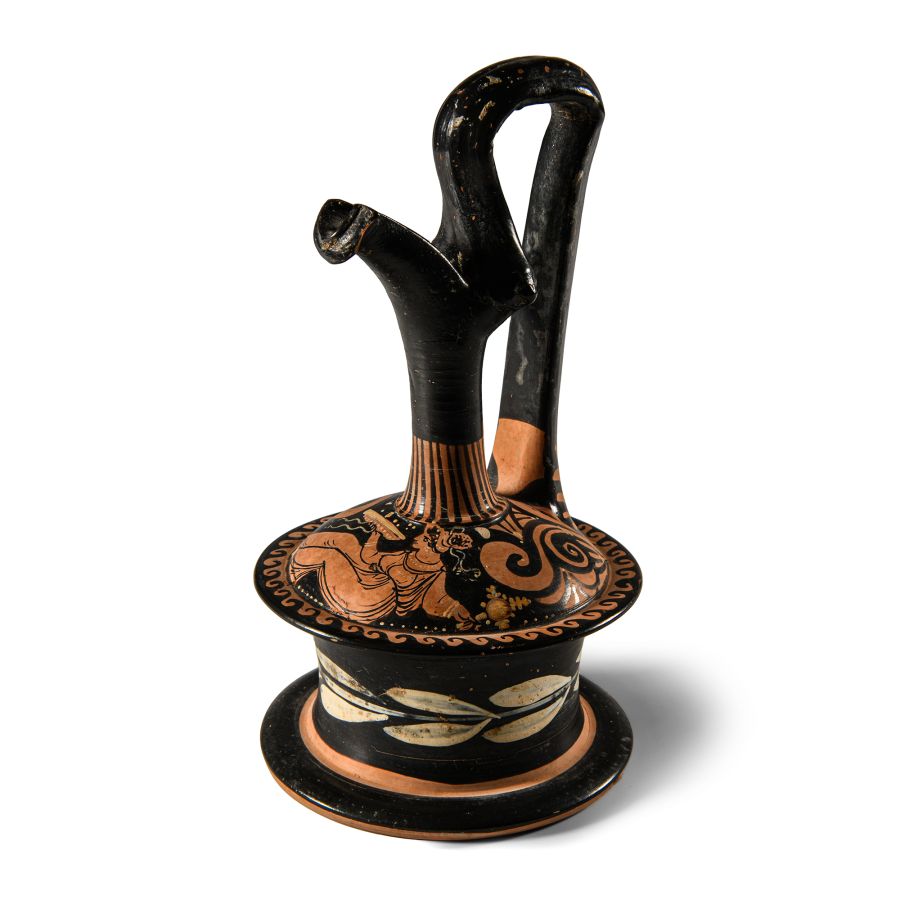
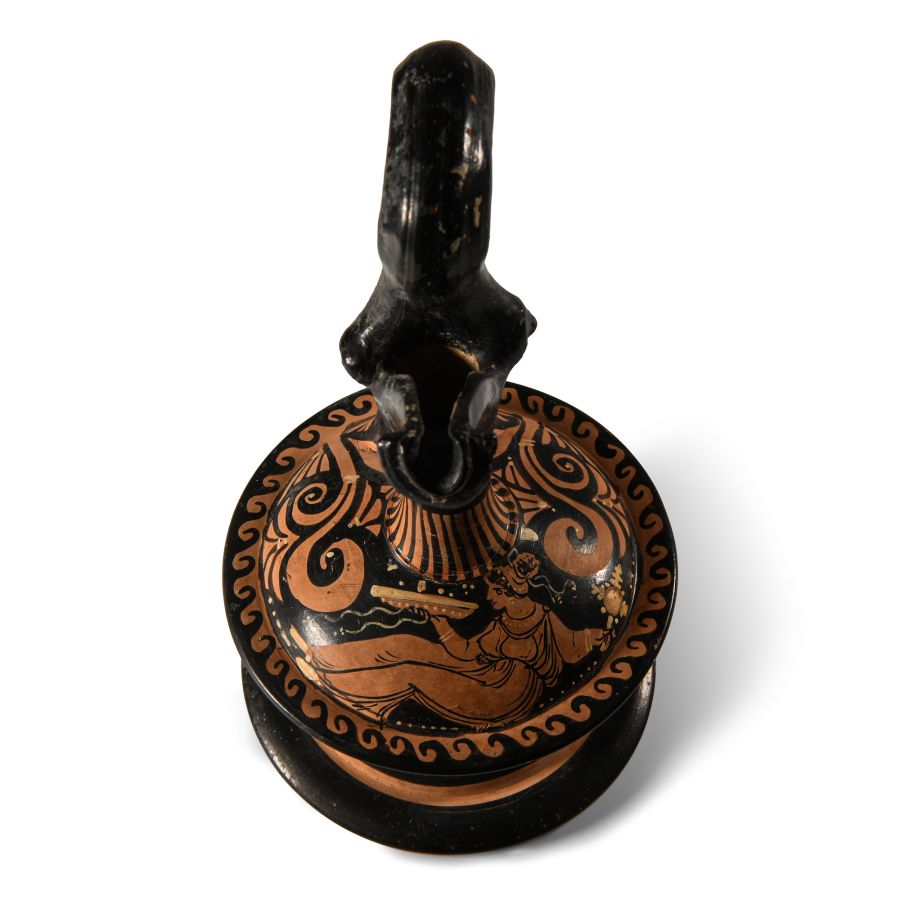
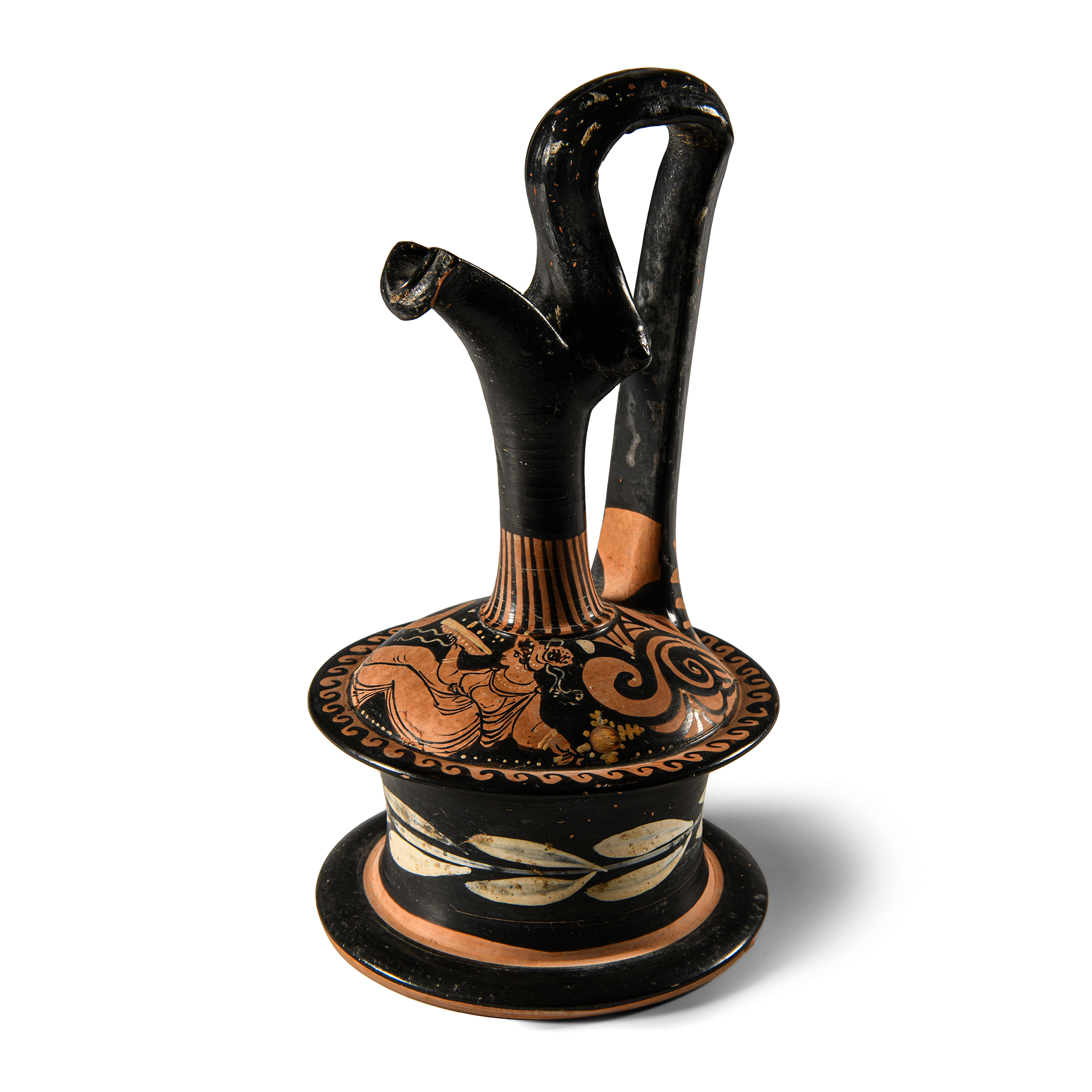
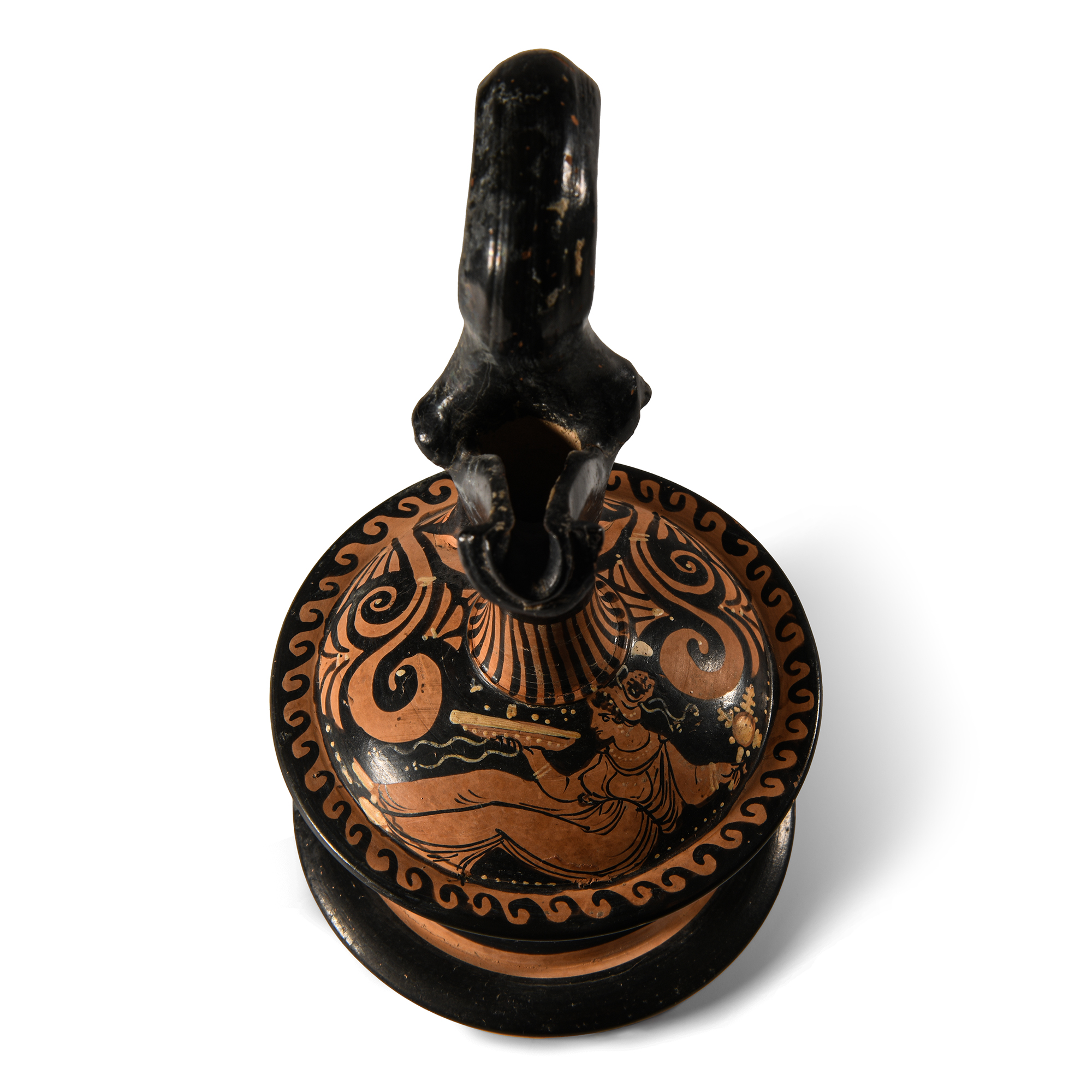
Greek Epichyses with Reclining Female Holding a Patera
APULIAN, 4TH CENTURY B.C.
6 1/2 in. (229 grams, 16.5 cm).
Enlivened with crimson, ochre and white slip; with rays on the neck, the shoulder showing a lady of fashion lying, adorned with earrings and bracelets, holding a patera in her right hand, and foliate sprigs in the field; palmette at the base of the handle, and grape vine on the cotton reel body.
ProvenanceEx Ancient Art Shop, Windsor, UK, in the 1990s.
Heads and Tales exhibition, Piccadilly, London, 2002.
From the collection of PA, Hertfordshire, UK.
Cf. similar vessel in the British Museum, accession no.1978.0414.38), a large Apulian epichyses, in Nicol, W., A Catalogue of the Greek and Etruscan Vases in the British Museum, London, 1851-1870, no.1524; cf. also Jentoft-Nilsen, M.R., Corpus Vasorum Antiquorum, The Paul Getty Museum, Malibu, 1990, pls.173-174, for similar.
FootnotesStretched-out figures of women or Eros appear frequently on the shoulders of epichyseis in the Menzies group. This epichyseis substituted the image of a woman to that of Eros, sitting nude in other identical vessels on a dotted white and white-stripe ground line with his legs outstretched before him. The woman holds in his right hand a patera, exactly as the Eros on the epichyses in the Getty Museum. The position of the woman, the treatment of the dress and the position of the legs, as well as the palmette decoration and adjuncts would suggest to associate the vase with the Menzies Group.
CONDITIONTimeLine Auctions follows a vetting process to ensure the authenticity and legality of all items, reinforcing our commitment to integrity and responsible trading. Each antiquity, antique, and coin lot undergoes thorough examination by a vetting committee of at least ten external specialists, professional trade association members, scientists, and archaeologists: Our Vetting Process
AUCTIONS:
TimeLine is a leading auction house specialising in antiquities, ancient art, collectables, natural history, coins, medals, and books. Our auctions offer museums, collectors, historians, and enthusiasts the opportunity to acquire unique and historically significant pieces.
LOT 0081
Greek Epichyses with Reclining Female Holding a Patera
Estimate £1,800 - 2,400€2,090 - 2,780 (for guidance only)$2,430 - 3,240 (for guidance only)
-
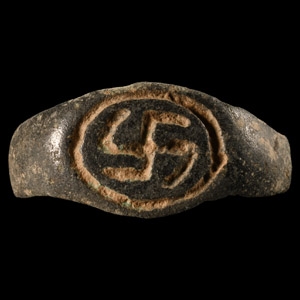
Greek Bronze Ring Bezel with Swastika
Circa 4th-3rd century B.C.Sold for (Inc. bp): £124
Ellipsoid bezel with incuse gammadion motif. 1.77 grams, 21 mm
Acquired 1980-2015. Ex Abelita family collection. -
.jpg)
Cypriot Red Polished Ware Jug Group
Early-Middle Bronze Age, circa 2700-1900 B.C.Sold for (Inc. bp): £572
Group of three jugs each with spherical body and trumpet-shaped mouth, loop handle to one side. 750 grams total, 11.5-15.3 cm
From a collection acquired on the UK art market from various auction houses and collections mostly before 2000. From an important Cambridgeshire estate; thence by descent. -
.jpg)
Phoenician Limestone Herakles Melqart Wearing Lionskin
Circa 6th-5th century B.C.Sold for (Inc. bp): £845
Modelled in the round, standing with lionskin mantle tied around the shoulders at the chest, with girdle to the waist and knee-length tunic; left hand resting on the handle of a club; mounted on a custom-made display stand. 1.85 kg total, 36.5 cm including stand
From a collection acquired on the UK art market from various auction houses and collections mostly before 2000. From an important Cambridgeshire estate; thence by descent.
Melqart was the Phoenician tutelary deity whose name means 'king of the city'; in the Roman interpretation, he was identified with Hercules.
