
Loading, please wait...
LOT 0072
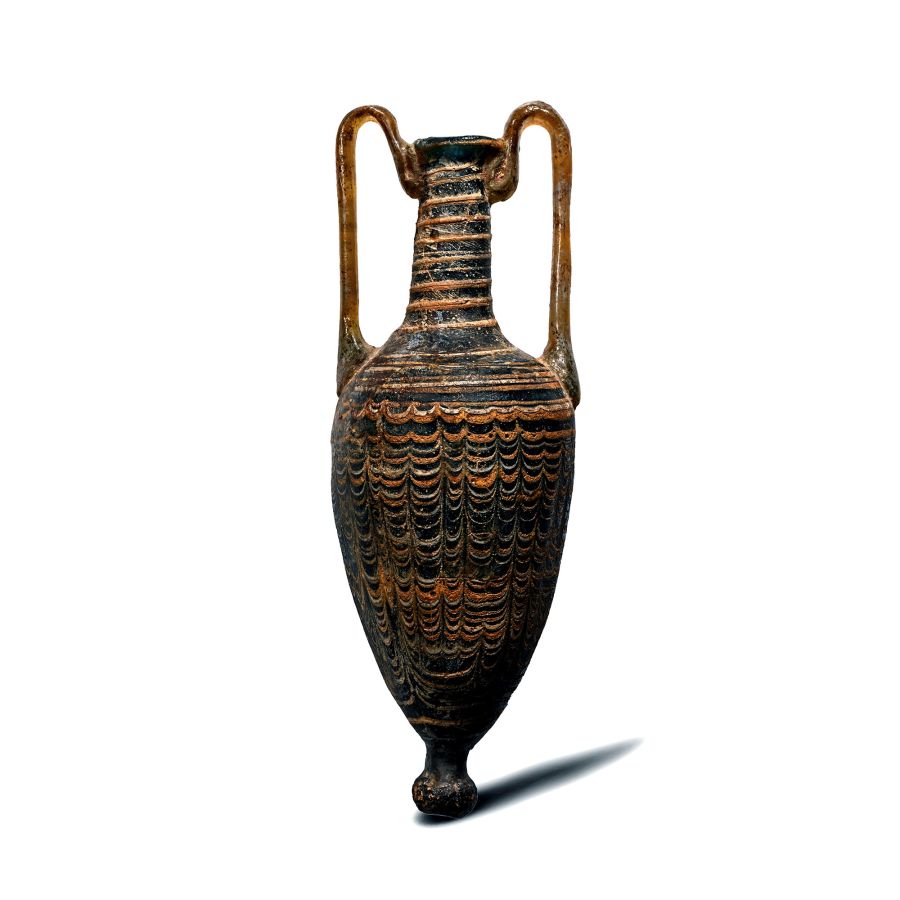
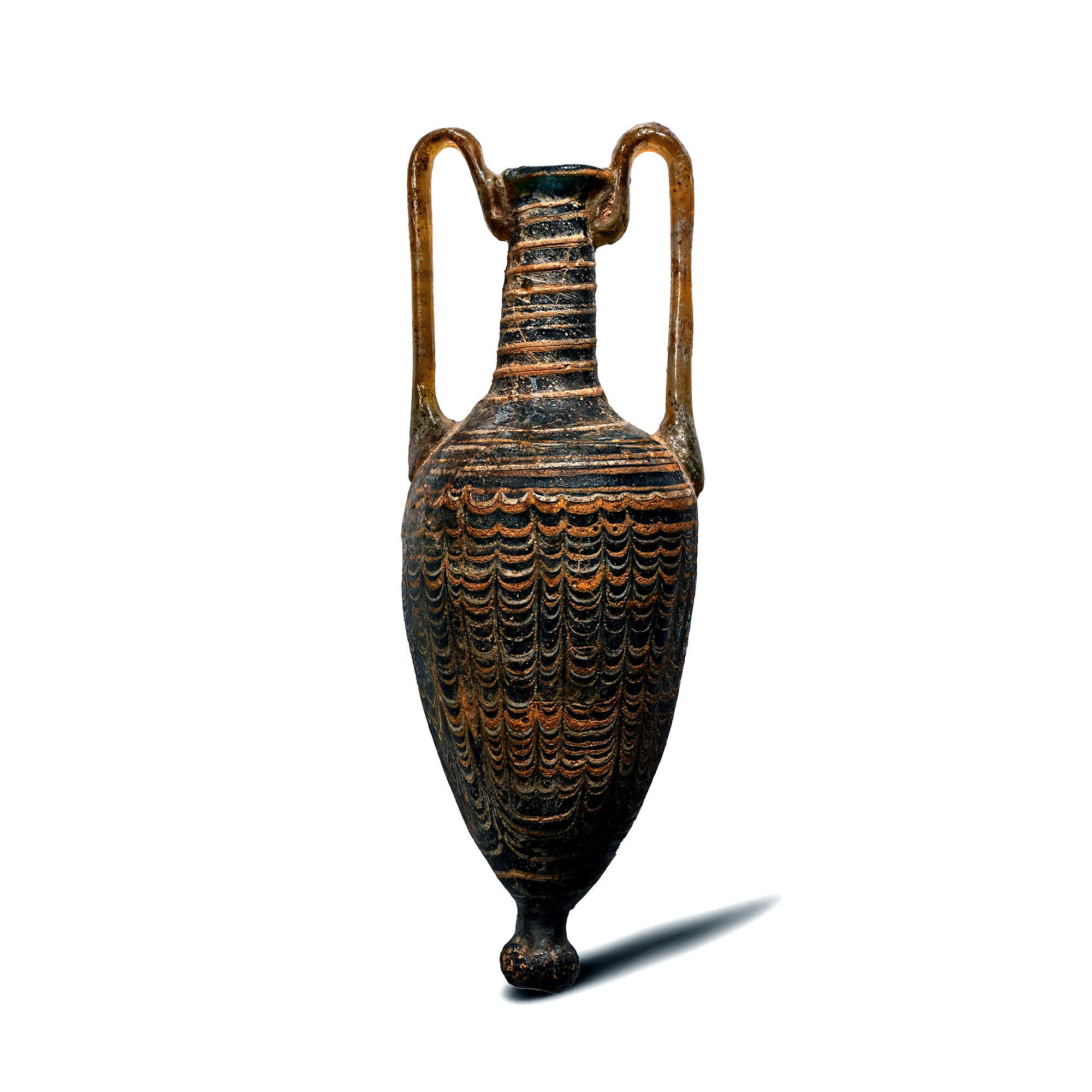
Greek Core-Formed Glass Amphoriskos
5TH-3RD CENTURY B.C.
7 in. (152 grams, 18 cm high).
Elongated piriform amphora shape, tubular neck and everted rim, decorated with polychrome festooning and trails, applied amber-green handles and knop foot.
ProvenanceAcquired early 1990s.
Ex private American collection; thence by descent.
Private collection since 1998.
This lot has been checked against the Interpol Database of stolen works of art and is accompanied by search certificate number no.12206-222129.
Cf. The Metropolitan Museum, New York, accession number 74.51.320, for similar.
CONDITIONTimeLine Auctions follows a vetting process to ensure the authenticity and legality of all items, reinforcing our commitment to integrity and responsible trading. Each antiquity, antique, and coin lot undergoes thorough examination by a vetting committee of at least ten external specialists, professional trade association members, scientists, and archaeologists: Our Vetting Process
AUCTIONS:
TimeLine is a leading auction house specialising in antiquities, ancient art, collectables, natural history, coins, medals, and books. Our auctions offer museums, collectors, historians, and enthusiasts the opportunity to acquire unique and historically significant pieces.
LOT 0072
Greek Core-Formed Glass Amphoriskos
Estimate £2,500 - 3,500€2,900 - 4,060 (for guidance only)$3,380 - 4,730 (for guidance only)
-
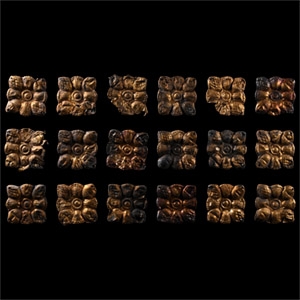
Greek Gold Applique Group
7th-5th century B.C.Sold for (Inc. bp): £2,340
Comprising eighteen repoussé plaques, each with a central boss and a flower bud to each side, the corners with alternating pinecones and acorns, pierced through the corners; mounted on a perspex backing. 91 grams total, 22 mm each
From the estate of Dr Jacob Hirsch. Acquired by Galerie Rhéa, Zurich, from the above in 1999. -
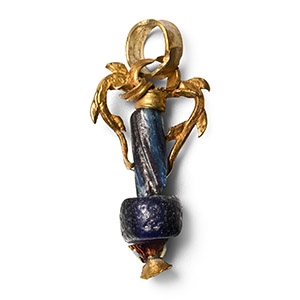
Hellenistic Gold Dolphin and Jasper Amphora Pendant
Circa 2nd-1st century B.C.Sold for (Inc. bp): £410
Formed as an amphora with cylindrical neck, biconical jasper body and small gold granulated bead; to the shoulders, two dolphins flanking the suspension loop, forming the handles of the amphora; each eye represented by a small circular cell to accept a gemstone; row of granulation down to the rear and around the perimeter of the eyes; loop added in antiquity for suspension. 1.17 grams, 25 mm
From a late Japanese specialist collector, 1970-2000s. -
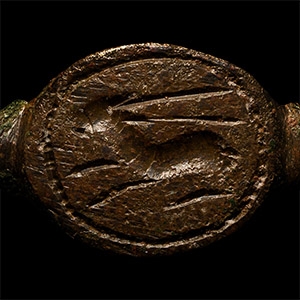
Parthian Bronze Engraved Ring
1st century B.C.-1st century A.D.Sold for (Inc. bp): £78
Comprising a D-section hoop with bulb to the underside, stepped shoulders, ellipsoid plaque with low-relief running ibex motif. 23.82 grams, 20.50 mm overall, 23.84 mm internal diameter (approximate size British N 1/2, USA 6 3/4, Europe 14.35, Japan 13)
Paris, France, art market, 1990s. From the collection of G.M.R.H., London, UK.
