
Loading, please wait...
LOT 0086
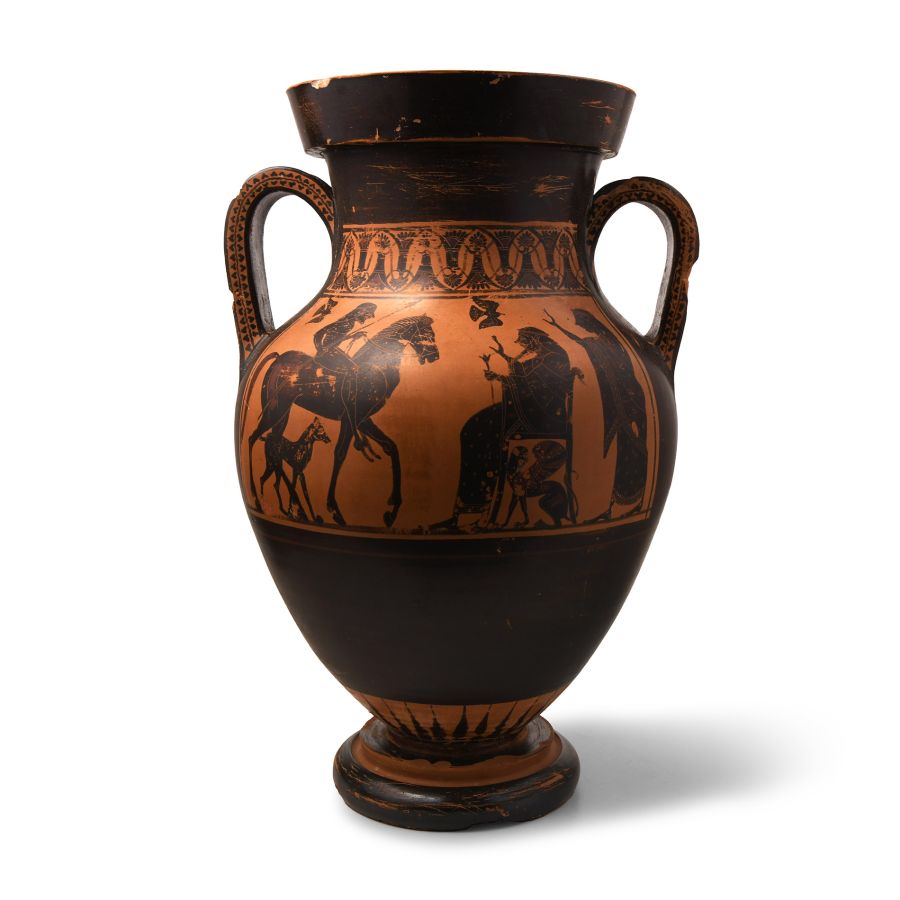
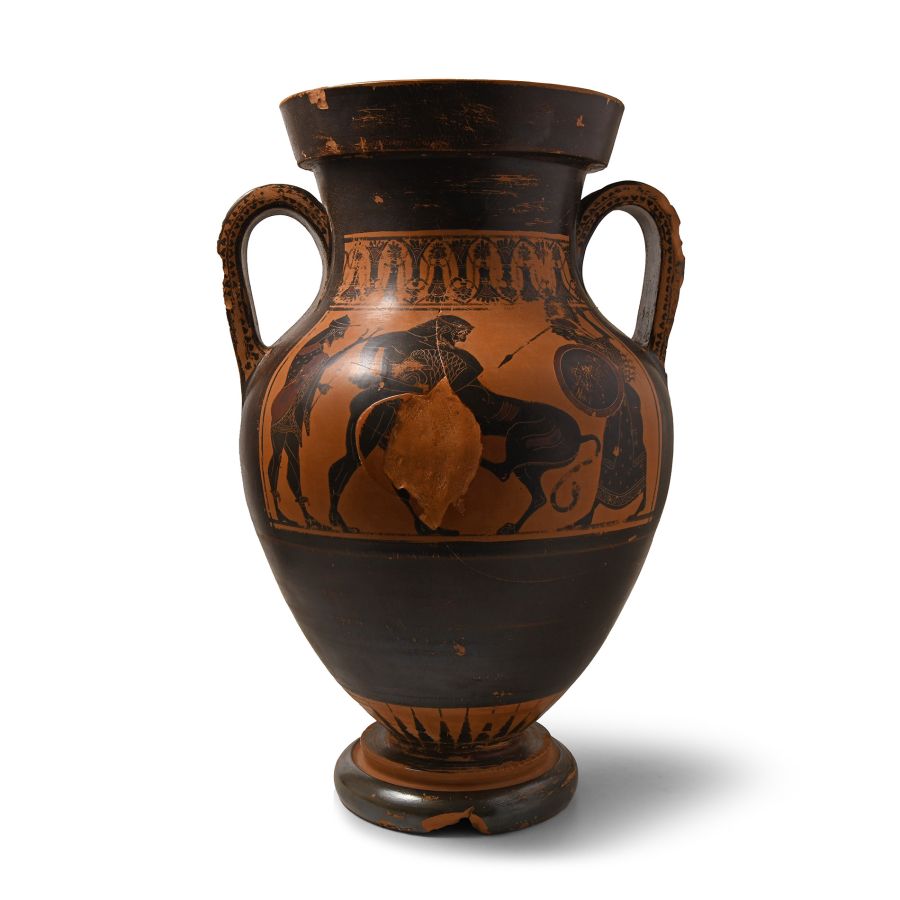
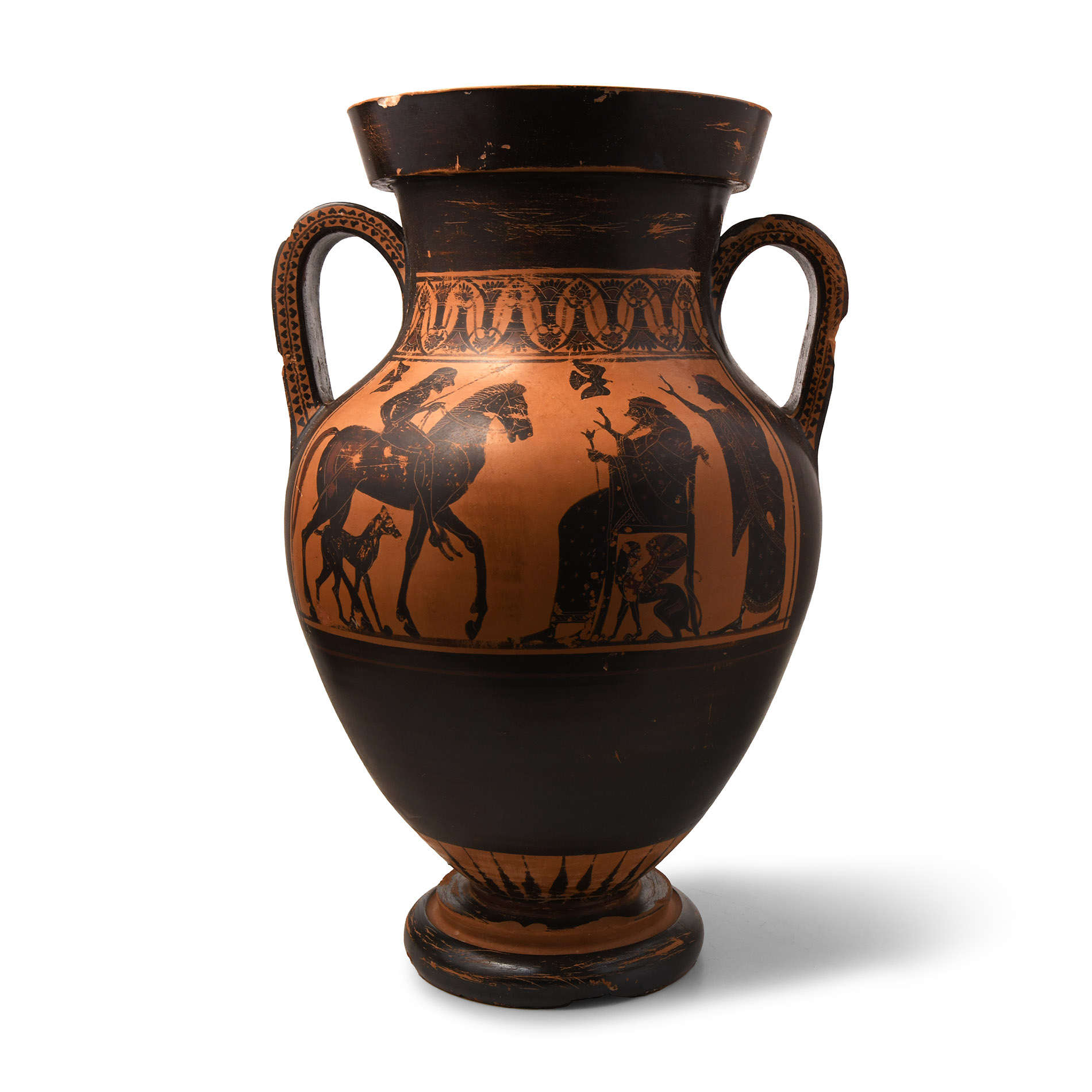
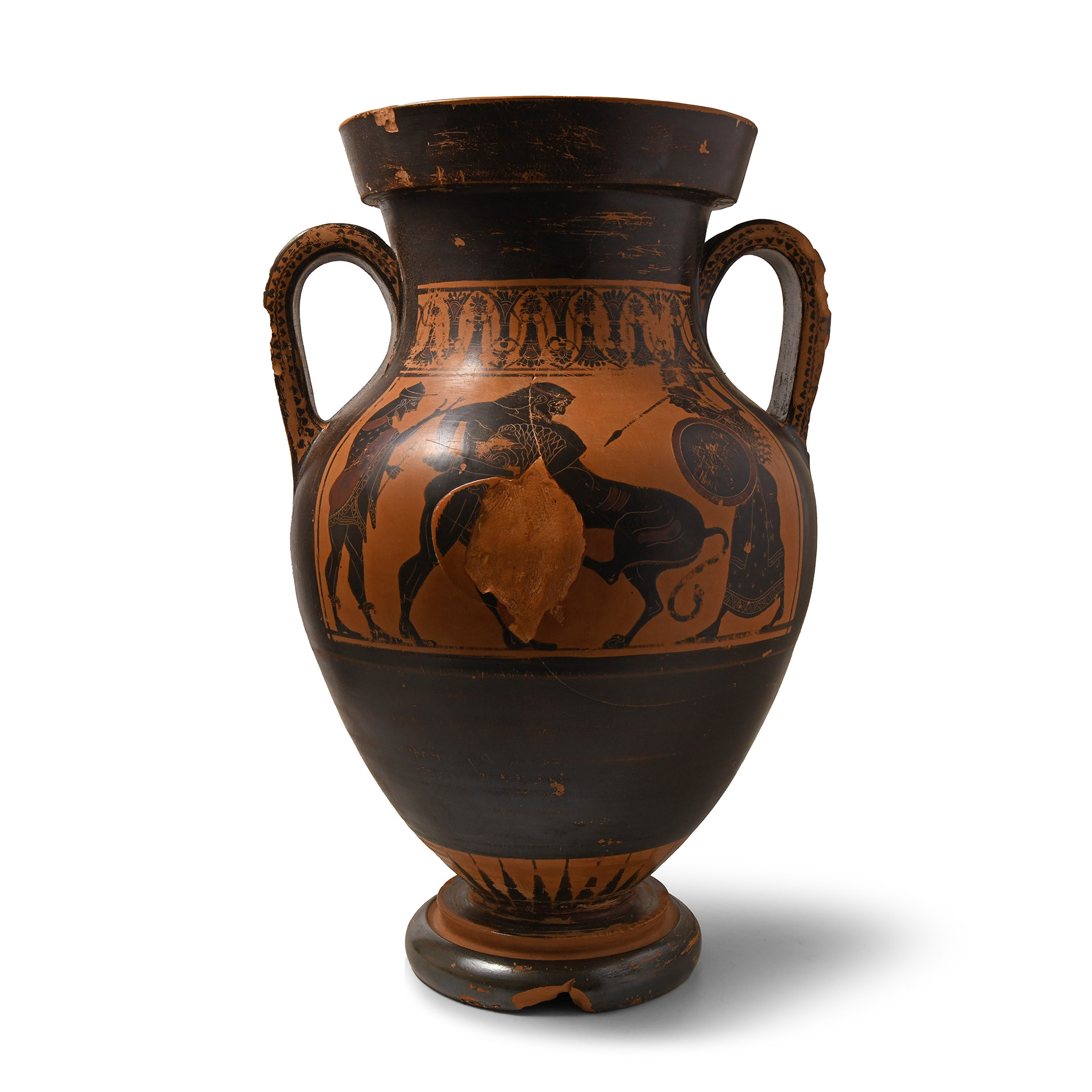
Greek Chalcidian Black-Figure Amphora with Heracles and Nemean Lion
CIRCA 650-575 B.C.
17 1/8 in. (3.1 kg, 43.5 cm).
With two figural scenes: Side A: the first of the canonical labours of Heracles, the fight against the Nemean lion - in the centre the hero standing over the lion, strangling it with his left arm while thrusting his sword into its neck; two other standing figures witness the fight - on the right Athena, fully armed and ready to defend Heracles with her lance, and to the left Hermes, recognisable by his hat (petasos), winged boots and the caduceus; Side B: a nude horseman, holding his lance and accompanied by his dog, walking towards a king seated on his throne, holding a sceptre in his left hand; on the far right, a standing woman, probably the king's wife; a sphinx under the throne and two flying birds; some restoration.
ProvenanceEx German private collection.
with Hampel Kunst Auction, Munich, 2012, no.867.
Private European collection, thence by family descent.
Accompanied by an academic report by Dr Raffaele D’Amato.
This lot has been checked against the Interpol Database of stolen works of art and is accompanied by a search certificate number no.12069-218134.
Cf. Boardman, J., Early Greek Vase Painting, London, 1998, p.219ff., ill.483-484, p.245 for a comparison; see neck amphora with Heracles killing the Nemean Lion, in the Harvard University, inventory no.1960.312, in Robinson, D. M., ‘Unpublished Greek Vases in the Robinson Collection,’ in American Journal of Archaeology (1956), 60.1, 1-25, p.7-9, no. 8, pl.5; cf. a similar terracotta neck-amphora (jar) attributed to the Polyphemos Group in the Metropolitan Museum, accession no.46.11.5.
FootnotesThe shape is typical of the period, and is decorated with black-figured technique, in which the figures were silhouetted in black slip on a reddish clay ground, and linear elements were incised with a needle, with additional details painted with white and cherry red-slip. The amphora seems to belong to one of the sub-types of the ‘Pseudo-Chalcidian’ group (the Poliphemus group), derived from the main Chalcidian series
CONDITIONTimeLine Auctions follows a vetting process to ensure the authenticity and legality of all items, reinforcing our commitment to integrity and responsible trading. Each antiquity, antique, and coin lot undergoes thorough examination by a vetting committee of at least ten external specialists, professional trade association members, scientists, and archaeologists: Our Vetting Process
AUCTIONS:
TimeLine is a leading auction house specialising in antiquities, ancient art, collectables, natural history, coins, medals, and books. Our auctions offer museums, collectors, historians, and enthusiasts the opportunity to acquire unique and historically significant pieces.
LOT 0086
Greek Chalcidian Black-Figure Amphora with Heracles and Nemean Lion
Sold for (Inc. bp): £45,500
-
Large Corinthian Mortarium with Frieze of Swans and Lions
Archaic, circa 8th-7th century B.C.Sold for (Inc. bp): £364
Broad dished bowl with carinated profile, flat rim with slashed detailing, band of reserved advancing lions and swans; central panel roughened for grinding. 3.3 kg, 33.5 cm wide
From a collection acquired on the UK art market from various auction houses and collections mostly before 2000. From an important Cambridgeshire estate; thence by descent. Accompanied by a thermoluminescence analysis report no.N124d55 from Oxford Authentication. -
Cypriot Painted Terracotta Storage Vessel
Circa 7th-5th century B.C.Sold for (Inc. bp): £182
With broad bulbous body and high flared neck, painted horizontal bands of geometric ornament. 894 grams, 17 cm wide
Acquired 1980-2015. Ex Abelita family collection. -
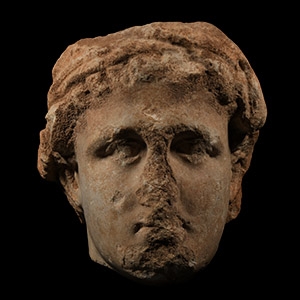
Greek Marble Head of a Ruler
Hellenistic, 3rd-1st century B.C.Sold for (Inc. bp): £31,200
Carved in the round with thick wreath of laurel leaves to the brow, short tousled hair, stern face with thick jaw; mounted on a custom-made stand. 23.7 kg total, 42.5 cm including stand
with Artemis Gallery, Munich, Germany, before 1998. with Oliver Forge, London, UK. Private collection, acquired from the above. Accompanied by a copy of an Art Loss Register certificate. Accompanied by an academic report by Prof. Neritan Ceka. This lot has been checked against the Interpol Database of stolen works of art and is accompanied by a search certificate number no.12092-218139.
The life-size head represents an adult male, probably still in his youth. The man is depicted with a short hair, and probably wearing a diadem of which the lower edge is partially visible. The size, the use of marble, and the quality of this work suggest that it was a portrait of a nobleman or possibly a prince of the Hellenistic period.
