
Loading, please wait...
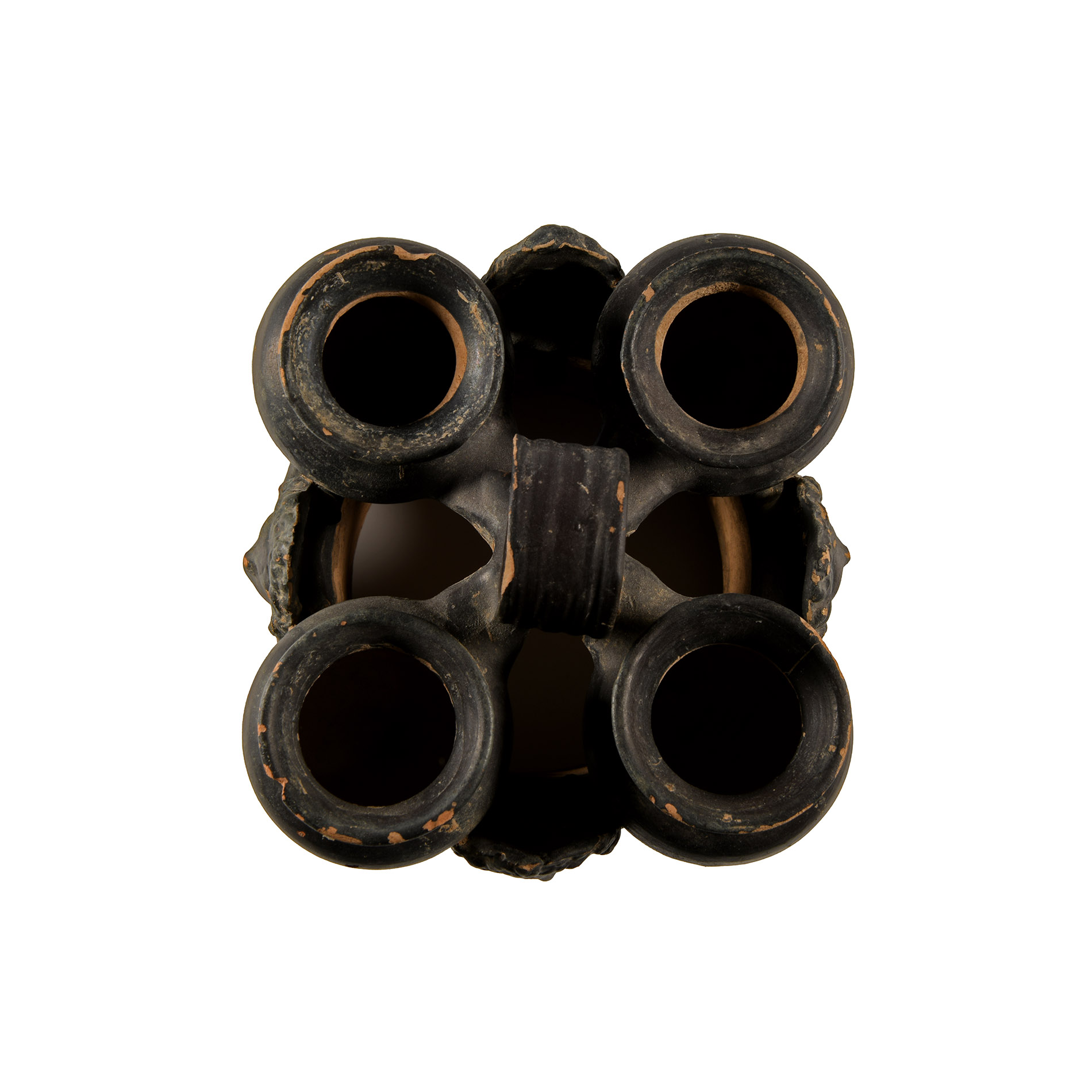
LOT 0095
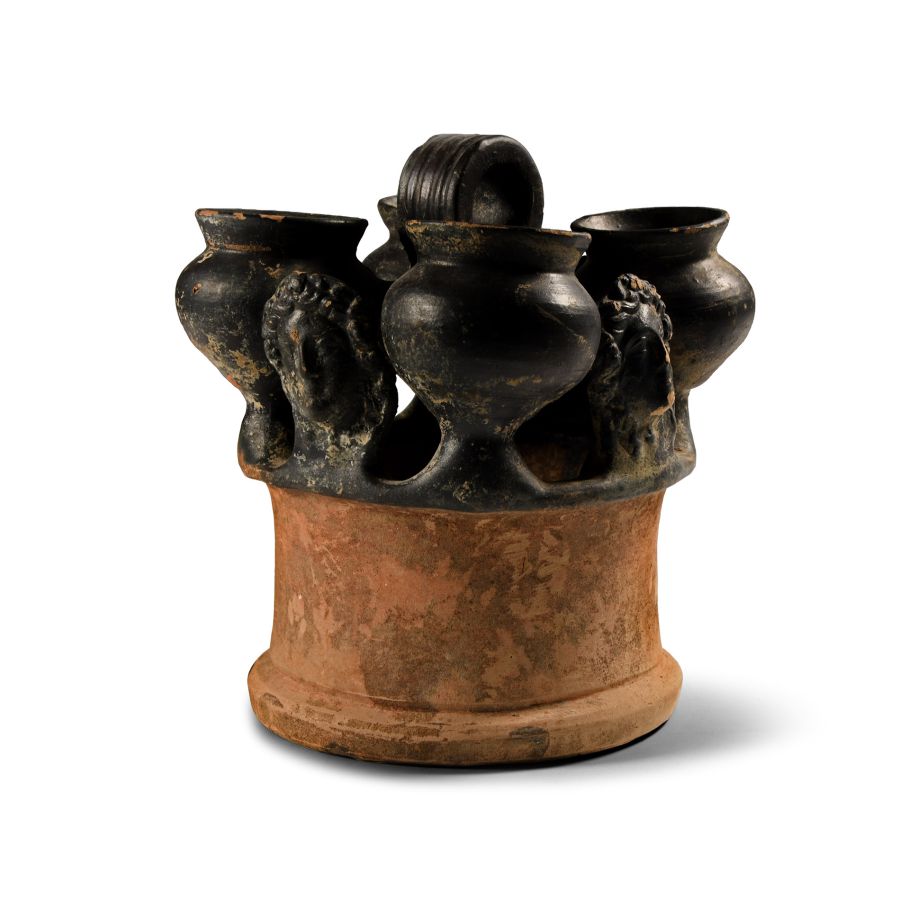
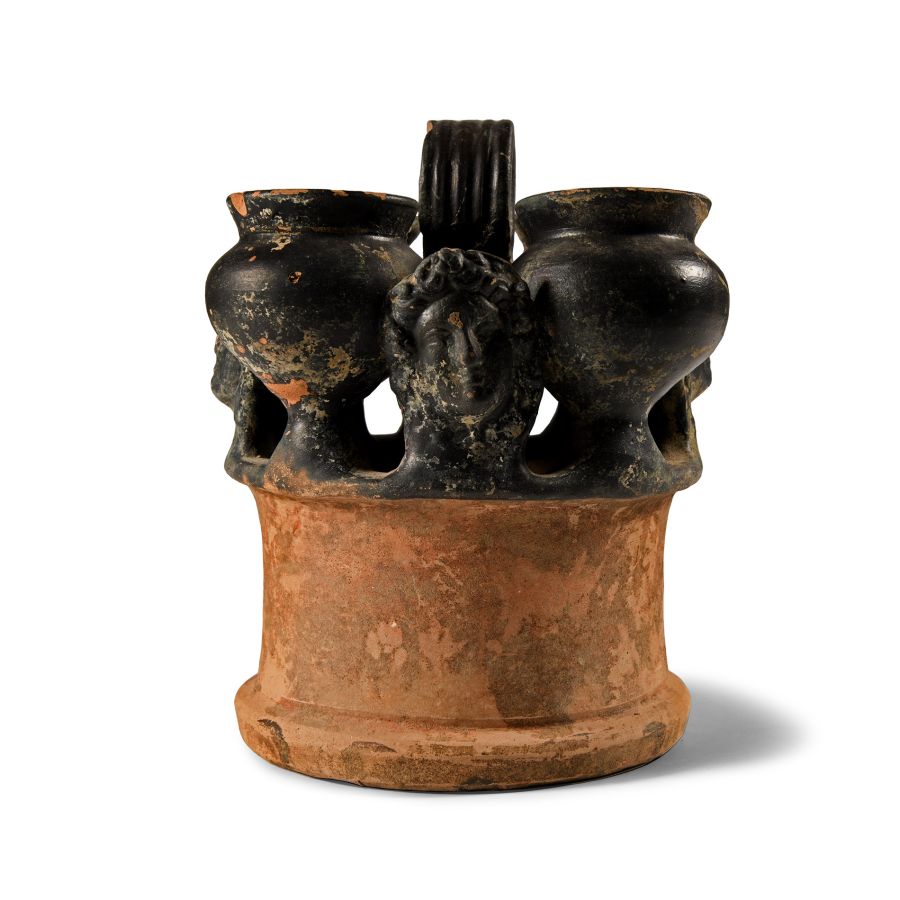
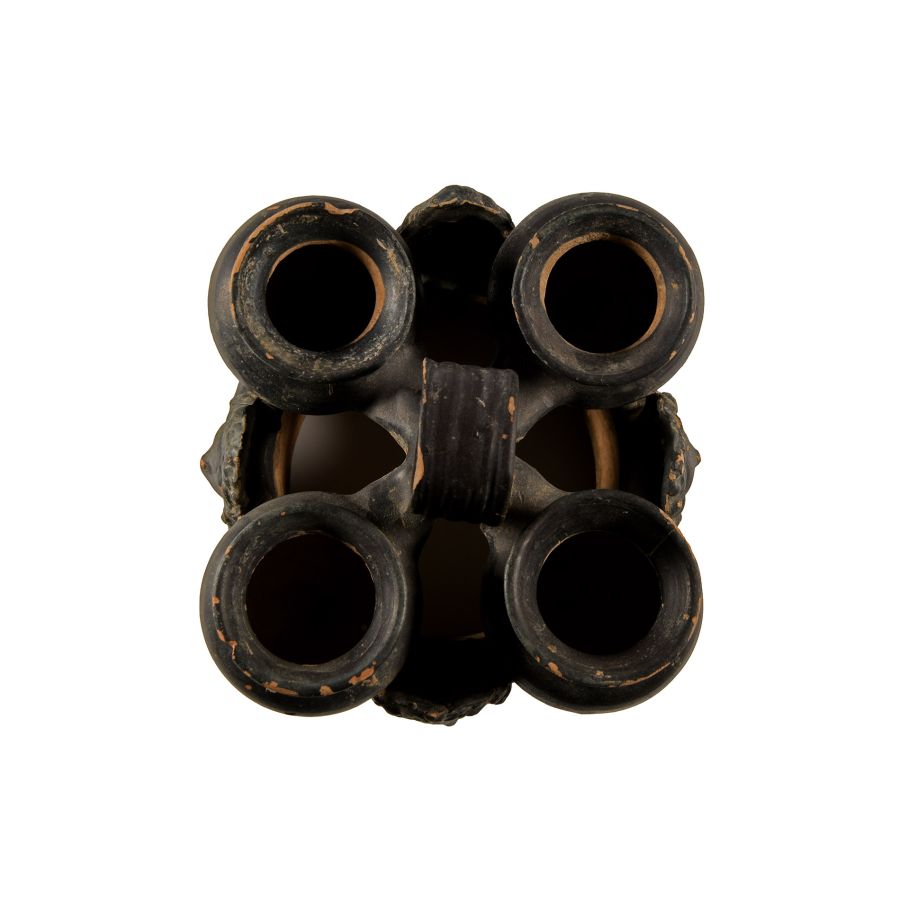
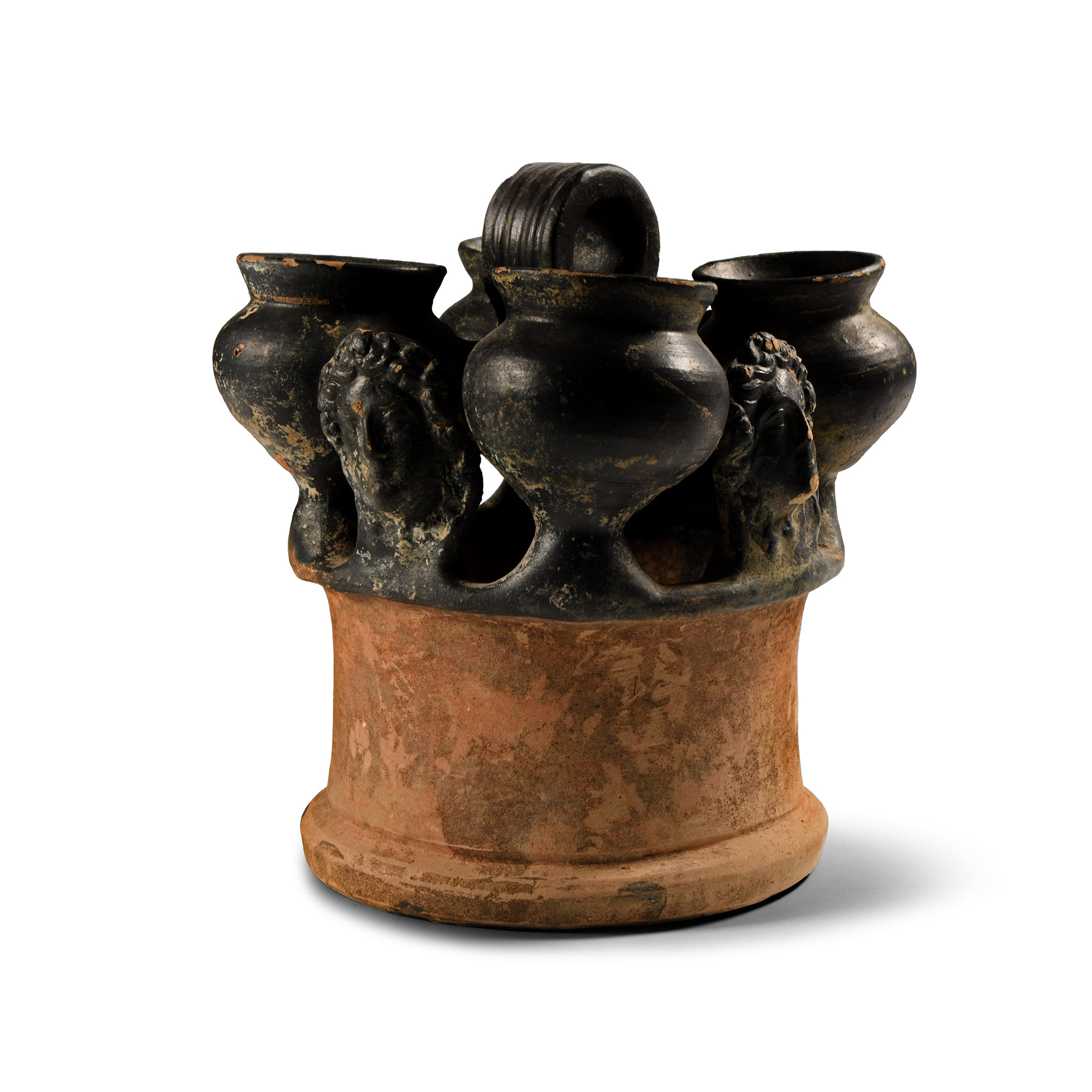
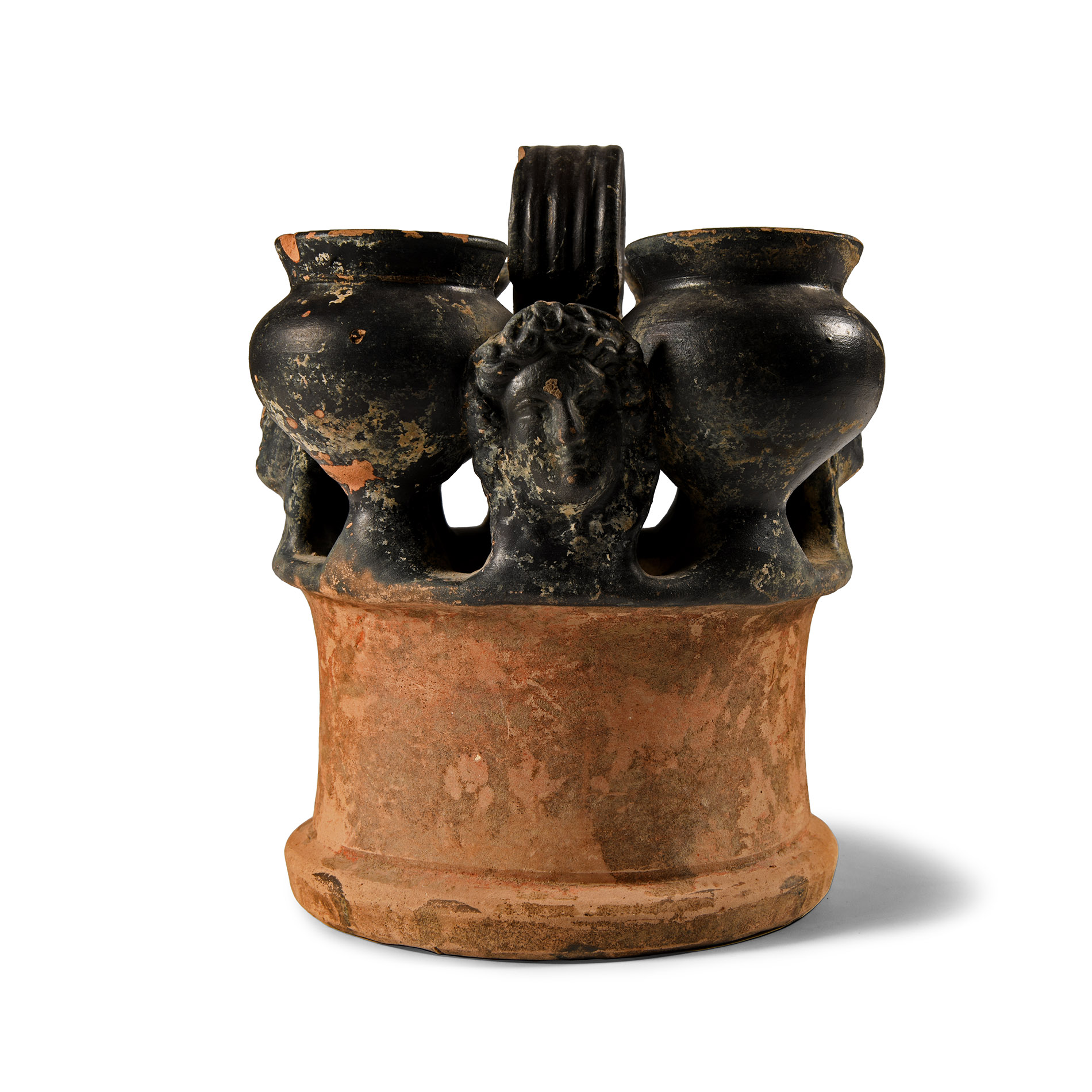
Greek Campanian Black-Glazed Kernos
LATE 4TH CENTURY B.C.
6 1/4 in. (623 grams, 16 cm high).
Comprising a round pedestal supporting four small offering pots, interspersed with four female face protomes; looped handle to the centre with parallel strokes in low-relief.
ProvenanceFrom the West German collection of H.W.
Acquired from the De Mynter, Belgium, in 2011.
with Gorny and Mosch, Munich, 3 June 2017, no.52.
Private Portuguese R.M. collection.
Accompanied by a previous catalogue information slip.
Cf. Miše, M., Gnathia and related Hellenistic Ware on the East Adriatic Coast, Oxford, 2015, fig.5, p.45, for similar.
FootnotesThe kernos can be recognised by a series of small cups on the lip, with examples dating back to the Bronze Age. It was used to store offerings made to the gods, specifically in cults pertaining to Demeter and Persephone. The receptacles probably contained foodstuffs, or perhaps flowers, and a lamp was sometimes placed in the centre. Kernoses, such as this, were often carried in processions at the Eleusinian Mysteries (secret initiation rites celebrating the goddesses Demeter and Persephone) and were an important object for Greek religious life. Kernoses are thus closely related to the agrarian cult and to the myth of Persephone and Demeter, the goddess of fertility and agriculture. The myth is recounted in an Homeric Hymn (c. 650 B.C.) according to which Persephone, Demeter’s daughter, was seized by Hades, the king of the underworld, who brought her to his kingdom to make her his wife. Distraught, Demeter caused a terrible drought, which continued until Persephone returned to her mother from the underworld. Having consumed pomegranate seeds whilst she was in the Underworld, she was only able to be with her for a few months of the year.
CONDITIONTimeLine Auctions follows a vetting process to ensure the authenticity and legality of all items, reinforcing our commitment to integrity and responsible trading. Each antiquity, antique, and coin lot undergoes thorough examination by a vetting committee of at least ten external specialists, professional trade association members, scientists, and archaeologists: Our Vetting Process
AUCTIONS:
TimeLine is a leading auction house specialising in antiquities, ancient art, collectables, natural history, coins, medals, and books. Our auctions offer museums, collectors, historians, and enthusiasts the opportunity to acquire unique and historically significant pieces.
-
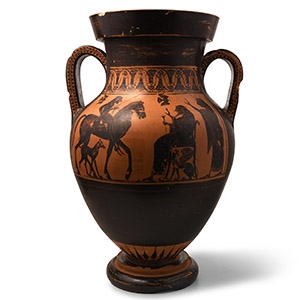
Greek Chalcidian Black-Figure Amphora with Heracles and Nemean Lion
Circa 650-575 B.C.Sold for (Inc. bp): £45,500
With two figural scenes: Side A: the first of the canonical labours of Heracles, the fight against the Nemean lion - in the centre the hero standing over the lion, strangling it with his left arm while thrusting his sword into its neck; two other standing figures witness the fight - on the right Athena, fully armed and ready to defend Heracles with her lance, and to the left Hermes, recognisable by his hat (petasos), winged boots and the caduceus; Side B: a nude horseman, holding his lance and accompanied by his dog, walking towards a king seated on his throne, holding a sceptre in his left hand; on the far right, a standing woman, probably the king's wife; a sphinx under the throne and two flying birds; some restoration. 3.1 kg, 43.5 cm
Some restoration, in general in good condition.
Ex German private collection. with Hampel Kunst Auction, Munich, 2012, no.867. Private European collection, thence by family descent. Accompanied by an academic report by Dr Raffaele D’Amato. This lot has been checked against the Interpol Database of stolen works of art and is accompanied by a search certificate number no.12069-218134.
The shape is typical of the period, and is decorated with black-figured technique, in which the figures were silhouetted in black slip on a reddish clay ground, and linear elements were incised with a needle, with additional details painted with white and cherry red-slip. The amphora seems to belong to one of the sub-types of the ‘Pseudo-Chalcidian’ group (the Poliphemus group), derived from the main Chalcidian series -
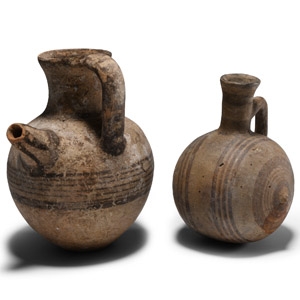
Cypriot Painted Geometric Vessel Group
Early Iron Age, circa 950-850 B.C.Sold for (Inc. bp): £260
Comprising: a spherical vessel with trumpet-shaped mouth and strap handle, painted concentric circles; similar, larger with lateral spout. 222 grams total, 9.5-11.2 cm
From a collection acquired on the UK art market from various auction houses and collections mostly before 2000. From an important Cambridgeshire estate; thence by descent. -
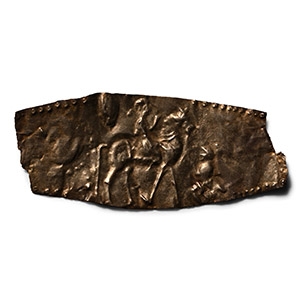
Hellenistic Silver Diadem
4th-3rd century B.C.Sold for (Inc. bp): £124
Leaf-shaped with repoussé frieze of an advancing horseman and kneeling figure; pellets to the border and other ornament. 1.96 grams, 68 mm
From a Northamptonshire collection in early 1990s. Ex Den of Antiquity, Cambridgeshire, UK.
