
Loading, please wait...
LOT 1023
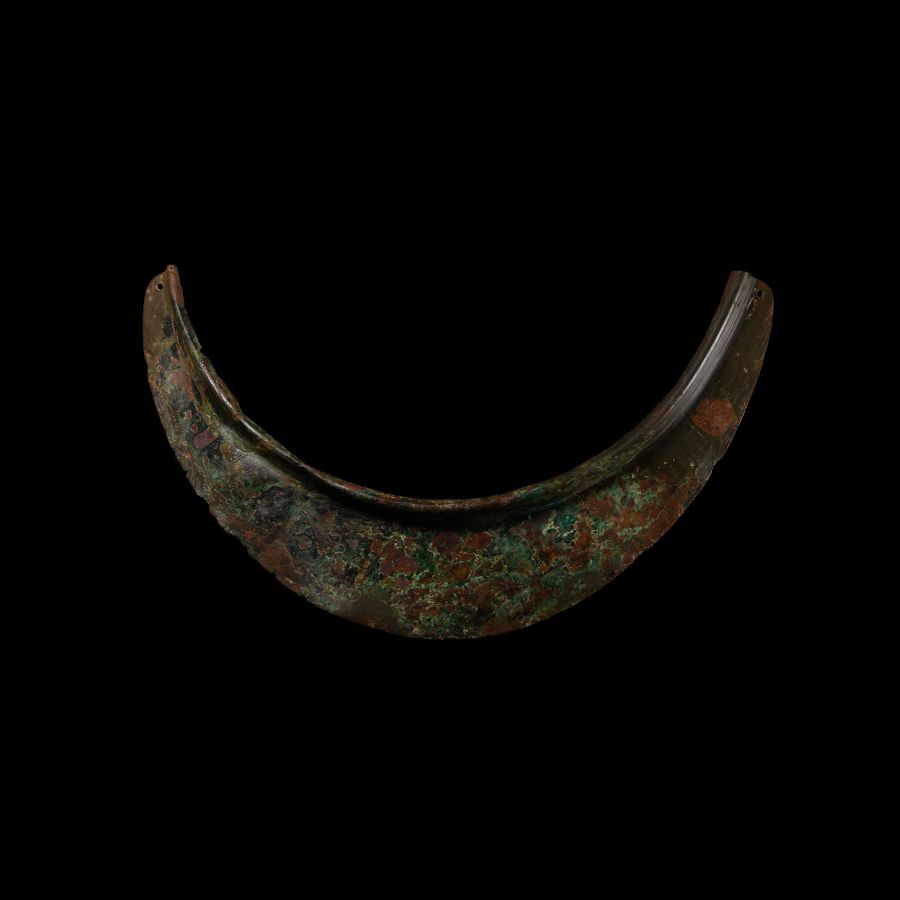
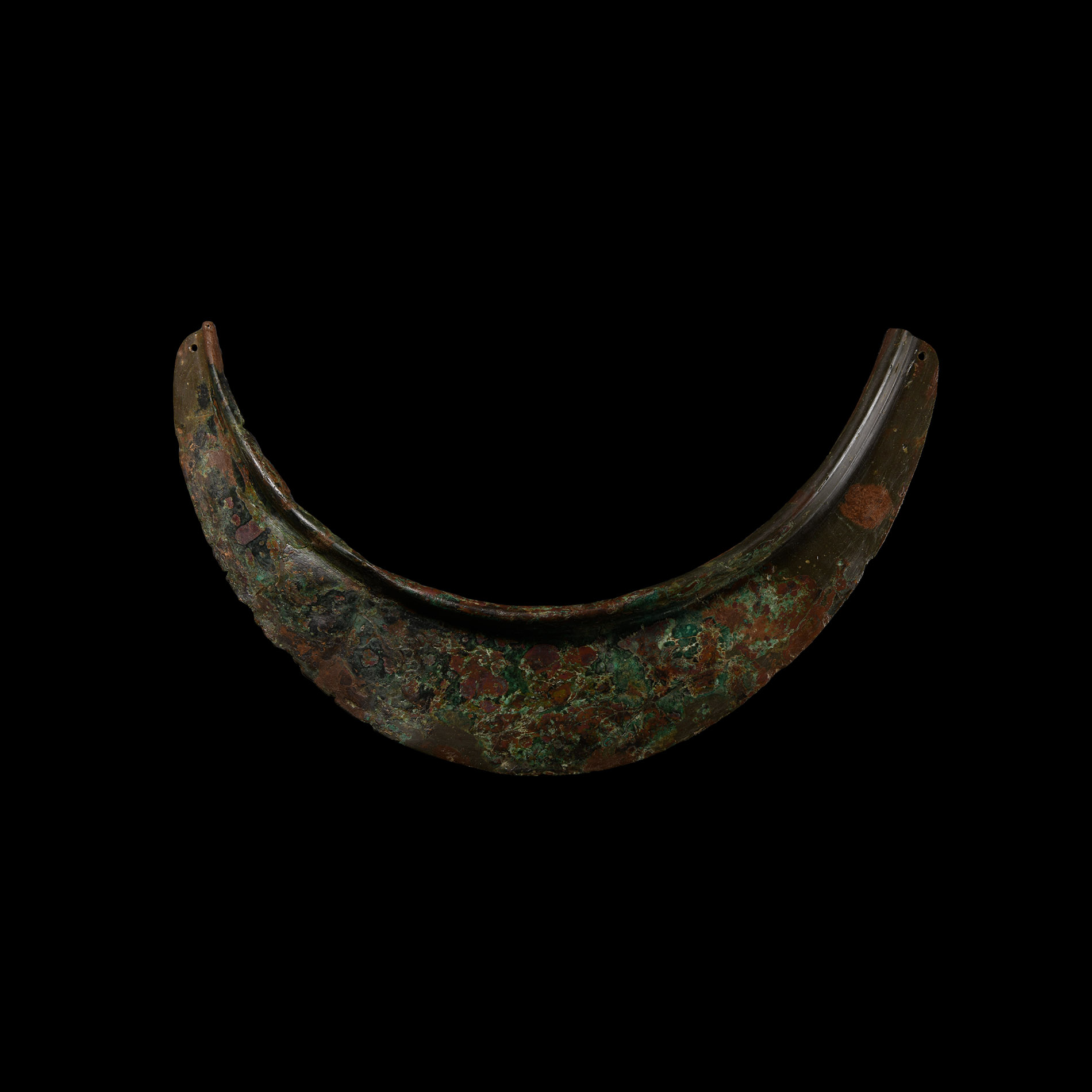
Greek Browband from Bronze Pseudo-Attic Helmet
3RD-2ND CENTURY B.C.
8 1/8 in. (42 grams, 20.6 cm).
Semi-circular in shape, flat, the upper part raised, the lower one fitted with two fastening holes for the attachment to the upper bowl of the helmet; restored.
ProvenancePrivate collection before 1937.
Private collection, acquired February 1937, thence by descent.
T.S. collection, UK, 1963.
Cf. Waurick, G., 'Helme der Hellenistiche Zeit und ihre Vorlaufer' in Antike Helme, RGZM Monographien 14, Mainz, 1988, pp.151ff., and item 50, p.439-440, for type; Dintsis, P., Hellenistiche Helme, Roma, 1986, pp.130,283ff., (I), pls 53, no.3 or 58, nos.1,2 (II).
FootnotesThe browband comes from a pseudo-Attic helmet of Thracian type (example from Brjastovec) or of a pseudo-Attic type with a high cap and fitted with a browband. These helmets, after prototypes already visible in the 5th century B.C., are typical of the Hellenistic era. The browband, if not fixed, was attached under the helmet's bowl, on the sides, by two rivets.
CONDITIONTimeLine Auctions follows a vetting process to ensure the authenticity and legality of all items, reinforcing our commitment to integrity and responsible trading. Each antiquity, antique, and coin lot undergoes thorough examination by a vetting committee of at least ten external specialists, professional trade association members, scientists, and archaeologists: Our Vetting Process
AUCTIONS:
TimeLine is a leading auction house specialising in antiquities, ancient art, collectables, natural history, coins, medals, and books. Our auctions offer museums, collectors, historians, and enthusiasts the opportunity to acquire unique and historically significant pieces.
-
.jpg)
Archaic Greek Modified Bronze Corinthian Helmet
Late 7th-early 6th century B.C.Estimate: £4,000 - 6,000 (+bp*)
Opening Bid: £2,000
Consisting of two sections joined with bronze rivets; above a domed section with row of rivets; below, a folded band with rolled rim, with rivets to the rear holding two halves; line of holes to the base for securing an inner lining. 2.2 kg total, 31.5 cm high including stand
Acquired in the 1970s. Ex private Austrian collection. The Kusmirek Collection, UK. Accompanied by an academic report by Dr Raffaele D'Amato. Accompanied by a metal analysis and appraisal by Dr Brian Gilmour. This lot has been checked against the Interpol Database of stolen works of art and is accompanied by search certificate number no.11764-203980.
The upper part of the helmet was probably modified in antiquity, the lower part of the eye holes and the cheek pieces have been cut away, and replacement cheek pieces, now lacking, were once crudely rivetted to the sides. -
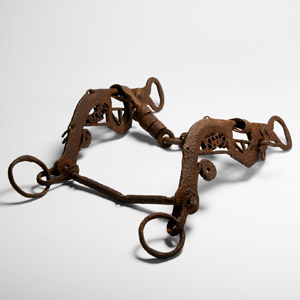
Byzantine Iron Horse Bit
14th-16th century A.D.Estimate: £250 - 350 (+bp*)
Opening Bid: £135
Composed of arched openwork shanks with looped terminals; one end fitted with large hoops and bar between; one end with a tripartite mouthpiece comprising two collared bars connected by a central hoop; Byzantine or early Ottoman. 340 grams, 19.5 cm
Fine condition.
Collection of Dr. Hanns-Ulrich Haedeke (1928-2017), author of ‘Schmuck Aus Drei Jahrtausenden’ and who became the director of the Museum of Klingenmuseum in Solingen, Germany, in 1968; the collection was formed in the early 1960s. From an important private Dutch collection.
This type of horse bit is visible on one of the most important equestrian artworks of the 15th century - the Cappella dei Magi by Benozzo Gozzoli, a painting representing the Three Kings visiting Christ, depicted in costumes belonging to the early quarter of 15th century. All the cavalrymen in the artwork had heavy curb-bits (with short and curved shanks, as in our specimen) and heavy, single reins. -
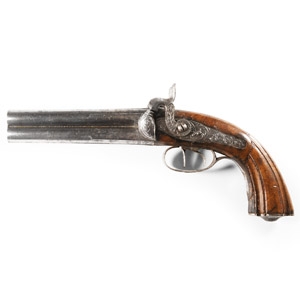
Italian Double-Barrelled Percussion Pistol
19th century A.D.Sold for (Inc. bp): £351
Double-barrelled, single action 9mm calibre smooth bored pistol with 13cm twin 'over-and-under' barrels fitted with twin hammers and triggers with guard, with floriate engraving; fitted with fluted wood stock and iron butt plate; action working. 445 grams, 26 cm
Acquired from Czerny's Auctions, Italy, 2016, lot 15. The Kusmirek Collection, UK. Accompanied by copies of the Czerny's paperwork.
Sold as an exempt item under Section 58 (2) of the Firearms Act, 1968, to be held as a curiosity or ornament. No license required but buyer must be over 18 years of age. Overseas bidders should note that, due to UK regulations governing export of all firearms, overseas buyers will need to make arrangements for shipping this lot out of the UK directly, by air freight, with a specialist company or agent.
