
Loading, please wait...
_900x900.jpg "Greek Bronze Illyrian Helmet")
_200x200.jpg "Greek Bronze Illyrian Helmet")
_900x900.jpg "Greek Bronze Illyrian Helmet")
_200x200.jpg "Greek Bronze Illyrian Helmet")
.jpg "Greek Bronze Illyrian Helmet")
.jpg "Greek Bronze Illyrian Helmet")
LOT 0253
Greek Bronze Illyrian Helmet
6TH-4TH CENTURY B.C.
12 1/4 in. (2.7 kg total, 31 cm high including stand).
Of domed Illyrian typology IIIA, variant 3, raised from a single sheet with protective cheek-pieces, two parallel corrugated raised ridges to the upper face, running over the crown from front to back, square-cut frontal opening with smooth edges, short curved rear flange developing from behind towards the forward curving cheek-protectors, the latter having two holes at the extremities for the fastening of a chin-strap; button pin at the centre of the back for attachment of a crest, pierced hole in the front for the corresponding pin.
ProvenanceEx Mr G. Grimm collection.
Acquired from a French auction house.
Ex important London gallery.
The Kusmirek Collection, UK.
Accompanied by an academic report by Dr Raffaele D'Amato
This lot has been checked against the Interpol Database of stolen works of art and is accompanied by search certificate number no.10194-167379.
See Pflug, H., 'Illirysche Helme' in Antike Helme, RGZM Monographien 14, Mainz, 1988, pp.43-64; Connolly, P., Greece and Rome at war, London, 1981; for an example of similar helmet with golden mask, from the grave 115 in Sindos, today in the archaeological Museum of Thessaloniki, see Pflug, 1988, p.60; an example with similar elements from the Axel Guttman collection (Christie's, 2004, p.80) showing the same long cheekpieces and short rear flange.
FootnotesThis helmet was probably fitted with a high crest, attached with animal glue and composed of horsehair. It was positioned inside a holder worn between the raised ridges and fastened to the front and back pins, one of them still visible. The recent finds of Illyrian helmets without reinforced edges have suggested that the variants of this typology of helmet could have evolved as their own group, during the late period of its employment (from mid 6th to 4th century B.C.). The earlier specimens have been found in Olympia and Trebeniste (North Macedonia), although the neck protection of these helmets was still in the style of archaic Illyrian types. The helmets from Sindos introduced the characteristics of such late evolution. The diffusion of this typology shows that it was preferred by Macedonian warriors, by the Illyrian fighters and by the Greeks in Sicily and Peloponnesos, considering that the finds are concentrated in the corresponding areas.
CONDITIONTimeLine Auctions follows a vetting process to ensure the authenticity and legality of all items, reinforcing our commitment to integrity and responsible trading. Each antiquity, antique, and coin lot undergoes thorough examination by a vetting committee of at least ten external specialists, professional trade association members, scientists, and archaeologists: Our Vetting Process
AUCTIONS:
TimeLine is a leading auction house specialising in antiquities, ancient art, collectables, natural history, coins, medals, and books. Our auctions offer museums, collectors, historians, and enthusiasts the opportunity to acquire unique and historically significant pieces.
LOT 0253
Greek Bronze Illyrian Helmet
Estimate £15,000 - 20,000€17,400 - 23,200 (for guidance only)$20,250 - 27,000 (for guidance only)
-
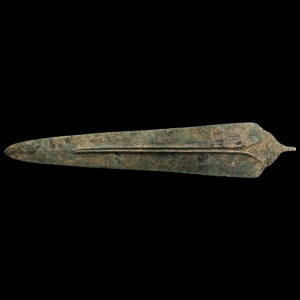
Luristan Bronze Short Sword Blade
1st millennium B.C.Sold for (Inc. bp): £130
Triangular profile with two parallel fullers tapering to a rounded tip, the tang forming an extension of the midrib. 194 grams, 30.7 cm
Ex German collection, Cologne, 1980-1990s.
The metalworking techniques used in making bronze weapons in Luristan were very complex. Surfaces were often finished in repoussé work, and some of the weapons were chased, others engraved. -
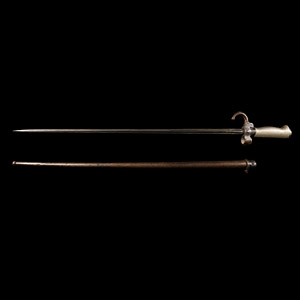
French Lebel 1886 Model 'Rosalie' Epee Bayonet with Scabbard
19th-20th century A.D.Sold for (Inc. bp): £52
Sword bayonet for use with the 8 mm M1886 Lebel rifle; fitted with 'German silver' grip scales; original scabbard. 532 grams, 65 cm
Property of a Luton, UK gentleman, by inheritance.
Known affectionately as “Rosalie” to French troops, the M1886 was the French mainstay during WWI and many were still in service at the Fall of France in 1940. The Lebel also saw extensive use worldwide by native troops in the French colonies. The M1886 introduced the distinctive cruciform blade, which remained a feature of most French bayonets until 1956. This example was made in 1890 at the Manufacture D'Armes St. Etienne (MAS). The scabbard was made by Manufacture Nationale d'Armes de Châtellerault (MAC). This is an early example that escaped later modifications, retaining its long blade, quillon, and raised round press stud. The silver-alloy grip is removable. -
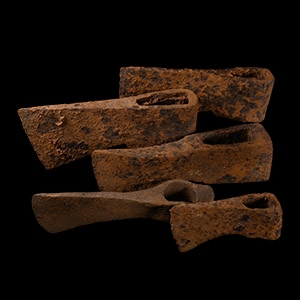
Medieval and Later Iron Axehead Collection
14th-18th century A.D.Sold for (Inc. bp): £117
Including socketted heads of various types, each with a convex cutting edge. 4.27 kg total, 12-19.2 cm
Acquired 1990s-early 2000s. East Anglian private collection.
