
Loading, please wait...
LOT 1429
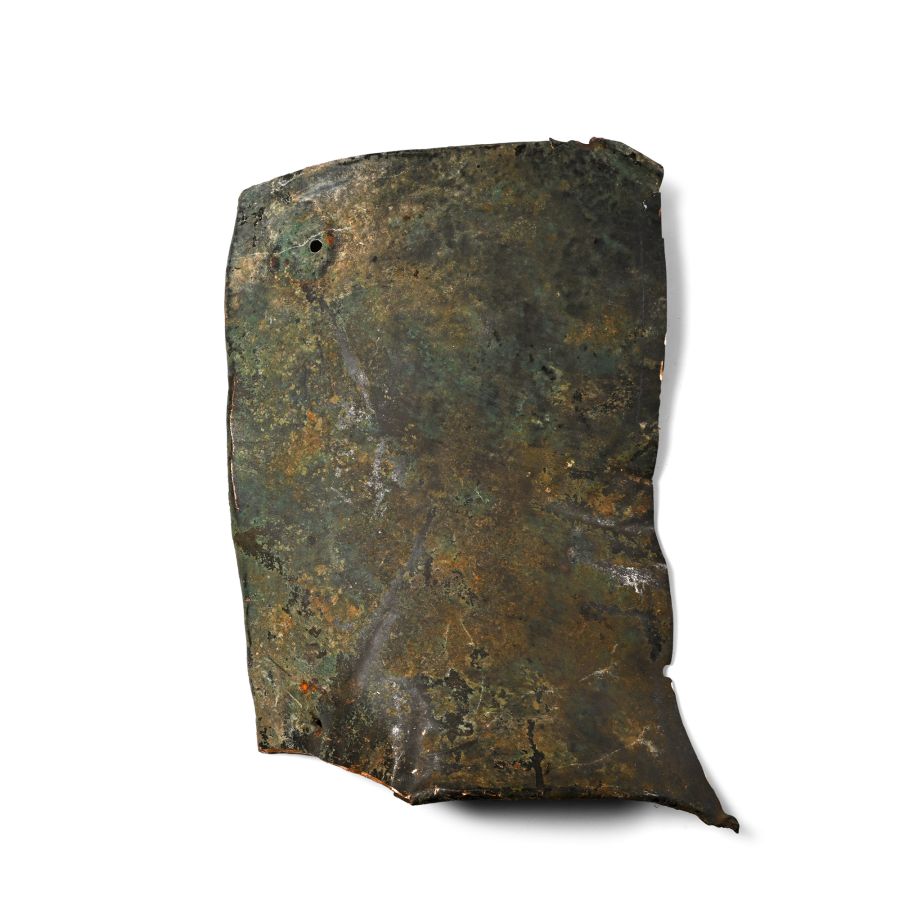
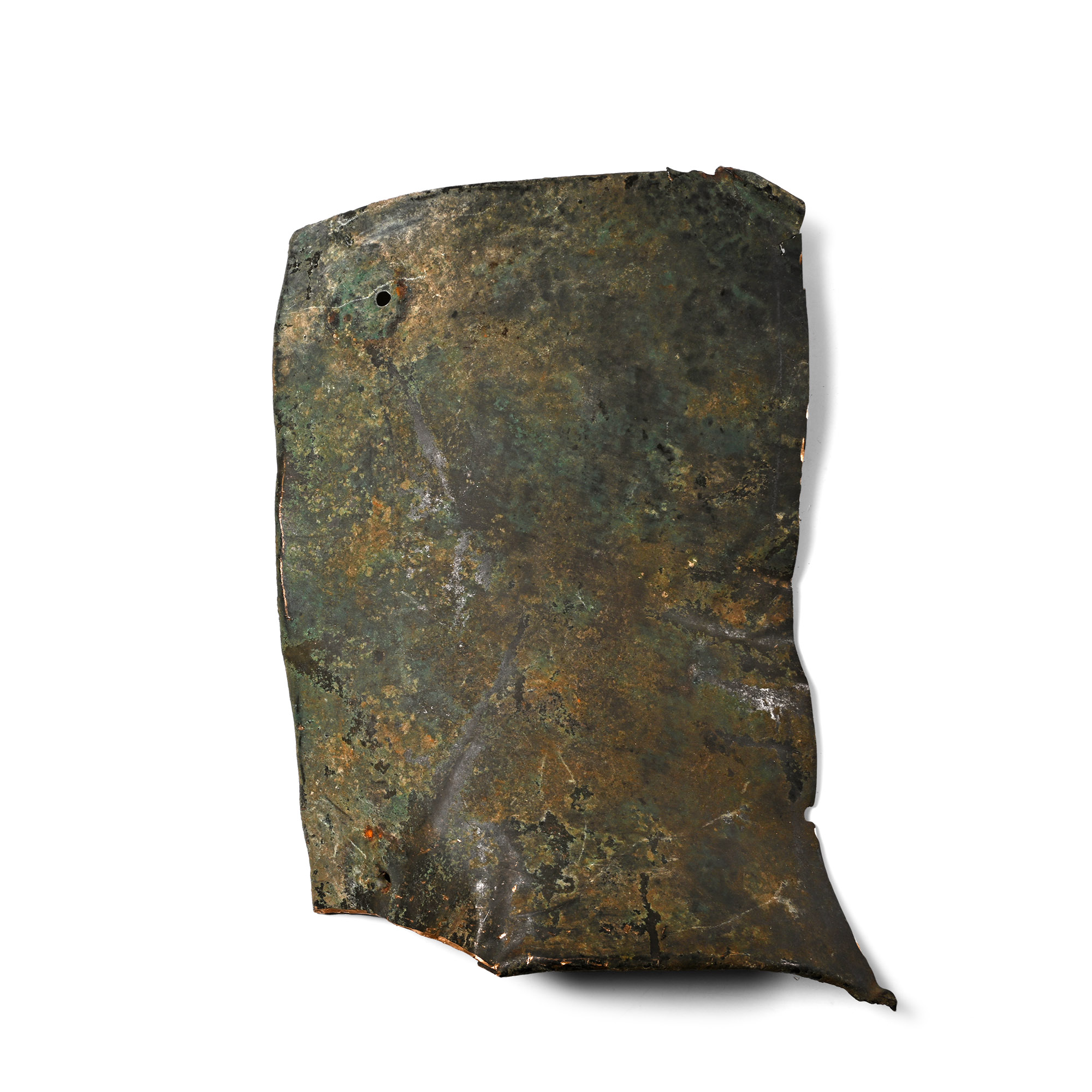
Greek Bronze Cuirass Section of Thorax Stadios
4TH-3RD CENTURY B.C.
8 5/8 in. (250 grams, 22 cm).
Possibly the lower left side element of a cavalry armour of thorax stadios (muscled armour) typology, upper, lower and external side with well preserved edge, fastening holes visible. [No Reserve]
ProvenanceUK private collection, acquired in 1996.
This lot is accompanied by an illustrated lot declaration signed by the Head of the Antiquities Department, Dr Raffaele D'Amato.
Cf. Connolly, P., Greece and Rome at War, London, 2006, figs.p.56, on the bottom, right.
FootnotesArmour for cavalrymen in classical Greece were specially designed with these characteristics. They were very broad on the hips to enable their wearers to sit a horse. Important parallels are known from South Italy, one of them preserved in the Bari Museum.
CONDITIONTimeLine Auctions follows a vetting process to ensure the authenticity and legality of all items, reinforcing our commitment to integrity and responsible trading. Each antiquity, antique, and coin lot undergoes thorough examination by a vetting committee of at least ten external specialists, professional trade association members, scientists, and archaeologists: Our Vetting Process
AUCTIONS:
TimeLine is a leading auction house specialising in antiquities, ancient art, collectables, natural history, coins, medals, and books. Our auctions offer museums, collectors, historians, and enthusiasts the opportunity to acquire unique and historically significant pieces.
-
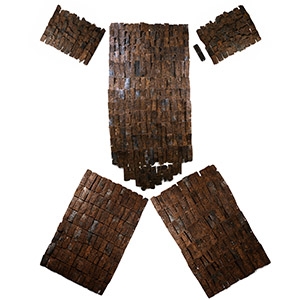
Jin Jurchen Warrior Signed Suit of Iron Plate Armour
Jin Dynasty, early 13th century A.D.Estimate: £8,000 - 10,000 (+bp*)
Opening Bid: £2,500
A complete suite of rectangular iron plates to form a protective coat; the plates provided with a series of holes close to the long edges by which they were laced together into articulating panels; one plate with inscription in Chinese script recording: 'first month of the Datong era / control of the propagation of Armour. Yanhui'. 8.5 kg total, 3-11.1 cm
From the private collection of a London gentleman, from his grandfather's collection formed before the early 1970s. Accompanied by a positive archaeometallurgy report by Dr Brian Gilmour PhD, Dip Cons, FSA, FCIFA, FRMS. Accompanied by an academic report by Dr Raffaele D’Amato. This lot has been checked against the Interpol Database of stolen works of art and is accompanied by a search certificate number no.12051-216403. This lot has been cleared against the Art Loss Register database, and is accompanied by an illustrated lot declaration signed by the Head of the Antiquities Department, Dr Raffaele D'Amato.
The Datong Era (大同, 1224–1233) is a name used for the reign of Puxian Wannu, a Jurchen warlord who established the Eastern Xia Dynasty in 13th century China. However, the war with the Jurchen states took more than 30 years: having first invaded the Jurchen borders in 1211, the Mongols finally defeated the Jin Empire only in 1234, while the Eastern Xia fell in 1246. -
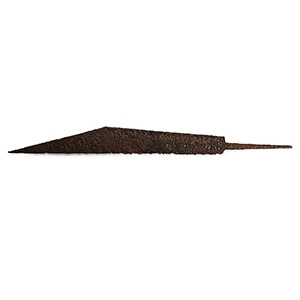
Large Viking Age Iron Broken-Backed Knife 'Seax' Blade
8th-10th century A.D.Sold for (Inc. bp): £117
With scooped forward edge, straight single edge and arched triangular back; transverse mounting tang. 208 grams, 37.5 cm
From a North American collection formed in the 1970s-1990s. This lot is accompanied by an illustrated lot declaration signed by the Head of the Antiquities Department, Dr Raffaele D'Amato.
This knife seems to be of type IV, like the one found in the Thames at Wandsworth. Based on its similarities with a specimen from Canterbury, it could be dated to the 8th century A.D. Underwood classifies these kind of knives under the typology C (angled back-curved cutting edge) dating them from the mid 6th to early 8th century A.D. -
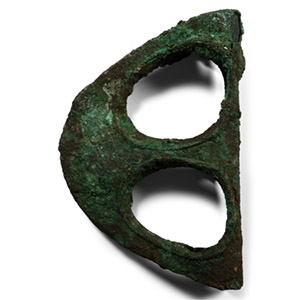
Canaanite 'Window' Bronze Axehead
2100-1800 B.C.Sold for (Inc. bp): £737
Curving blade with two large 'eye-shaped' openings, cylindrical socket. 142 grams, 11 cm
Acquired in the mid 1980s. Private collection, Switzerland, thence by descent. Private collection, since the late 1990s This lot is accompanied by an illustrated lot declaration signed by the Head of the Antiquities Department, Dr Raffaele D'Amato.
The ‘window’ axes have several morphological characteristics. The blade, semi-circular or elongated in shape, always ended in a rounded edge. In this type the blade was flat in section. It included two openings at its base—windows—of varying width, circular or oval. The haft consisted of a collar as wide as the blade. The weapon was threaded into an elongated wooden handle, often curved at its base, of oval section, with a differential width promoting the strength of the haft. It was thus wedged, and a rivet passed through the handle, just above the axe, serving as a stop.
