
Loading, please wait...
LOT 0255
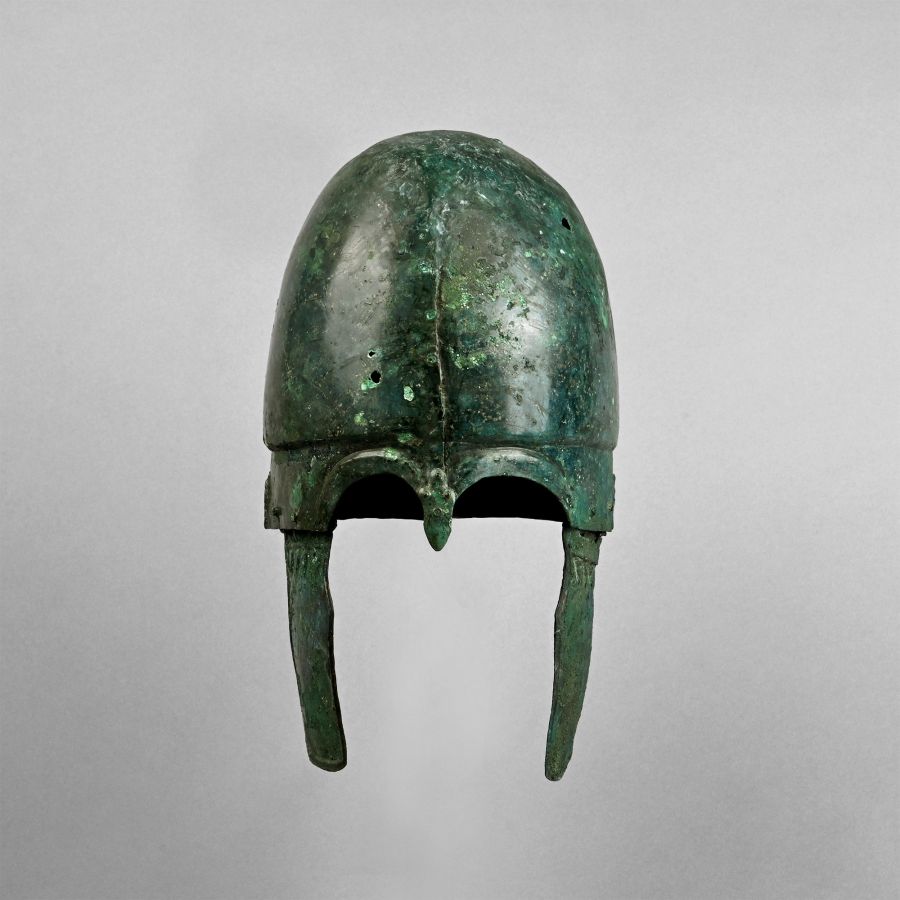
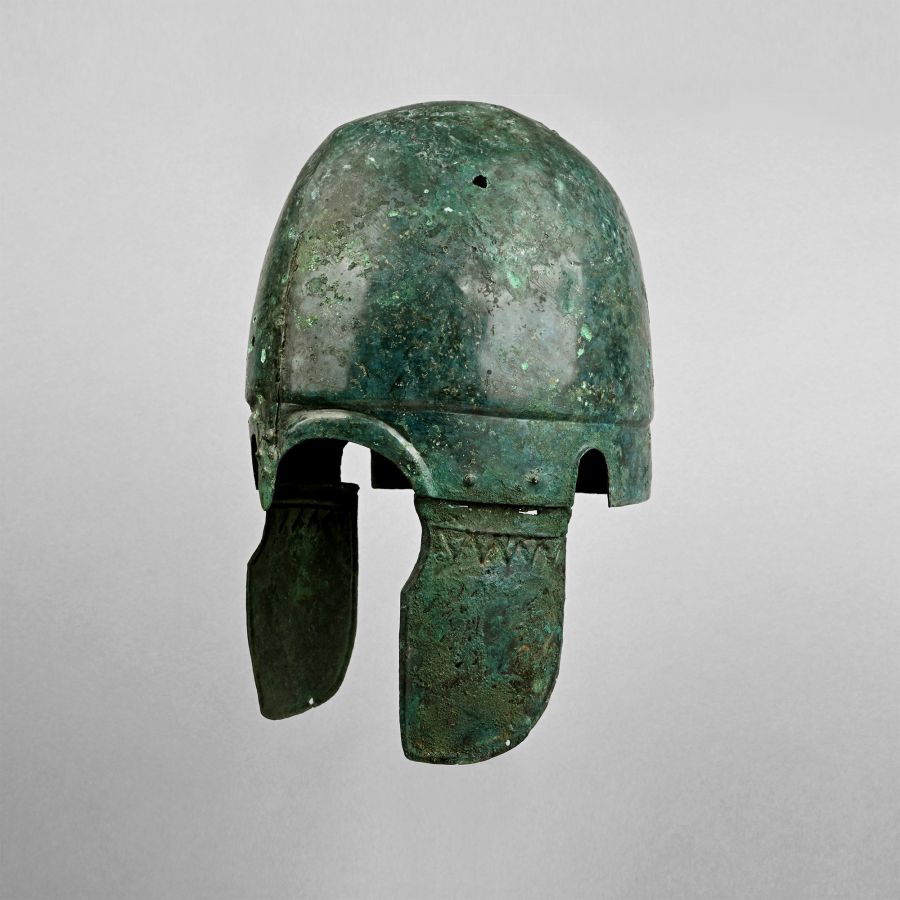
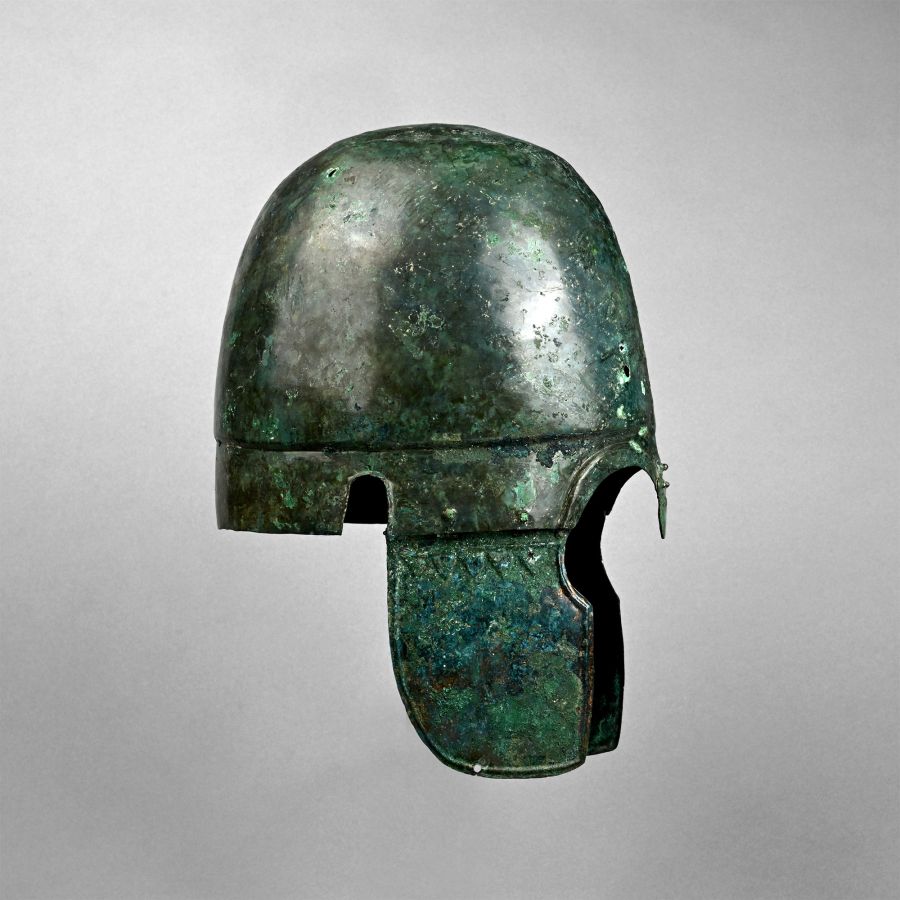
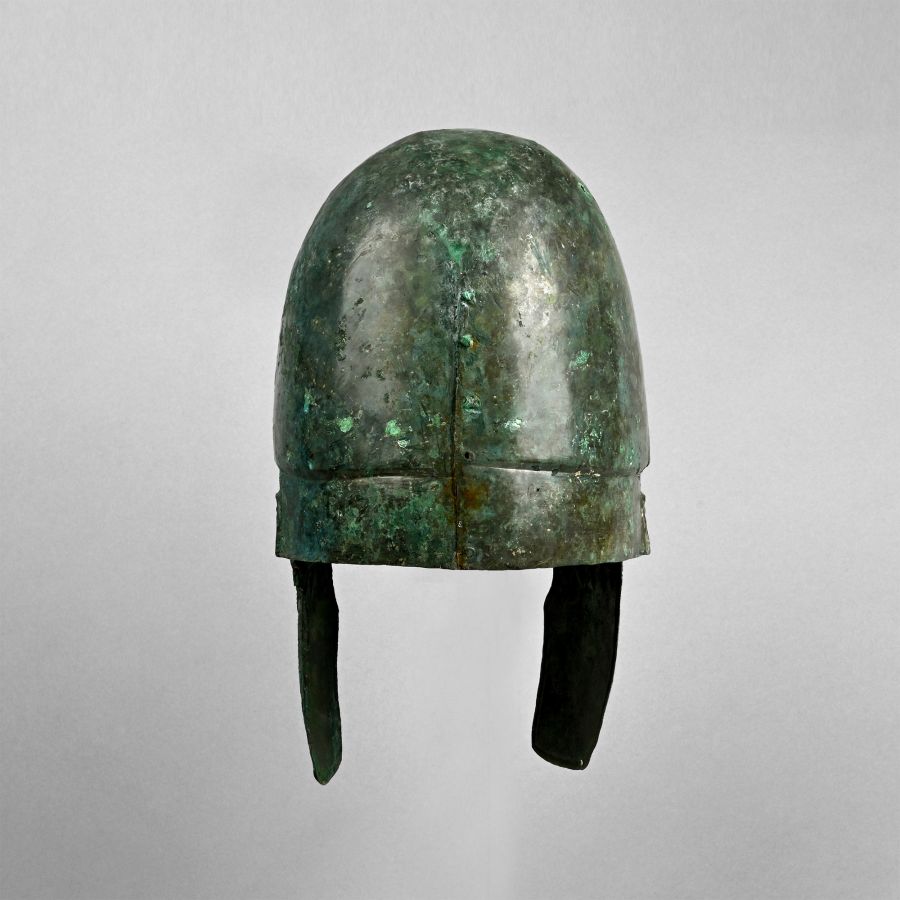
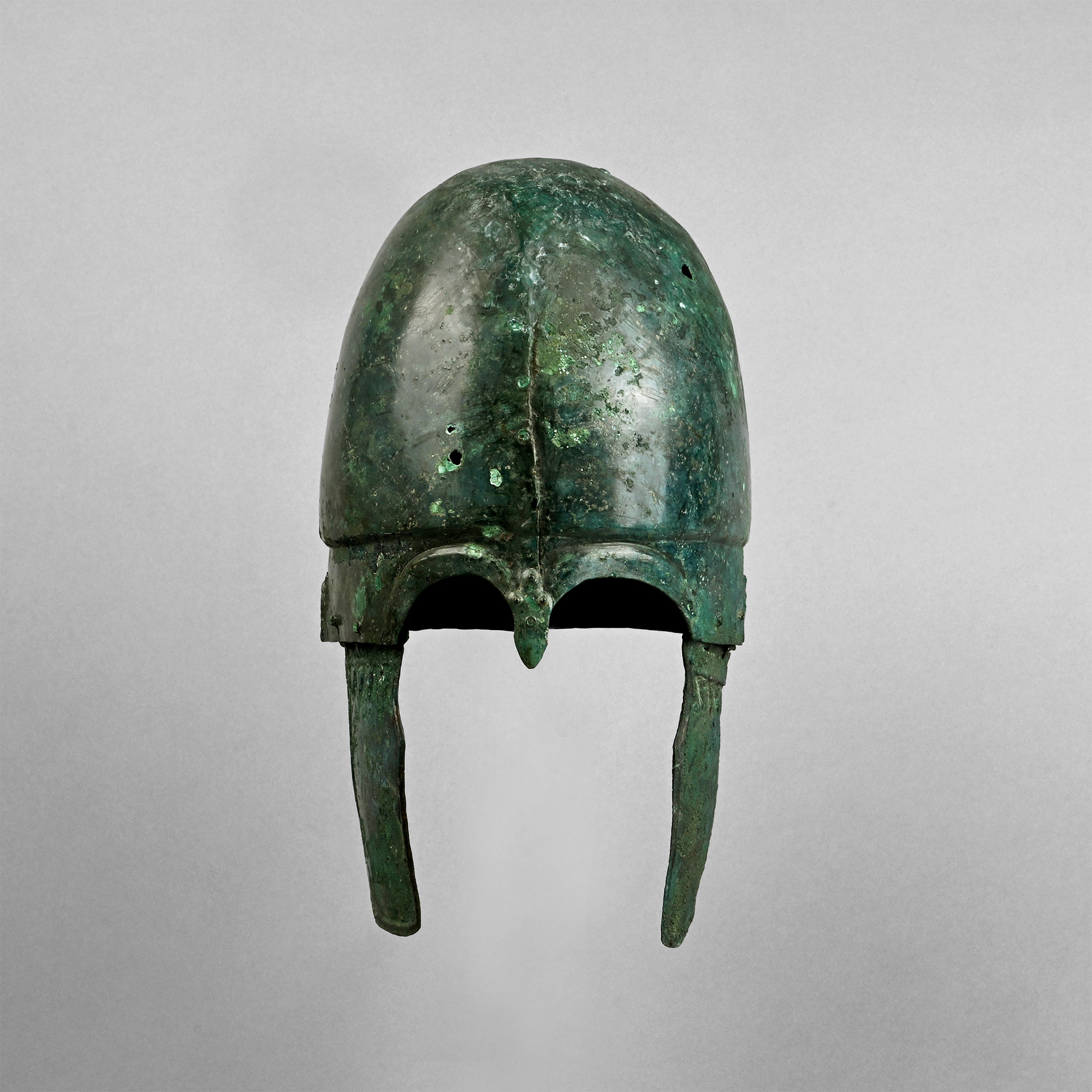
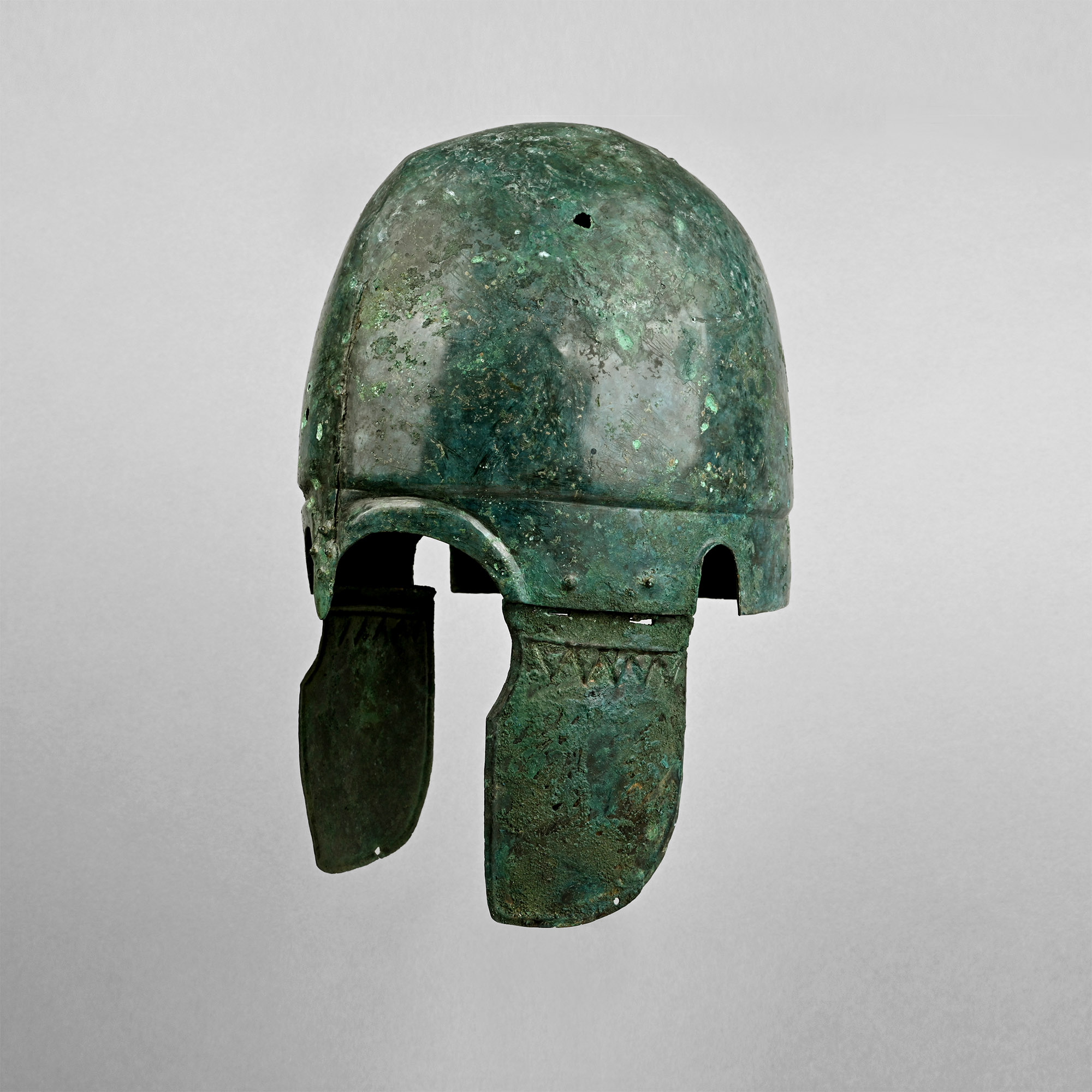
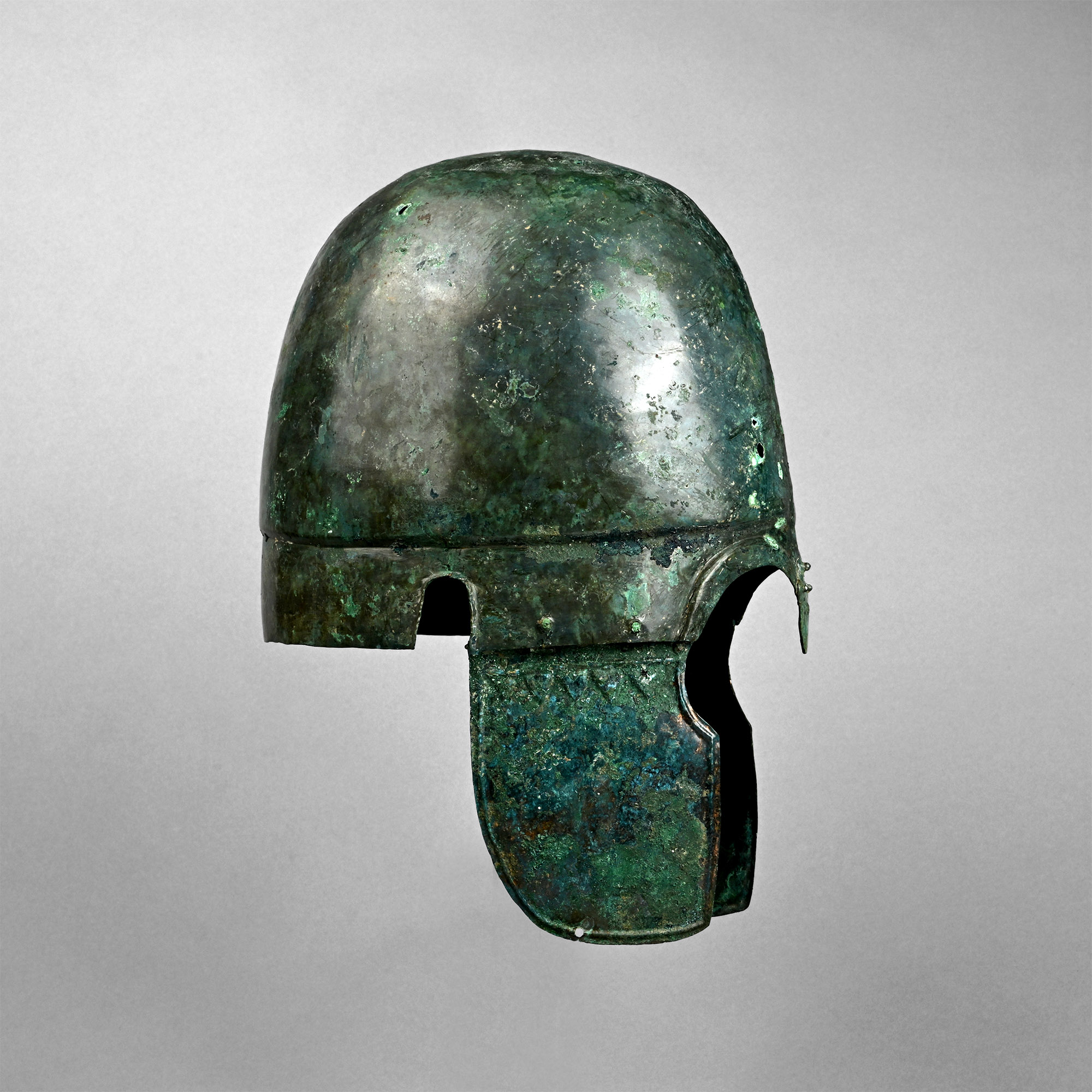
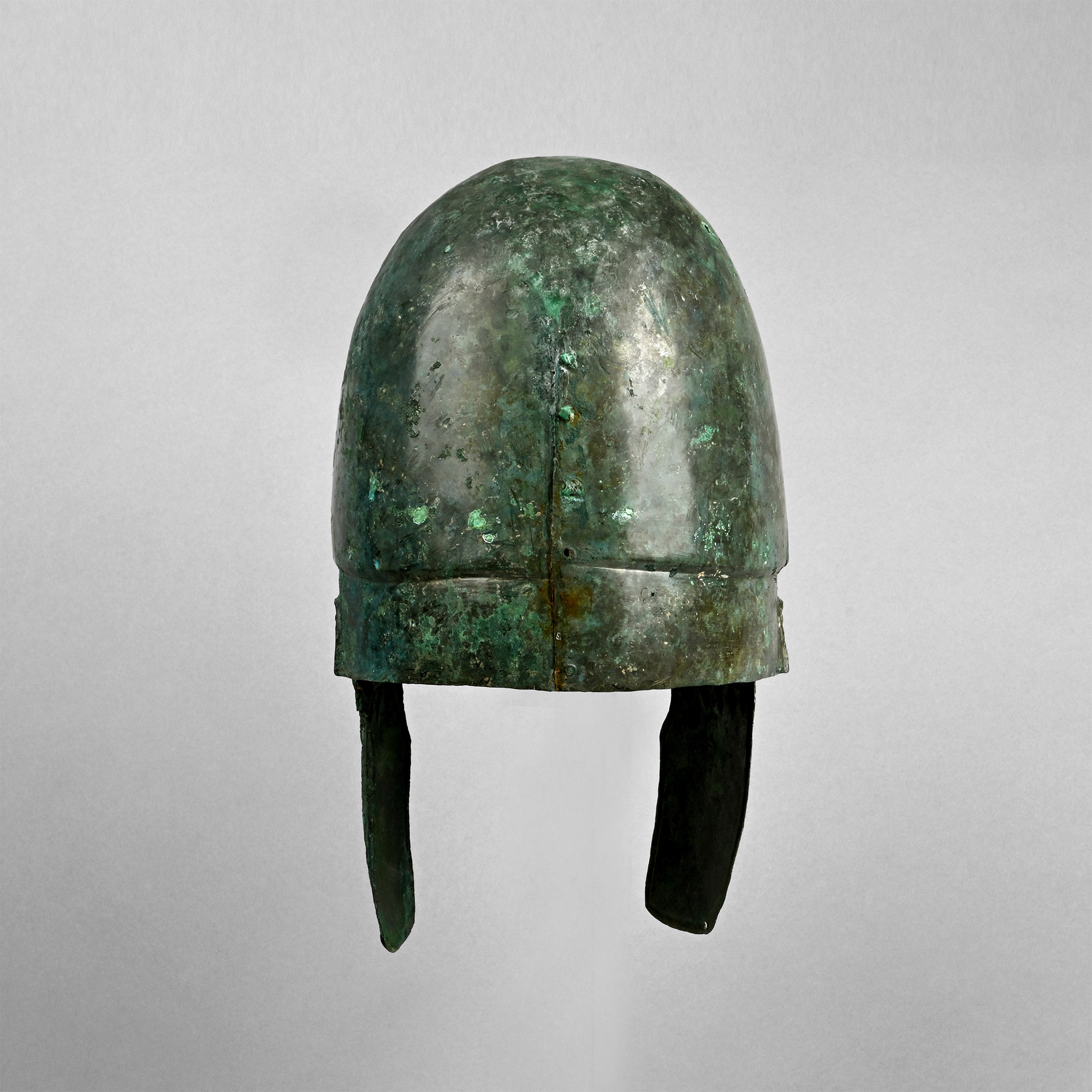
Greek Bronze Chalcidian-Type Helmet
CIRCA 5TH-4TH CENTURY B.C.
19 in. (1.46 kg total, 48 cm including stand).
Hammered from sheet-bronze, hemispherical dome with a seam at the front and back, the seams secured together with a series of pins, threaded through rivet holes; from the front, a repoussé ridge forming curved brows leading down towards a nasal decorated with four pellets; two small perforations above the right brow and a perforation on either side of the top section; two cheek guards present, a characteristic of the helmet’s type, attached to the helmet with hinges, allowing for easier wear and construction; the cheek-pieces rectangular in shape and curved at the back; a horizontal band of inverted triangles decorating the top of each cheek guard, each pierced towards the bottom, where an inner lining would have been attached, two curved cut-outs behind to accommodate ears; accompanied by a custom-made display stand.
ProvenancePreviously with the Parthenon Gallery, WC1, London, UK; acquired 2010.
From the J.L. collection, Surrey, UK.
Accompanied by an academic report by Dr Raffaele D'Amato.
This lot has been checked against the Interpol Database of stolen works of art and is accompanied by search certificate number no.12909-244364.
Cf. Pflug, H., 'Chalkidische Helme' in Antike Helme, RGZM Monographien 14. Mainz, 1988, 137-150; Simonenko, А. V., 'Шлемы сарматского времени из Восточной Европы' (Sarmatian Age Helmets from Eastern Europe, in Russian), in Stratum Plus, n. 4, 2014, pp. 249-284, fig.13, nos.1-2-3; Hixenbaugh, R., Ancient Greek Helmets, a complete guide and catalogue, New York, 2019, fig.X244.
FootnotesThe Chalcidian helmet was a popular type of helmet in the Hellenistic world, particularly in the Greek-occupied region of southern Italy, during the 5th and 4th centuries. However, types have also been found from the mid-6th century BC. It was a lightweight progression from the Corinthian helmet and allowed the wearer better hearing and vision than its older, bulkier Corinthian counterparts. The term ‘Chalcidian’ originates from its frequent depiction on pottery once thought to have come from the Euboean city of Chalcis. This variant of the Chalcidian helmet, featuring hinged cheekplates, is also known as the Lucanian type, as it was used extensively in Lucania. This type of helmet was still in use by the time of Alexander the Great, particularly by the hoplites, heavy infantrymen, and is thought to have developed into the Attic helmet, used well into the Imperial Roman era.
CONDITIONTimeLine Auctions follows a vetting process to ensure the authenticity and legality of all items, reinforcing our commitment to integrity and responsible trading. Each antiquity, antique, and coin lot undergoes thorough examination by a vetting committee of at least ten external specialists, professional trade association members, scientists, and archaeologists: Our Vetting Process
AUCTIONS:
TimeLine is a leading auction house specialising in antiquities, ancient art, collectables, natural history, coins, medals, and books. Our auctions offer museums, collectors, historians, and enthusiasts the opportunity to acquire unique and historically significant pieces.
LOT 0255
Greek Bronze Chalcidian-Type Helmet
Estimate £12,000 - 17,000€13,920 - 19,720 (for guidance only)$16,200 - 22,950 (for guidance only)
-
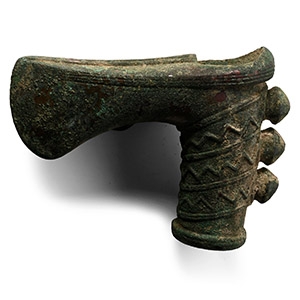
Elamite Decorated Bronze Axehead
2nd-1st millennium B.C.Estimate: £500 - 700 (+bp*)
Opening Bid: £250
With a slender, scooped blade, a round socket with a ribbed outer flange, and three lobed extensions to the rear of the socket with low-relief decorative bands. 360 grams, 10.4 cm
French collection, 1980s. Acquired on the London art market. Private collection, London, UK. -
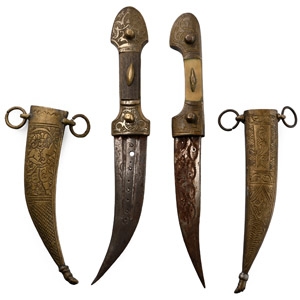
Western Asiatic Style Dagger Group
20th century A.D.Sold for (Inc. bp): £208
Each a curved steel blade with two fullers, stamped ornament; waisted bronze grip with applied bone panels, tendril ornament; cast scabbard with suspension rings, advancing warrior with scimitar to each face. 425 grams total, 23.2-23.7 cm
Acquired during the 1960s. From an old North London oriental and ethnographical collection. From the property of a late Lincolnshire, UK, gentleman. -
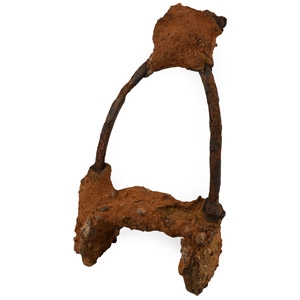
Anglo-Scandinavian Viking Iron Stirrup
Circa 11th century A.D.Sold for (Inc. bp): £416
D-shaped stirrup with square-section frame, rectangular footplate with projections to the underside, accretion to the suspension loop at the top. 948 grams, 25.5 cm high
Found whilst searching with a metal detector in Harling, Breckland, Norfolk, on Monday 5th February 2024. Accompanied by a copy of the British Museum's Portable Antiquities Scheme (PAS) report no.NMS-396237.
