
Loading, please wait...
LOT 0251
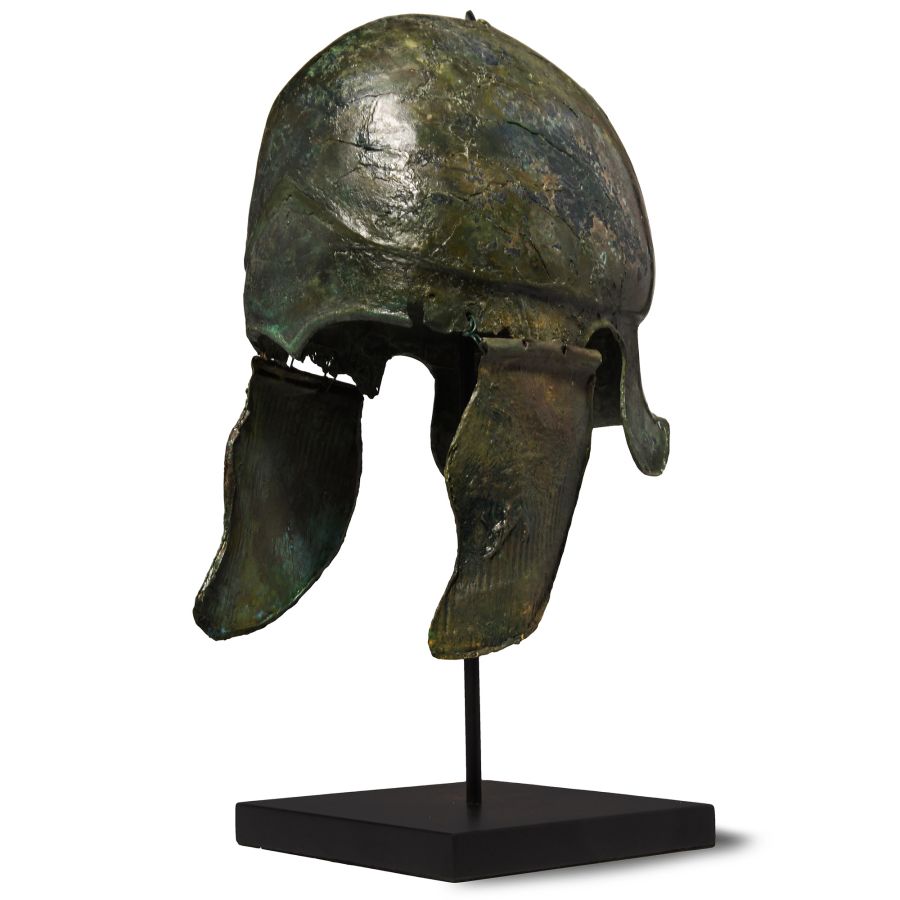
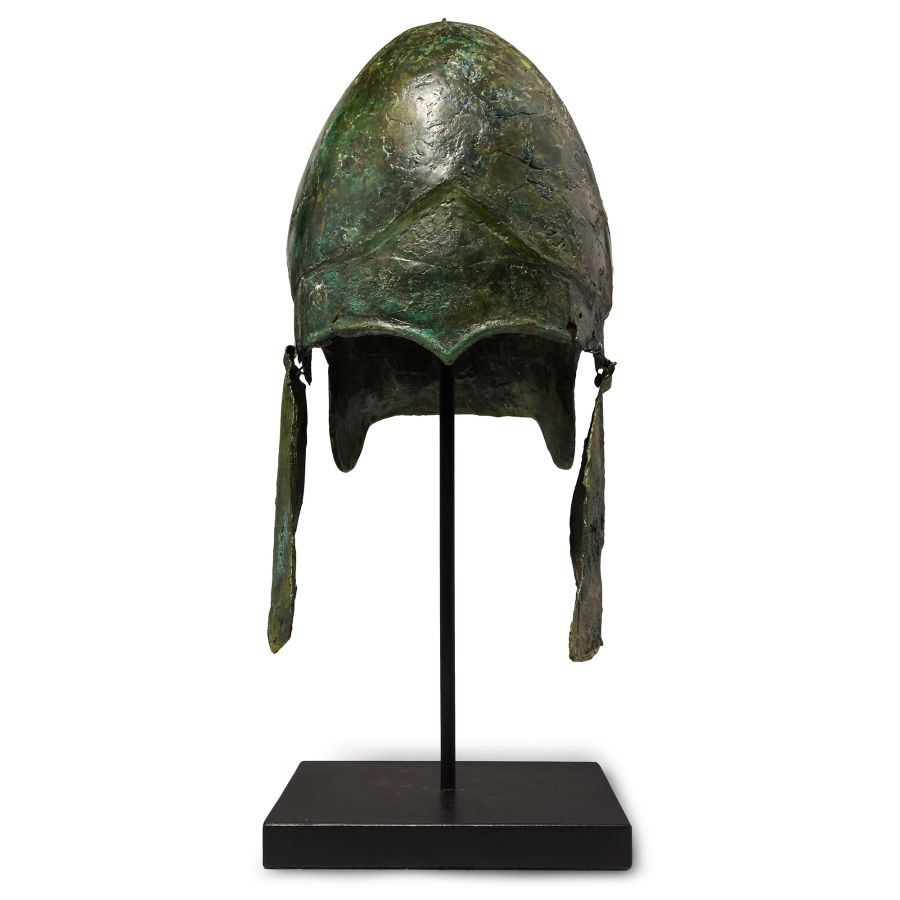
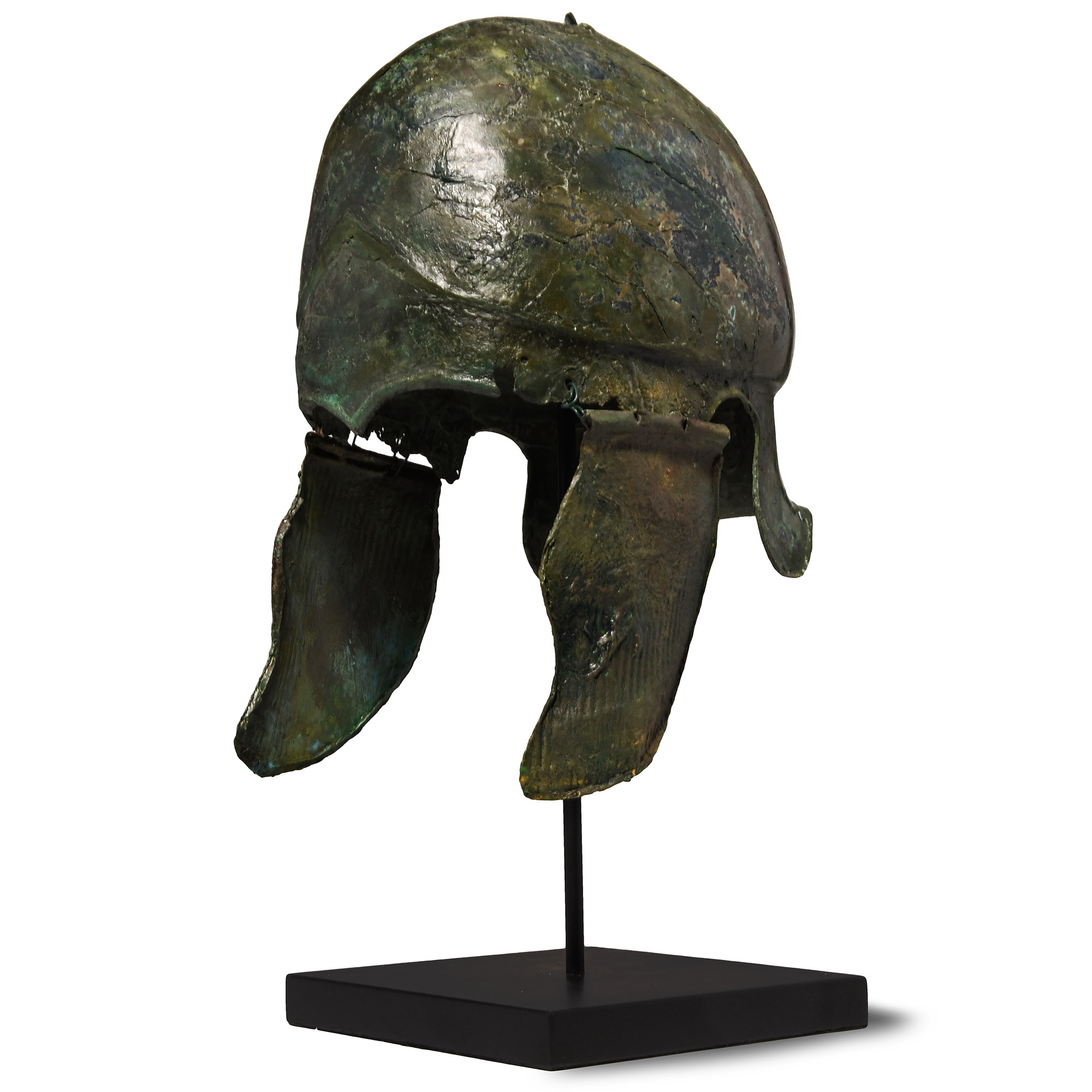
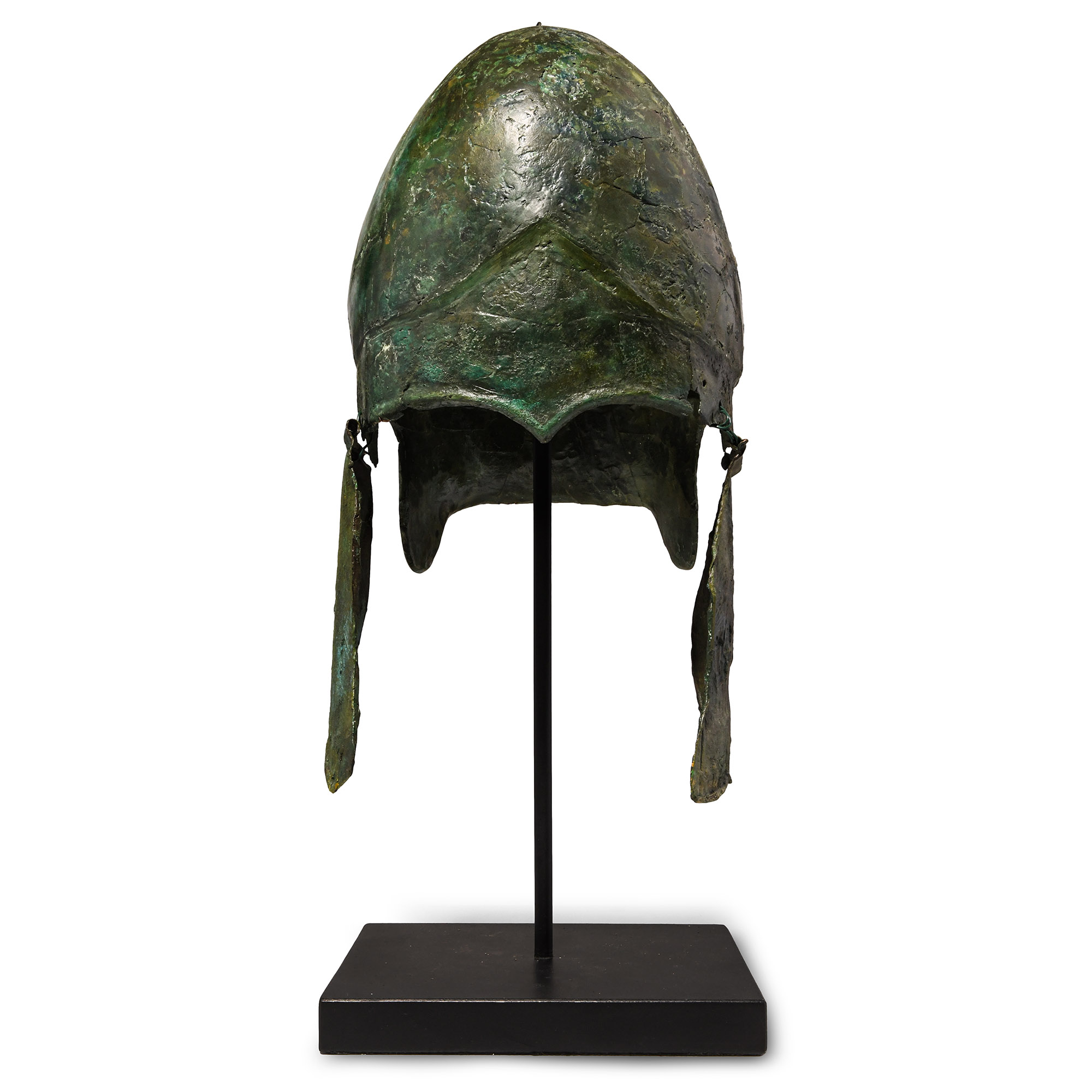
Greek Bronze Chalcidian Helmet
5TH-4TH CENTURY B.C.
16 1/2 in. (2.7 kg total, 42.5 cm high including stand).
Of Kunze Group VII, formed from two curved segments, each with a flared rim, nasal, raised panels to the upper section of the bowl, repoussé ridge forming curved brows, a recess for the ear to each side; star-shaped attachment to the top with slot for plumes; restored and with replica cheek pieces.
ProvenanceAcquired in the 1970s.
Ex private Austrian collection.
The Kusmirek Collection, UK
Accompanied by an academic report by Dr Raffaele D'Amato.
Accompanied by a report of metallurgical analytical results, written by metallurgist Dr Brian Gilmour of the Research Laboratory for Archaeology and History of Art, University of Oxford.
This lot has been checked against the Interpol Database of stolen works of art and is accompanied by search certificate number no.11763-203979.
Cf. Pflug, H., 'Chalkidische Helme' in: Antike Helme, RGZM Monographien 14, Mainz, 1988, pp.137-150; Hixenbaugh, R., Ancient Greek Helmets, a complete guide and catalogue, New York, 2019, figs.X185-X229; see also Chernenko, E.V., The Scythians 700-300 BC, Hong Kong, 1998.
FootnotesAmong the Chalcidian helmet types, the fifth and last typology, corresponding to the Kunze group VII (Pflug, 1988, p.138), was characterised by the presence of detached cheek-guards. By the end of the 5th century BC, the fixed cheek-pieces had been entirely abandoned on the Chalcidian helmets for the more versatile hinged cheek pieces. As is the case with most of the Greek helmets in 5th and 4th century B.C., very few originals have been found on the Greek continent. Several district regional workshops produced such helmets by the 5th century B.C.: mainland Greece, the Black Sea Coast, Thrace, Southern Italy and Iberia.
CONDITIONTimeLine Auctions follows a vetting process to ensure the authenticity and legality of all items, reinforcing our commitment to integrity and responsible trading. Each antiquity, antique, and coin lot undergoes thorough examination by a vetting committee of at least ten external specialists, professional trade association members, scientists, and archaeologists: Our Vetting Process
AUCTIONS:
TimeLine is a leading auction house specialising in antiquities, ancient art, collectables, natural history, coins, medals, and books. Our auctions offer museums, collectors, historians, and enthusiasts the opportunity to acquire unique and historically significant pieces.
LOT 0251
Greek Bronze Chalcidian Helmet
Estimate £4,000 - 6,000€4,640 - 6,960 (for guidance only)$5,400 - 8,100 (for guidance only)
-
Byzantine Iron Horse Bit
14th-16th century A.D.Estimate: £250 - 350 (+bp*)
Opening Bid: £135
Composed of arched openwork shanks with looped terminals; one end fitted with large hoops and bar between; one end with a tripartite mouthpiece comprising two collared bars connected by a central hoop; Byzantine or early Ottoman. 340 grams, 19.5 cm
Fine condition.
Collection of Dr. Hanns-Ulrich Haedeke (1928-2017), author of ‘Schmuck Aus Drei Jahrtausenden’ and who became the director of the Museum of Klingenmuseum in Solingen, Germany, in 1968; the collection was formed in the early 1960s. From an important private Dutch collection.
This type of horse bit is visible on one of the most important equestrian artworks of the 15th century - the Cappella dei Magi by Benozzo Gozzoli, a painting representing the Three Kings visiting Christ, depicted in costumes belonging to the early quarter of 15th century. All the cavalrymen in the artwork had heavy curb-bits (with short and curved shanks, as in our specimen) and heavy, single reins. -
Roman Iron Dagger with Ring Pommel
Circa 2nd-3rd century A.D.Sold for (Inc. bp): £1,170
Featuring a distinctively shaped ring at the end of the grip, double-edged relatively short blade and a tapered tip. 376 grams, 58 cm
Acquired 1990s-early 2000s. East Anglian private collection. Accompanied by an academic report by Dr Raffaele D'Amato.
This kind of sword - called by modern scholars as ringknaufschwert or ring-pommel sword - was firstly diffused amongst the auxiliary troops, probably Sarmatians and Germans, and then, during the 2nd century A.D., was also commonly used amongst the milites legionis and the officers. The shape of their blades is similar to the Pompey typology, but a slightly less acute angle characterises the passage from the blade to the short point. There were longer specimens like spatha, opening the transformation of the legionary gladius in the longer spatha specimens of the successive period, and also shorter specimens. An important dating element for earlier specimens is the sword from the Matrica grave, in Pannonia, dated exactly to 147 A.D. based on the other grave goods. Specimens of the second half of 2nd century A.D. are known from Wehringen and Geneva (180 A.D.). A specimen from Bosnia could be chronologically assigned to the same period, although such kind of swords became much more widespread for infantry and cavalry in later times. However, the importance of such swords has been recently associated with the rank of the provincial officers who used them, including miniature variations of such swords used as pendants as insignia badge of the staff of the Provincial governors. It was connected with the image of the sword and the dagger as a symbol of the Imperial power. -
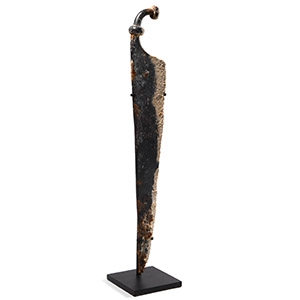
Iron Age Celtic La Tene Dagger
1st century B.C.-1st century A.D.Estimate: £1,200 - 1,700 (+bp*)
Opening Bid: £500
Featuring a gently curved single-edged iron blade and one-sided fuller, curved handle with knot pommel; mounted on a custom-made display stand. 525 grams total, 35 cm high including stand
Dutch art market. Private collection of K.S., Cologne, Germany, acquired 1996.
One of the military insignia of a Celtic warrior was the war-knife, usually between 33 and 35 cm long. For example, in the collection of Celtic military equipment from Galish-Lovachka, the archaeologists have found a short sword with an X-shaped handle (l = 41 cm), two middle La Tène swords (72.5 and 75 cm long), 12 large curved knives, 27 spearheads, two javelin heads, 14 arrowheads, and nine iron chain belts for hanging a sword. The war-knife was also used for hunting, as a spare weapon, or to cut the throat of an enemy in a surprise attack.
