
Loading, please wait...
LOT 0537
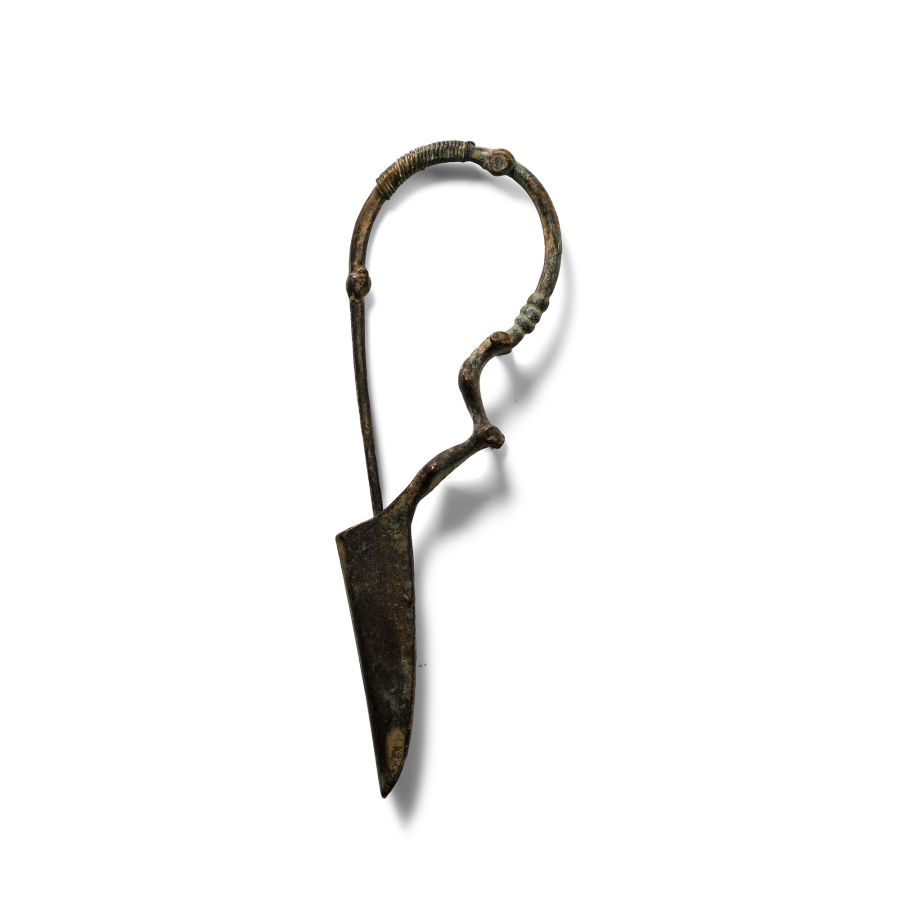
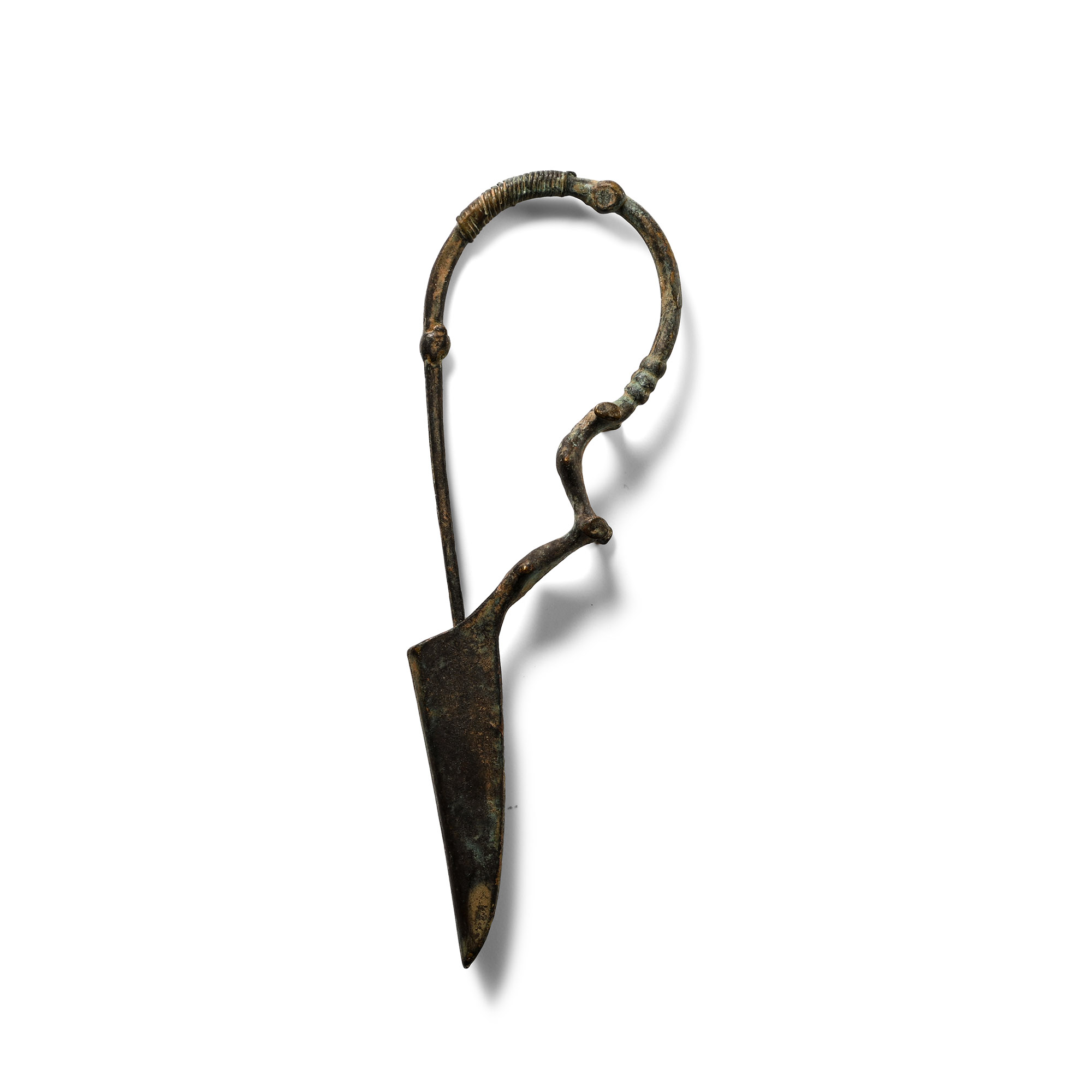
Greek Bronze Brooch
4TH CENTURY B.C.
3 5/8 in. (10 grams, 92 mm).
Comprising a deep bow with coiled wire above the pin, scooped forward section with lateral lugs, triangular catchplate.
ProvenanceAcquired on the German art market, 1989-1995.
with The Museum Gallery, 19 Bury Place, London, WC1, UK, 1998-2003.
Property of a London based academic, 2003 to present.
This lot is accompanied by an illustrated lot declaration signed by the Head of the Antiquities Department, Dr Raffaele D'Amato.
Cf. Beck, H. et al., Fibel und Fibeltracht, Berlin, 2000, abb.95, for type.
CONDITIONTimeLine Auctions follows a vetting process to ensure the authenticity and legality of all items, reinforcing our commitment to integrity and responsible trading. Each antiquity, antique, and coin lot undergoes thorough examination by a vetting committee of at least ten external specialists, professional trade association members, scientists, and archaeologists: Our Vetting Process
AUCTIONS:
TimeLine is a leading auction house specialising in antiquities, ancient art, collectables, natural history, coins, medals, and books. Our auctions offer museums, collectors, historians, and enthusiasts the opportunity to acquire unique and historically significant pieces.
-
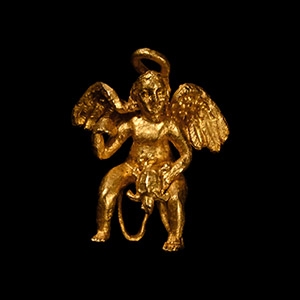
Greek Gold Eros Holding a Turtle Pendant
4th century B.C.Sold for (Inc. bp): £4,420
A delicately crafted pendant depicting a seated Eros with spread wings, holding a small turtle with his left hand and his right hand raised, feather detailing to wings and carefully modelled face with a smiling expression; a double suspension loop underneath and a single loop above; likely from an earring. 1.41 grams, 13 mm
Solothurn exhibition catalogue 1967, no.421. Notable Swiss private scholarly collection. with Galerie Rhéa, Zurich, Switzerland. This lot has been checked against the Interpol Database of stolen works of art and is accompanied by a search certificate number no.12671-236392. This lot has been cleared against the Art Loss Register database, and is accompanied by an illustrated lot declaration signed by the Head of the Antiquities Department, Dr Raffaele D'Amato. -

Large Attic Greek Terracotta Statue of Kore with Sea Encrustations
5th century B.C.Sold for (Inc. bp): £3,510
Hollow-form and standing on a pedestal with her right knee slightly bent, both hands holding the edges of her flowing peplos, wearing a polos crown, naturalistic detailing to face; traces of pigment remaining, a rectangular cut-out on her back. 604 grams, 31.5 cm
From the collection of Pierre and Claude Vérité, Paris, France, acquired between 1930 and 1960. with Christie's, Paris, Collection Pierre et Claude Vérité, 20 December 2011, no.121 (part). Ex Galerie Günter Puhze GmbH, Germany, 2012. Private collection, Bern, Switzerland. Accompanied by copies of the relevant Christie's catalogue pages. This lot has been checked against the Interpol Database of stolen works of art and is accompanied by a search certificate number no.12664-236370. This lot has been cleared against the Art Loss Register database, and is accompanied by an illustrated lot declaration signed by the Head of the Antiquities Department, Dr Raffaele D'Amato. -

Etruscan Impasto 'Spiral' Amphora
7th century B.C.Sold for (Inc. bp): £715
Comprising a bulbous body and a short neck with everted rim, two strap handles with incised striations continuing in an inverted V-shape beneath the handles; on each side of the body a large double spiral flanked by five curving lines, a stylised bird above. 343 grams, 16.5 cm
Ex Fortuna, Gallery for Ancient Art (Zurich, Kirchgasse 31) Basel, 7 April 1984. Private collection, Bern, Switzerland. This lot is accompanied by an illustrated lot declaration signed by the Head of the Antiquities Department, Dr Raffaele D'Amato.
With the arrival of the Greeks (775 B.C. at Pithekoussai, 750 B.C. at Cumae), a clear technical advancement in ceramic production was observed: impasto vessels began to show more varied patterns, were fired at higher temperatures, and were eventually replaced by wheel-made pottery in the Greek style. Despite growing populations, there remained a significant demand for this more 'old-fashioned' yet technically refined pottery. Note on the term impasto (Italian): in painting, it refers to the thick application of paint (a textured, paste-like technique). In ceramics, it refers to a thick layer of slip (a watered suspension of purified clay) applied before firing, which results in a homogenous, matte-glossy surface after firing.
