
Loading, please wait...
LOT 1158
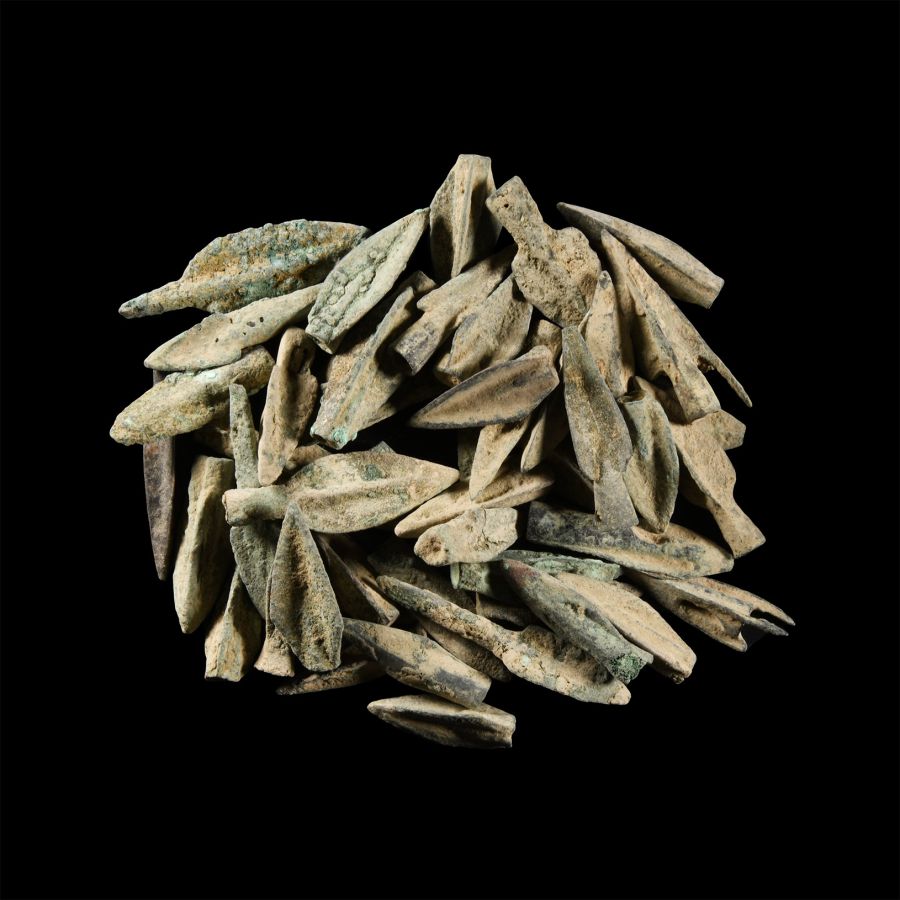
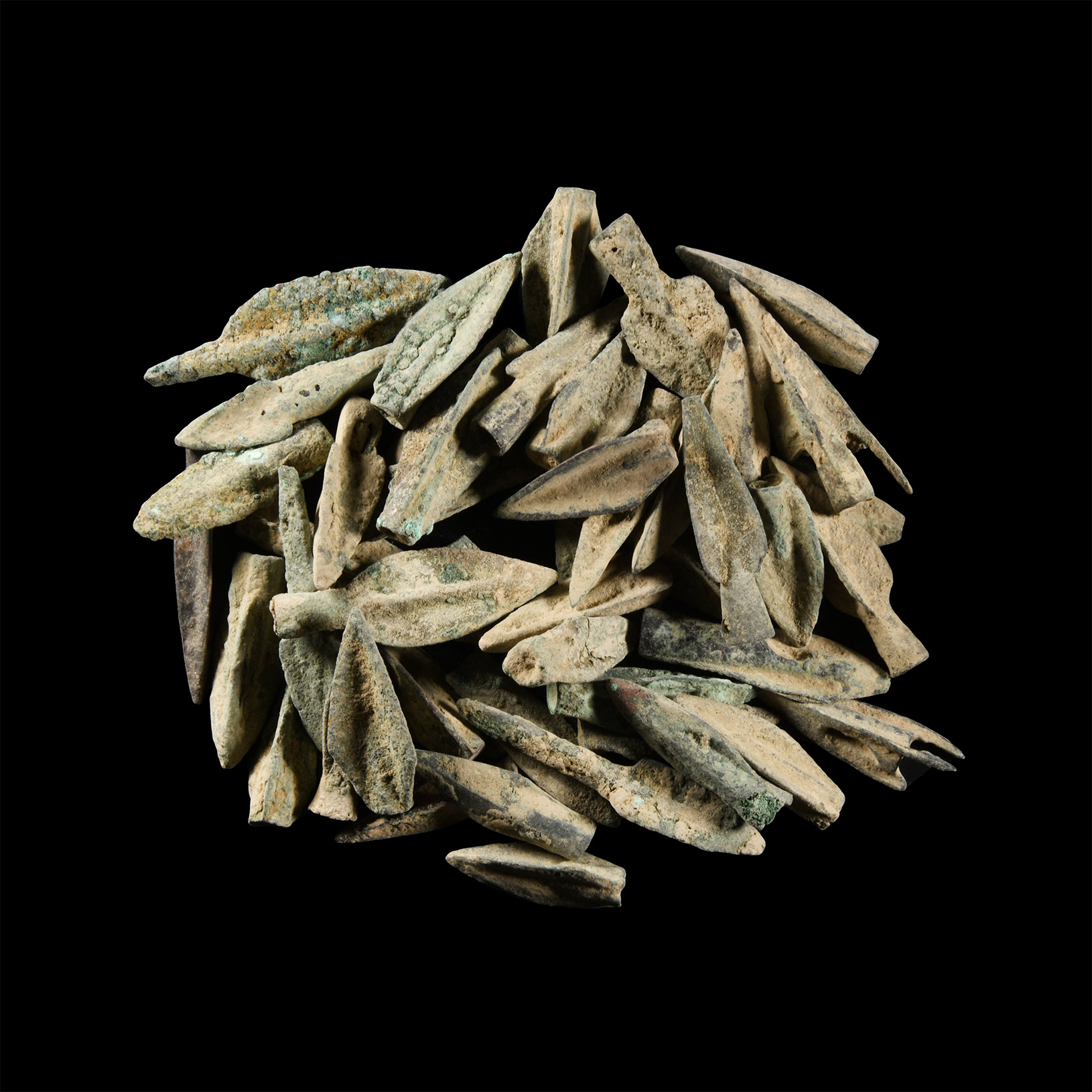
Greek Bronze Arrowhead Group
5TH-3RD CENTURY B.C.
1 1/4 - 2 1/4 in. (213 grams total, 32-56 mm).
Mainly comprising socketted arrowheads of triangular type, including at least one barbed and one tanged example. [50, No Reserve]
ProvenanceEx private collection, 1980s.
Acquired on the UK art market in the 1990s.
TimeLine Auctions follows a vetting process to ensure the authenticity and legality of all items, reinforcing our commitment to integrity and responsible trading. Each antiquity, antique, and coin lot undergoes thorough examination by a vetting committee of at least ten external specialists, professional trade association members, scientists, and archaeologists: Our Vetting Process
AUCTIONS:
TimeLine is a leading auction house specialising in antiquities, ancient art, collectables, natural history, coins, medals, and books. Our auctions offer museums, collectors, historians, and enthusiasts the opportunity to acquire unique and historically significant pieces.
-
.jpg)
South German Burgonet Helm
Circa 1560-1570 A.D.Estimate: £2,000 - 3,000 (+bp*)
Opening Bid: £944
The one-piece skull rising to a prominent baluster-shaped finial, facetted upper half, the lower writhen projecting forward to flat obtusely pointed integral peak and backwards to a similar but shorter integral neck-guard, hinged cheek-pieces embossed with a star with four points, an auditory hole between each arm; fitted internally with a quilted canvas lining; with possible punched 'eagle' maker mark to visor projection. 1.54 kg, 24 cm high
with Thomas Del Mar Ltd, 6th December 2017, lot 199. The Kusmirek Collection, UK. Accompanied by an academic report by Dr Raffaele D'Amato. Accompanied by a copy of the relevant Thomas Del Mar Ltd catalogue pages and purchase invoice. This lot has been checked against the Interpol Database of stolen works of art and is accompanied by search certificate number no.11770-203982.
Most original burgonets feature some form of decoration. Rolled and roped edges and pierced cheek-pieces are common, and the finest burgonets were engraved, inlaid and/or selectively coloured and polished. Some were covered in fine cloth in the tradition of sallets. The name seems to be a corrupted form of bourguignotte, the contemporary French term for this helmet type. -
.jpg)
Roman Bronze Armour Squama Scales Group
2nd-3rd century A.D.Sold for (Inc. bp): £715
Mixed group of semi-rigid bronze scales with scalloped lower edges, pierced for attachment; together with two small panels of articulated lamina scales. 30 grams total, 10-65 mm
Acquired in the late 1980s. The Kusmirek Collection, UK.
A new form of rigid scale-armour, typified by pieces found in Britannia (Corbridge, Carlisle), Pannonia (Musov), Moesia (Iron Gates) and in various other provinces of the empire, was introduced earlier in the Antonine Period, and continued for all of the 3rd and 4th centuries A.D. The new body protection was realised with scales attached by wire to each of their four neighbouring scales. These new scales tended to be not only very small, but also long and slender and needed to be carefully shaped around the neck. -
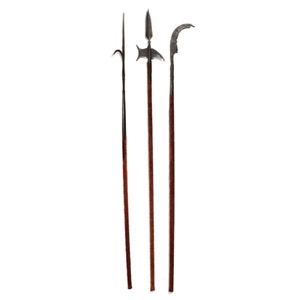
Post Medieval Iron Pike Collection
16th-18th century A.D.Sold for (Inc. bp): £1,170
Comprising three weapons: a 'ronca contadina' (peasant scythed staff weapon, known as forest bill) made of trunco-conical tubular gorbia with tapering iron shaft, inclined to the right with respect to the axis of the weapon, ending in a bill; an alabarda-sergentina, iron blade halberd with central rib, two axe-heads, one convex one concave; an alghiero, guisarme with tapering pointed iron shaft of rectangular section, furnished with a side-bill; all three mounted upon wooden velvet-covered shafts. 6.3 kg total, 2.26-2.34 m
Ex Christie's, Holland, circa 2010. East Anglian private collection.
Certainly the most interesting of the three weapons is the peasant roncone. The hooked part of the weapon could be used to hook or cut things, but also for severing a horse's hocks causing both horse and rider to fall.
