
Loading, please wait...
_900x900.jpg "Greek Attic Black-Figure Lekythos with Fighting Warriors")
_200x200.jpg "Greek Attic Black-Figure Lekythos with Fighting Warriors")
_900x900.jpg "Greek Attic Black-Figure Lekythos with Fighting Warriors")
_200x200.jpg "Greek Attic Black-Figure Lekythos with Fighting Warriors")
_900x900.jpg "Greek Attic Black-Figure Lekythos with Fighting Warriors")
_200x200.jpg "Greek Attic Black-Figure Lekythos with Fighting Warriors")
.jpg "Greek Attic Black-Figure Lekythos with Fighting Warriors")
.jpg "Greek Attic Black-Figure Lekythos with Fighting Warriors")
.jpg "Greek Attic Black-Figure Lekythos with Fighting Warriors")
LOT 0056
Greek Attic Black-Figure Lekythos with Fighting Warriors
6TH CENTURY B.C.
5 1/2 in. (154 grams, 13.9 cm).
With flared foot, broad shoulder and trumpet-shaped mouth, strap handle to the rear; painted frieze with scene of two warriors fighting on foot with spears, watched by two silhouetted companions; ivy leaves to shoulder.
ProvenanceEx Gübelin, Switzerland, before 1970.
with Fischer Luzern, 2006.
Acquired by the previous owner from the above, 9 June 2006.
Private collection, Europe.
Accompanied by a copy of an Art Loss register certificate, no.S00066703.
This lot has been checked against the Interpol Database of stolen works of art and is accompanied by a search certificate number no.12638-264603.
This lot has been cleared against the Art Loss Register database, and is accompanied by an illustrated lot declaration signed by the Head of the Antiquities Department, Dr Raffaele D'Amato.
Cf. Beazley, J.D., Attic Black-Figure Vase-Painters, New York, 1978, pp.463-464, for type.
CONDITIONTimeLine Auctions follows a vetting process to ensure the authenticity and legality of all items, reinforcing our commitment to integrity and responsible trading. Each antiquity, antique, and coin lot undergoes thorough examination by a vetting committee of at least ten external specialists, professional trade association members, scientists, and archaeologists: Our Vetting Process
AUCTIONS:
TimeLine is a leading auction house specialising in antiquities, ancient art, collectables, natural history, coins, medals, and books. Our auctions offer museums, collectors, historians, and enthusiasts the opportunity to acquire unique and historically significant pieces.
LOT 0056
Greek Attic Black-Figure Lekythos with Fighting Warriors
Sold for (Inc. bp): £4,160
-
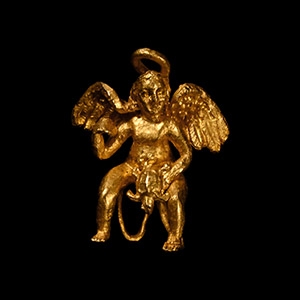
Greek Gold Eros Holding a Turtle Pendant
4th century B.C.Sold for (Inc. bp): £4,420
A delicately crafted pendant depicting a seated Eros with spread wings, holding a small turtle with his left hand and his right hand raised, feather detailing to wings and carefully modelled face with a smiling expression; a double suspension loop underneath and a single loop above; likely from an earring. 1.41 grams, 13 mm
Solothurn exhibition catalogue 1967, no.421. Notable Swiss private scholarly collection. with Galerie Rhéa, Zurich, Switzerland. This lot has been checked against the Interpol Database of stolen works of art and is accompanied by a search certificate number no.12671-236392. This lot has been cleared against the Art Loss Register database, and is accompanied by an illustrated lot declaration signed by the Head of the Antiquities Department, Dr Raffaele D'Amato. -
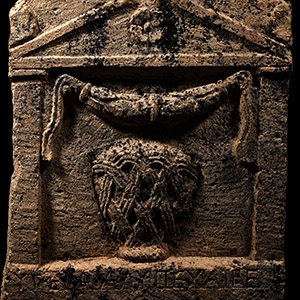
Graeco-Roman Naiskos-Type Limestone Stele with 'Long Life, Free from Sorrow, Farewell' Inscription
Asia Minor, 1st century B.C.-1st century A.D.Sold for (Inc. bp): £11,700
With rosette in the gable, a basket filled with wool and a garland above it; inscription in Greek reading: 'ΥΓΕΙΑ ΑΛΥΠΕ ΧΑΙΡΕ (HEGHIA ALYPE CHAERE' (Long life [or health], free from sorrow, farewell!). 88 kg, 70.5 cm
Ex Schloss Solitude, Stuttgart, Germany, during the 19th century. with Galerie Rhéa, Zurich, Switzerland. This lot has been checked against the Interpol Database of stolen works of art and is accompanied by a search certificate number no.12657-236384. This lot has been cleared against the Art Loss Register database, and is accompanied by an illustrated lot declaration signed by the Head of the Antiquities Department, Dr Raffaele D'Amato.
This type of stele is comparatively rare, and highly gendered: it is intended to represent a woman when decorated with a basket of wool, and for a man when decorated with an eagle. They are typical of the Zeugma area of the Euphrates river in ancient Seleukia. -
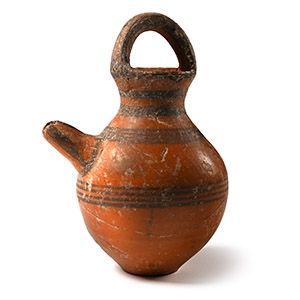
Cypriot Terracotta Vessel
Cypro-Archaic, 750-600 B.C.Sold for (Inc. bp): £286
Miniature ewer with tapering spout to the shoulder, flared neck and rounded rim with applied loop handle; painted decorative bands. 51 grams, 88 mm
Acquired in the mid 1980s-1990s. Private collection, Switzerland, thence by descent. Private collection, since the late 1990s. This lot is accompanied by an illustrated lot declaration signed by the Head of the Antiquities Department, Dr Raffaele D'Amato.
