
Loading, please wait...
_900x900.jpg "Greek Apulian Red-Figure Stand")
_200x200.jpg "Greek Apulian Red-Figure Stand")
_900x900.jpg "Greek Apulian Red-Figure Stand")
_200x200.jpg "Greek Apulian Red-Figure Stand")
.jpg "Greek Apulian Red-Figure Stand")
.jpg "Greek Apulian Red-Figure Stand")
LOT 0044
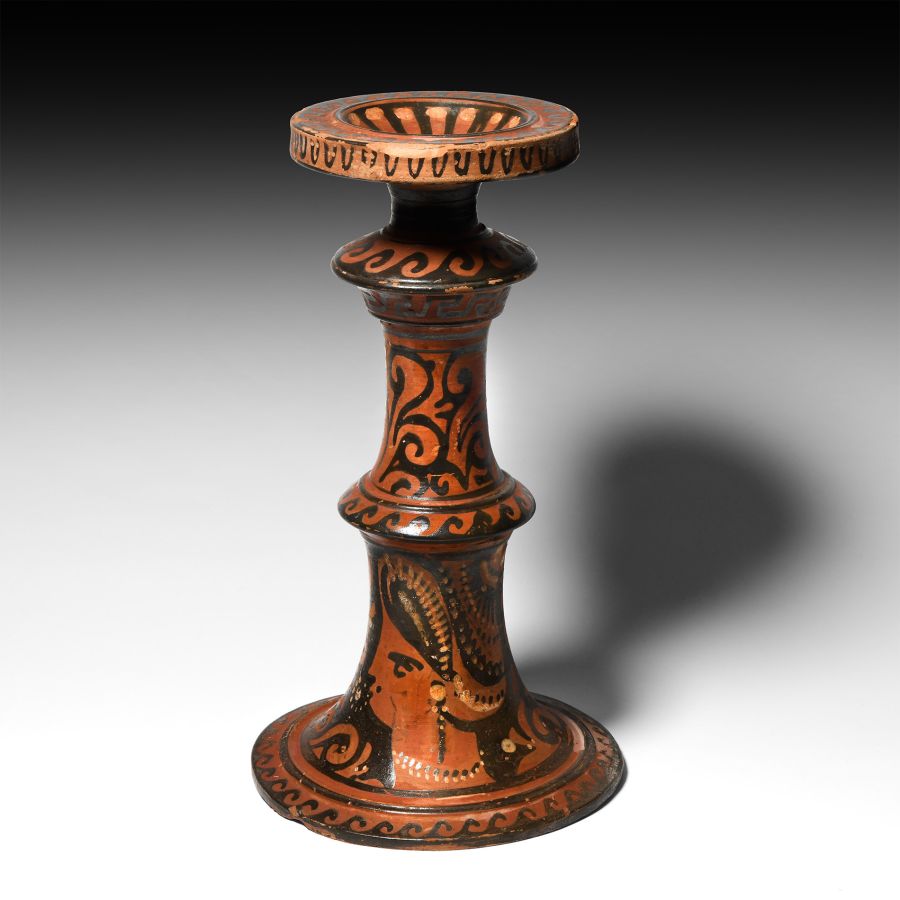
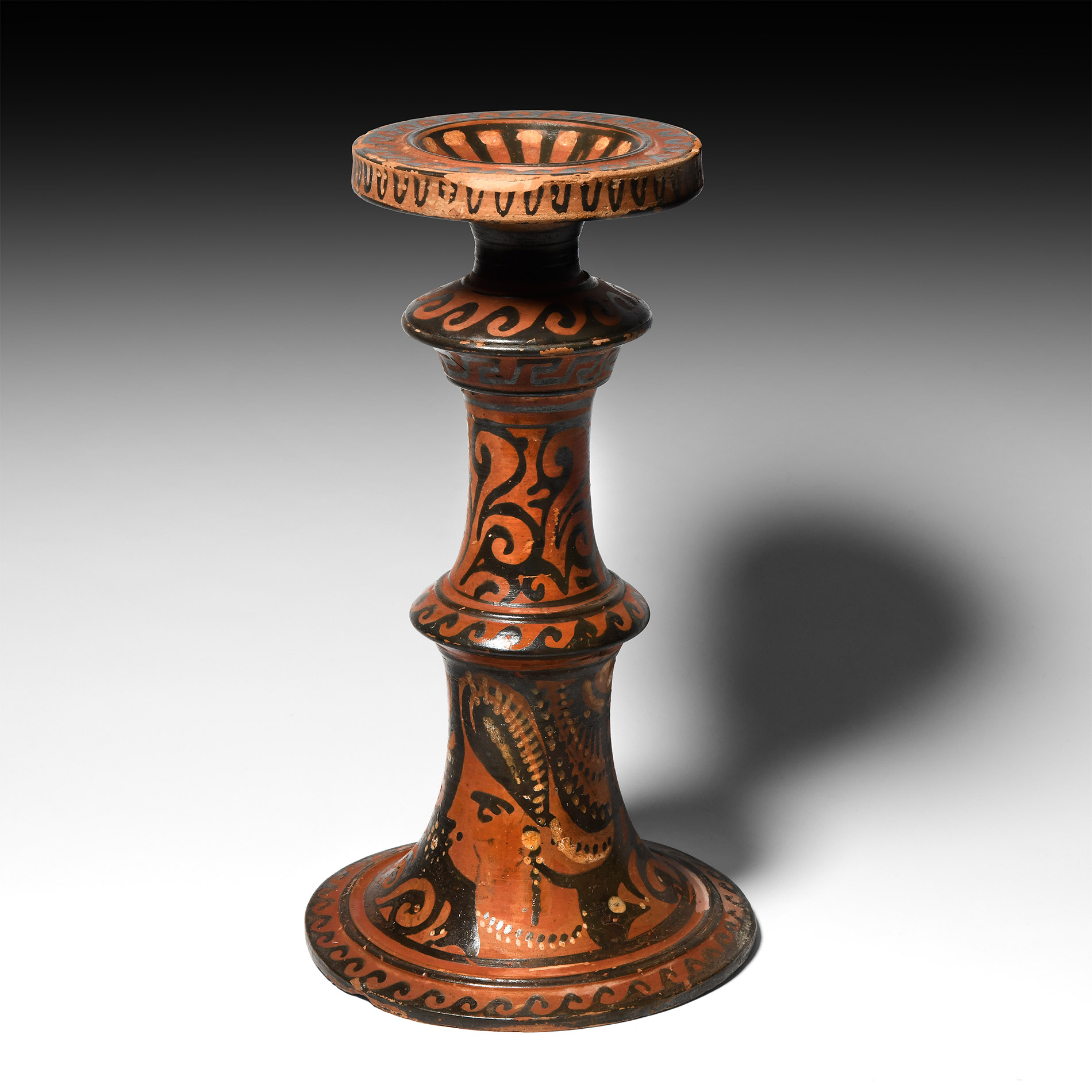
Greek Apulian Red-Figure Stand
4TH CENTURY B.C.
9 7/8 in. (847 grams, 25 cm high).
Comprising a trumpet-shaped base, carinated balusters and broad upper face with dished centre; painted with running wave patterns to the baluster, base and top, the centre with a rosette; the base with the profile head of a lady of fashion with the earrings, necklace and diadem picked out in white.
ProvenanceFrench collection, 1990s-early 2000s.
Ex Hampel Auctions, Munich, Germany, 1990s.
Cf. similar item in the British Museum, London, under accession number 1856,1226.168.
CONDITIONTimeLine Auctions follows a vetting process to ensure the authenticity and legality of all items, reinforcing our commitment to integrity and responsible trading. Each antiquity, antique, and coin lot undergoes thorough examination by a vetting committee of at least ten external specialists, professional trade association members, scientists, and archaeologists: Our Vetting Process
AUCTIONS:
TimeLine is a leading auction house specialising in antiquities, ancient art, collectables, natural history, coins, medals, and books. Our auctions offer museums, collectors, historians, and enthusiasts the opportunity to acquire unique and historically significant pieces.
LOT 0044
Greek Apulian Red-Figure Stand
Estimate £800 - 1,000€930 - 1,160 (for guidance only)$1,080 - 1,350 (for guidance only)
-
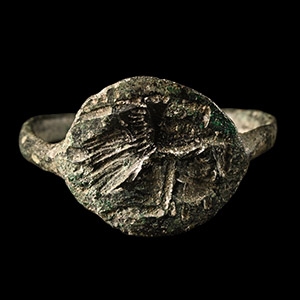
Hellenistic Bronze Ring with Horse Motif
Circa 2nd-1st century B.C.Sold for (Inc. bp): £52
Displayed in relief on a broad elliptical bezel. 2.16 grams, 20.95 mm overall, 18.48 mm internal diameter (approximate size British Q, USA 8, Europe 17.49, Japan 16)
Acquired 1990s-early 2000s. East Anglian private collection. -
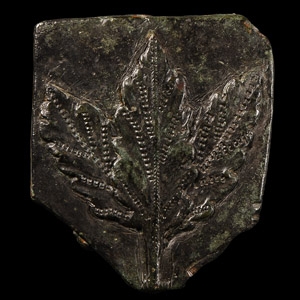
Hellenistic Bronze Acanthus Jewellery Matrix
4th-2nd century B.C.Estimate: £100 - 140 (+bp*)
Opening Bid: £56
Likely for jewellery production, bearing an acanthus leaf motif in relief to one face, with delicate detailing. 78 grams, 57 mm
German collection before 2000. Collection of Mr.D.H., formed in UK, from the EU art market. Property of a Surrey gentleman.
In antiquity, matrices for raising jewellery elements, ornaments and plaques were made of bronze, stone or reinforced terracotta. Matrices with designs in relief were used as an alternative to matrices with hollow designs or intaglio matrices. -
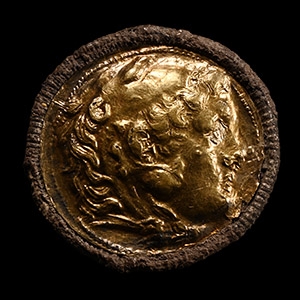
Greek Gold-Foiled Alexander the Great Coin Brooch
Circa 3rd century B.C.Sold for (Inc. bp): £4,550
Comprising a tetradrachm coin of Alexander III of Macedonia depicting his profile bust right wearing a lion-skin and, to the reverse, Zeus, seated left holding an eagle; set in a surround with hinge and catch affixed to the reverse. 22.03 grams, 33 mm
Acquired 1990s-early 2000s. East Anglian private collection.
