
Loading, please wait...
LOT 0551
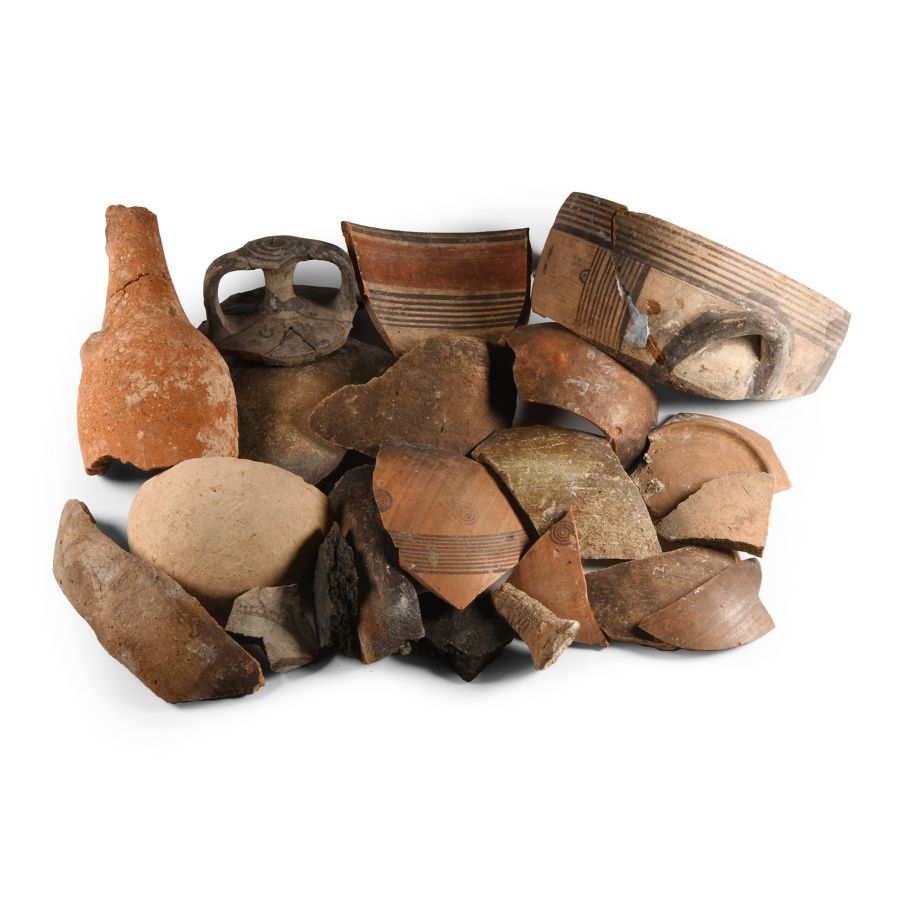
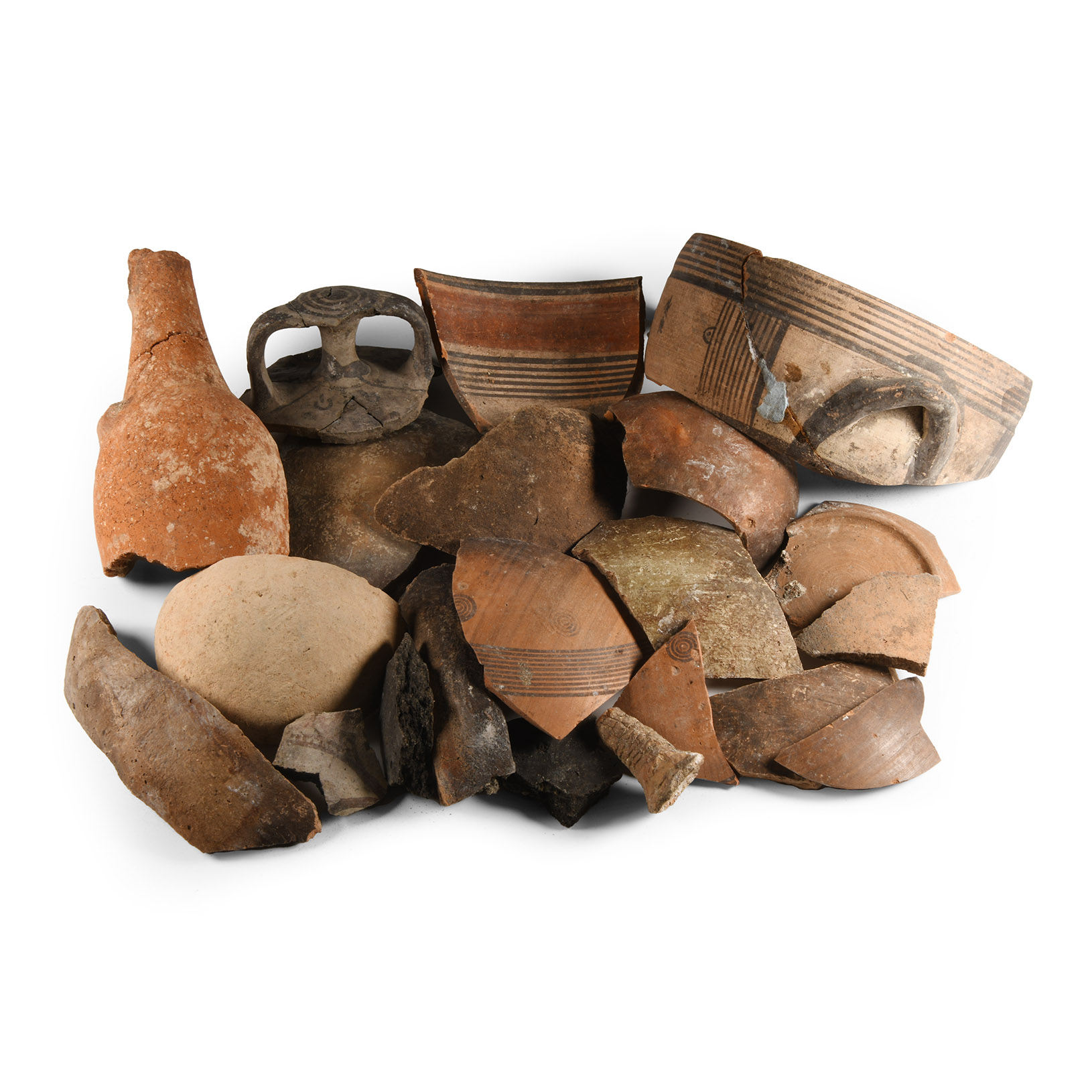
Greek and Other Pottery Sherd Group
CIRCA 1ST MILLENNIUM B.C.
1 3/8 - 6 1/8 in. (1 kg total, 3.6-15.5 cm).
Including fragments of amphora, lekythos, kylix and other types. [18, No Reserve]
ProvenanceFrom a collection acquired on the UK art market from various auction houses and collections mostly before 2000.
From an important Cambridgeshire estate; thence by descent.
TimeLine Auctions follows a vetting process to ensure the authenticity and legality of all items, reinforcing our commitment to integrity and responsible trading. Each antiquity, antique, and coin lot undergoes thorough examination by a vetting committee of at least ten external specialists, professional trade association members, scientists, and archaeologists: Our Vetting Process
AUCTIONS:
TimeLine is a leading auction house specialising in antiquities, ancient art, collectables, natural history, coins, medals, and books. Our auctions offer museums, collectors, historians, and enthusiasts the opportunity to acquire unique and historically significant pieces.
-
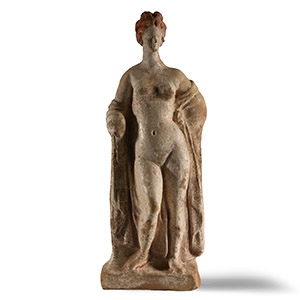
Hellenistic Painted Terracotta Figure of Aphrodite
Mid 4th-mid 3rd century B.C.Estimate: £3,000 - 4,000 (‡+bp*)
Opening Bid: £1,111
Bearing the weight of her body on her left leg, wearing a himation draped over her left and right arms, the right arm bent to grasp a part of the himation that falls behind her, leaving her shoulders uncovered and revealing her naked body; the head turned slightly to the left; the hair arranged in the typical flattering melon coiffure, parted into six large sections and gathered into a low bun; oval face with a small, fleshy mouth and a fine nose; wearing large circular earrings; her right hand resting on top of a small pillar, covered by the cloak; the lower part of the himation embroidered with volutes; the back flat with a square hole for attachment; red-brown pigment on the hair, white coating, traces of pink on the himation and red on the edges of the feet. 493 grams, 22.5 cm high
Collected in the 1950s-1990s. Ex R. Liechti collection (1934-2010), acquired in Geneva. Accompanied by an academic report by Raffaele D'Amato. This lot has been checked against the Interpol Database of stolen works of art and is accompanied by search certificate no.11999-211931.
In particular in South Italy, two types of female statuettes leaning on small pillars were widespread, derived from Tanagra prototypes: the first type dressed in a high-belted chiton with crowned head, the second consisting of partially draped or nude female figures identified as Aphrodite, like our specimen. The Tanagra production ended in about 200 B.C., but the models created by the Boeotian workshops would continue to be produced until the end of the 1st century B.C. The statuette shows extensive traces of the original polychromy, characterised by strongly contrasting hues in keeping with the local style. The Tanagrine elements are mainly identifiable in the ‘melon coiffure’, the intense red colour of the hair and the pose characterised by the turned hip. -
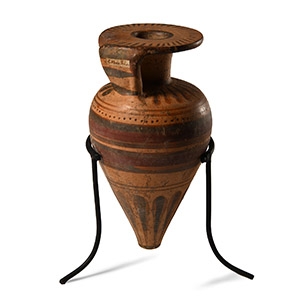
Etrusco-Corinthian Terracotta Piriform Aryballos
Circa 600-550 B.C.Sold for (Inc. bp): £572
With piriform body, narrow neck and broad rim to the mouth, broad strap handle; painted with radiating strokes to the mouth and shoulder, band or pellets and tongue pattern to the foot; old collector's label 'C Vecchia', probably Civita Vecchia, a seaport serving Rome. 96 grams total, 10 cm high (10.5 cm high including stand)
Private collection Hertfordshire, England. with Ancient Resource Auctions, 2 December 2013, no.124A (US$ 2,500-4,000). Property of a South Australian private collector, with collection reference 14.04. Accompanied by detailed collector's catalogue pages including description and image. -
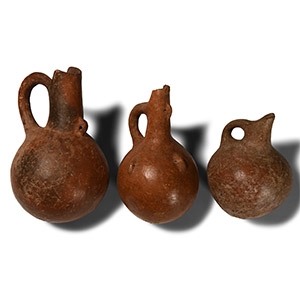
Cypro-Archaic Red Polished Ware Zoomorphic Jug Group
Circa 1400-600 B.C.Sold for (Inc. bp): £208
Group of three spherical jugs each with a tall neck and lateral loop handle; two with second smaller loop to the other side. 878 grams total, 9.8-15 cm
From a collection acquired on the UK art market from various auction houses and collections mostly before 2000. From an important Cambridgeshire estate; thence by descent.
