
Loading, please wait...
LOT 1487
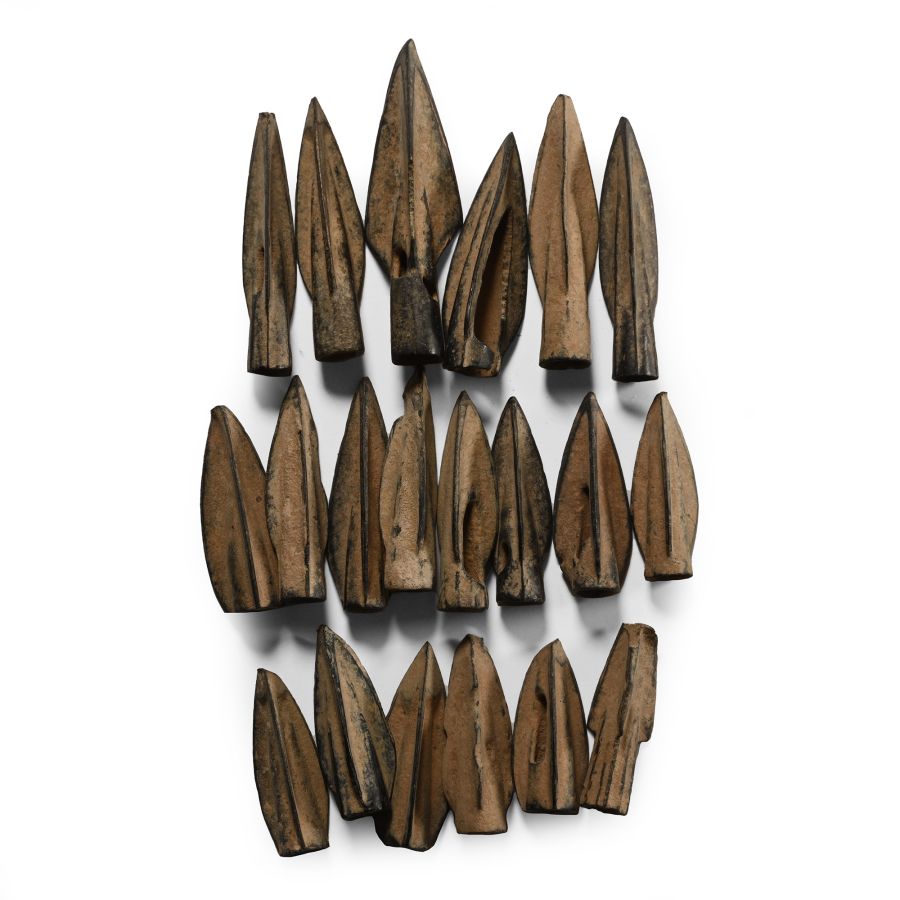
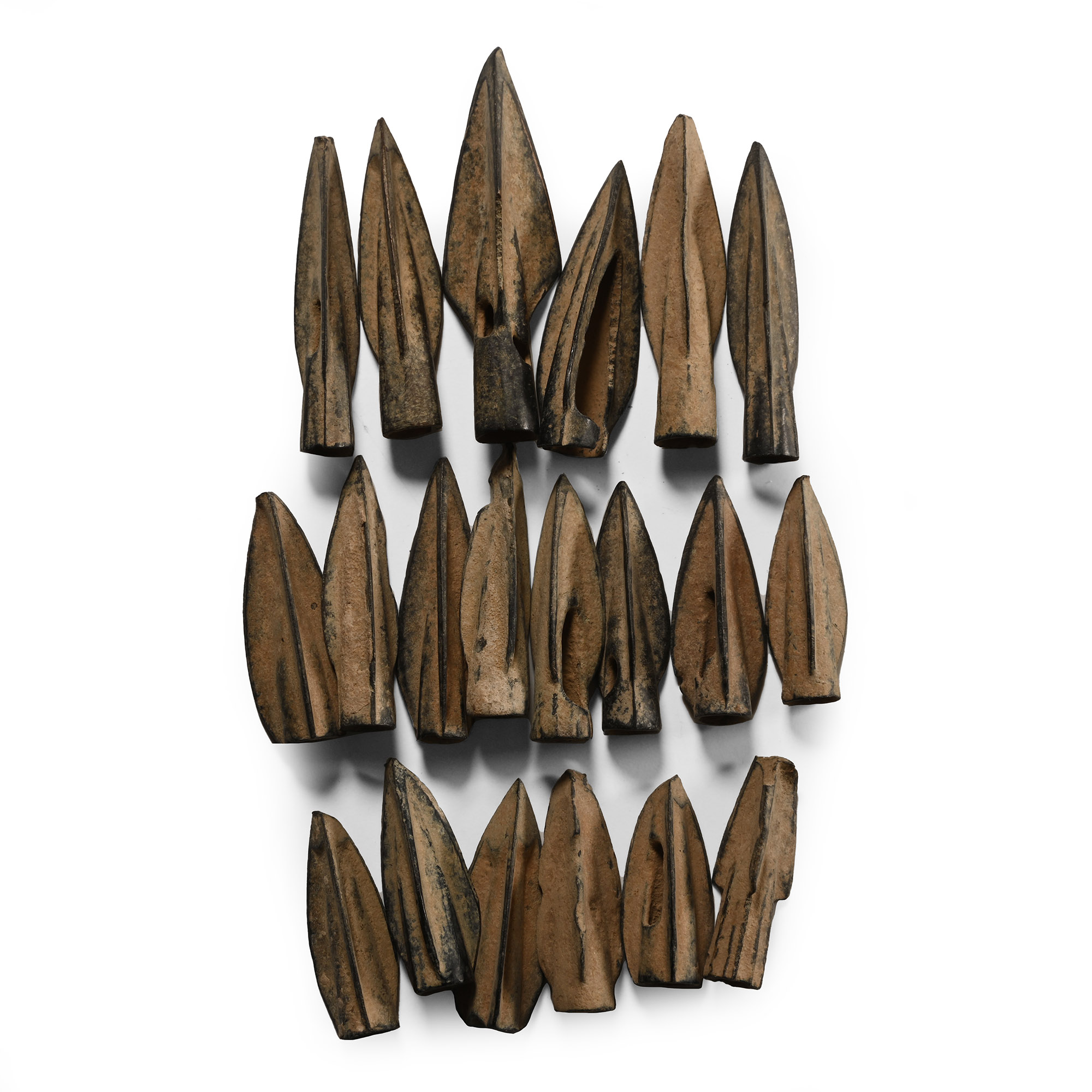
Greek and Other Bronze Arrowhead Collection
CIRCA 5TH-3RD CENTURY B.C.
1 - 1 5/8 in. (63.5 grams total, 24-42 mm).
The group comprising triangular trilobate types, all socketted. [20]
ProvenanceEx London art market, 1980-1990s.
This lot is accompanied by an illustrated lot declaration signed by the Head of the Antiquities Department, Dr Raffaele D'Amato.
Cf. similar Graeco-Persian arrowheads in Head, D., The Achaemenid Persian Army, Stockport, 1992, figs.13,16.
FootnotesIn the Greek warfare, archers were mainly employed by Scythians and Cretans. Both used composite bows made of wood, horn, bone and sinew. This explains the great range of Scythian arrowheads found on the Greek sites.
CONDITIONTimeLine Auctions follows a vetting process to ensure the authenticity and legality of all items, reinforcing our commitment to integrity and responsible trading. Each antiquity, antique, and coin lot undergoes thorough examination by a vetting committee of at least ten external specialists, professional trade association members, scientists, and archaeologists: Our Vetting Process
AUCTIONS:
TimeLine is a leading auction house specialising in antiquities, ancient art, collectables, natural history, coins, medals, and books. Our auctions offer museums, collectors, historians, and enthusiasts the opportunity to acquire unique and historically significant pieces.
LOT 1487
Greek and Other Bronze Arrowhead Collection
Estimate £100 - 140€120 - 160 (for guidance only)$140 - 190 (for guidance only)
-
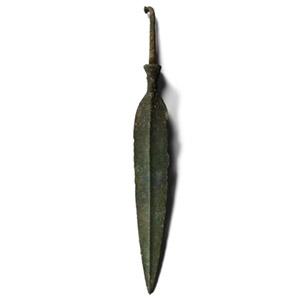
Large Luristan Bronze Spearhead
Late 3rd millennium B.C.Sold for (Inc. bp): £117
Leaf-shaped blade with pronounced midrib and thick neck, flared base, square-section tang with stud. 504 grams, 41cm
Ex London art market, 1980-1990s. This lot is accompanied by an illustrated lot declaration signed by the Head of the Antiquities Department, Dr Raffaele D'Amato.
The type belongs to the category of tripartite lances with long pointed biconvex blade and single bevelled tang. In this typology the blade, of rhomboidal section, is usually well balanced. The stem, medium or short, is widened at its base and forms a fairly clean stop. Elements of shaft of a similar spear found at Tepe Hissar has allowed to reconstruct the length of the spear reaching up to 1.40 m. -
.jpg)
North-Western Persian Type Bronze Blade
Early 1st millennium B.C.Sold for (Inc. bp): £59
With tapering triangular blade, having straight shoulders, flat midrib and tapering square-sectioned tang ending with a rounded pommel. 99 grams, 33 cm
Acquired 1980-2015. Ex Abelita family collection. This lot is accompanied by an illustrated lot declaration signed by the Head of the Antiquities Department, Dr Raffaele D’Amato. This lot is accompanied by an illustrated lot declaration signed by the Head of the Antiquities Department, Dr Raffaele D'Amato.
Moorey, Gordon and Khorasani created a classification of bladed weapons, according to which daggers are edged weapons not greater than 36cm in length, dirks (short swords) are between 36cm and 50cm in length, and swords are edged weapons greater than 50cm in length. -
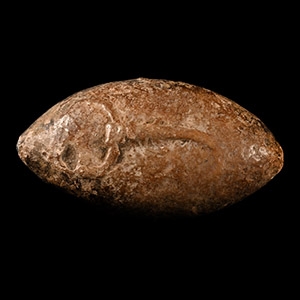
Hellenistic Rhodian Lead Slingshot with Scorpion
3rd century B.C.Sold for (Inc. bp): £598
Lentoid-section and depicting a stylised scorpion to one side, a type sometimes known to have the Rhodian legend ΚΑΛΑ to verso. 29.6 grams, 29 mm
From a Manchester, UK, collection, 1990s. This lot is accompanied by an illustrated lot declaration signed by the Head of the Antiquities Department, Dr Raffaele D'Amato.
Together with the Balearic slingers, Rhodian slingers were considered to be the best of the Hellenistic world, and they were also used in the Roman army. The slingshots with an image of a scorpion on one side and with an inscription ΚΑΛΑ on the other are believed to originate from the Island of Rhodes. On these sling bullets ΚΑΛΑ should be translated as “nice things.” Of course, ironically, these “nice things” were designed to kill enemies and to sting like a scorpion, and the message of those with the image of a scorpion could be understood, as proposed by M. Manov and N. Torbov, as: “nice things sting like a scorpion.”
