
Loading, please wait...
LOT 1445
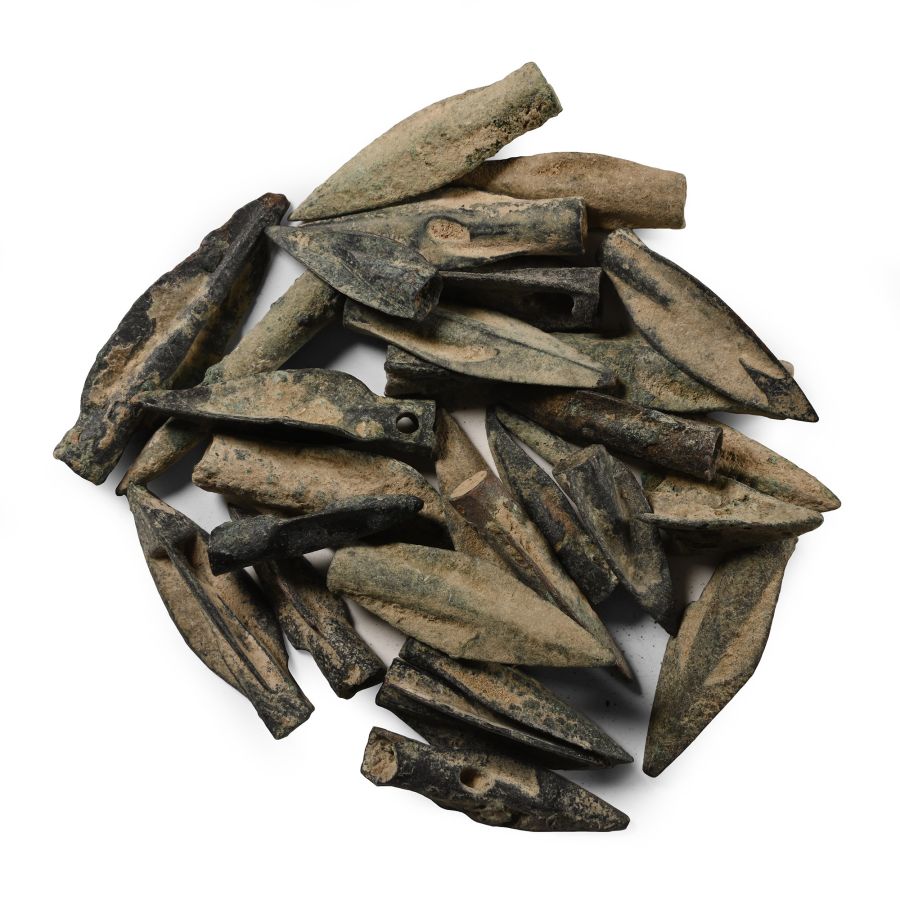
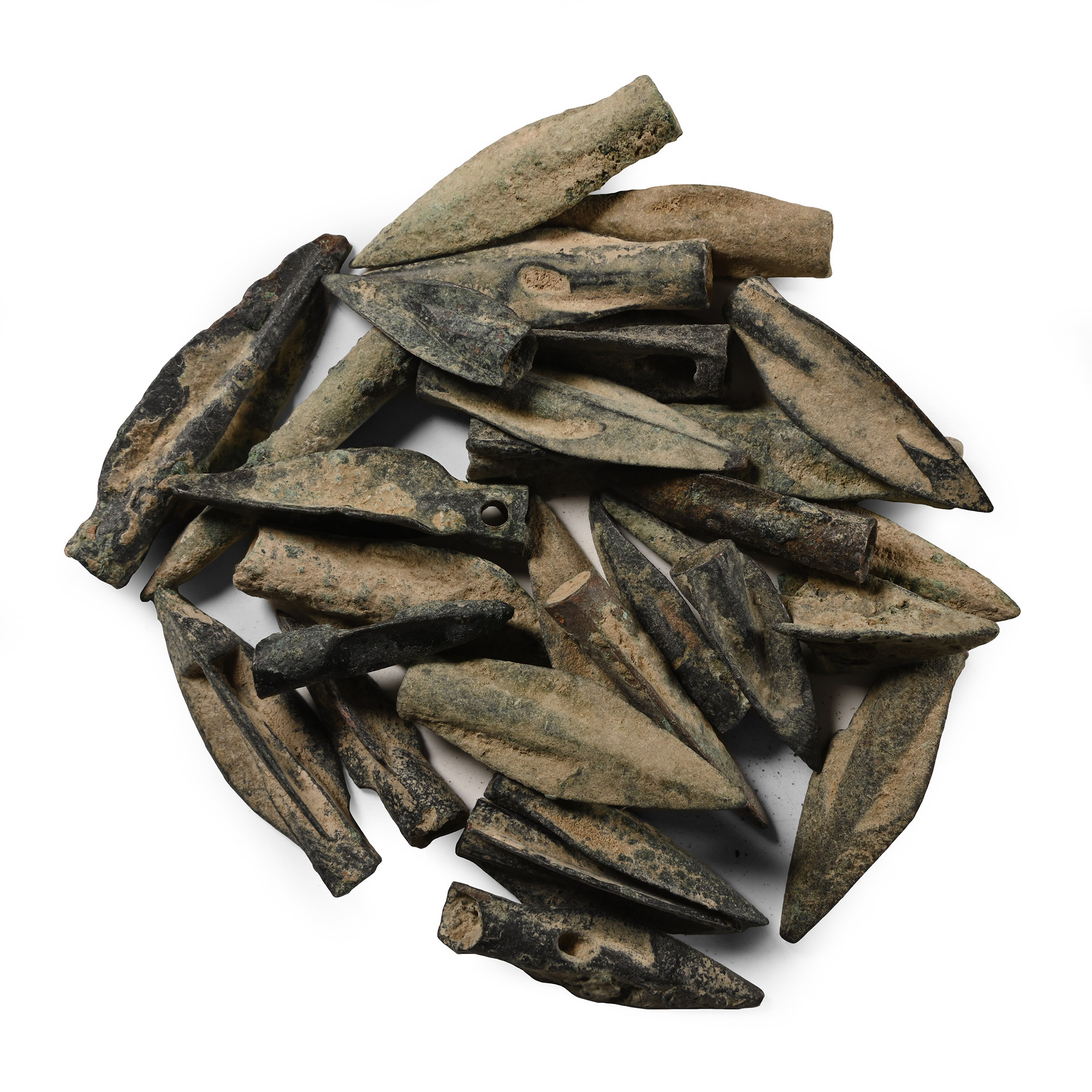
Greek and Other Bronze Arrowhead Collection
CIRCA 5TH-3RD CENTURY B.C.
1 - 1 5/8 in. (98.5 grams total, 24-40 mm).
Comprising mainly leaf-shaped, triangular, and trilobate socketted arrowheads. [28]
ProvenanceEx London art market, 1980-1990s.
This lot is accompanied by an illustrated lot declaration signed by the Head of the Antiquities Department, Dr Raffaele D'Amato.
Cf. similar Graeco-Persian arrowheads in Head, D., The Achaemenid Persian Army, Stockport, 1992, figs.13, 16.
FootnotesIn Greek warfare, archers were mainly employed by Scythians and Cretans. Both used composite bows made of wood, horn, bone and sinew. This explains the great range of Scythian arrowheads also found on the Greek sites.
CONDITIONTimeLine Auctions follows a vetting process to ensure the authenticity and legality of all items, reinforcing our commitment to integrity and responsible trading. Each antiquity, antique, and coin lot undergoes thorough examination by a vetting committee of at least ten external specialists, professional trade association members, scientists, and archaeologists: Our Vetting Process
AUCTIONS:
TimeLine is a leading auction house specialising in antiquities, ancient art, collectables, natural history, coins, medals, and books. Our auctions offer museums, collectors, historians, and enthusiasts the opportunity to acquire unique and historically significant pieces.
-
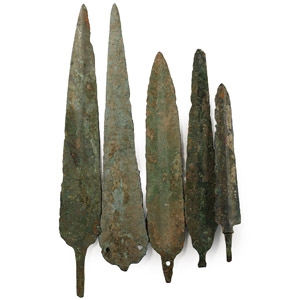
Western Asiatic Bronze Dagger Blade Collection
2200-600 century B.C.Sold for (Inc. bp): £182
Comprising four triangular and leaf-shaped blades, one with pierced tang with rivet hole and one pierced through the shoulders with two rivet holes; an arrowhead with strong mid-rib, short tang and narrow foliate blade. 321 grams total, 15-24.5 cm
Ex London art market, 1980-1990s. This lot is accompanied by an illustrated lot declaration signed by the Head of the Antiquities Department, Dr Raffaele D'Amato.
Some of the daggers represent one of the earliest form of the tangless round-heeled dagger, and the smaller examples were used as knives. Small tanged blades without a rivet, which have sometimes been identified as spearheads, are knives, while the riveted form could be used as a dagger or for domestic purposes. -
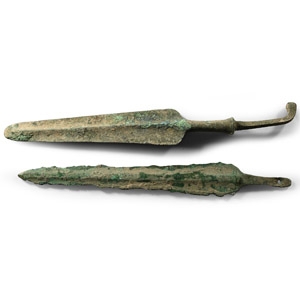
Luristan Bronze Spearhead Group
13th-11th century B.C.Estimate: £80 - 100 (+bp*)
Opening Bid: £44
Comprising a tanged spearhead with heavily ridged and tapered blade, short collared shaft and square-section tapered tang bent at the tip; a spearhead with foliate narrow blade, short tang with fastening hole. 300 grams total, 26.2-28.7 cm
Acquired 1980-2015. Ex Abelita family collection. This lot is accompanied by an illustrated lot declaration signed by the Head of the Antiquities Department, Dr Raffaele D’Amato. This lot is accompanied by an illustrated lot declaration signed by the Head of the Antiquities Department, Dr Raffaele D'Amato.
Both types of spearheads were found in Amlash and Marlik, and are connected with the types 1 and 2 of the Khorasani classification. The type 1 is characterised by a bent tang and was the evolution of a typology which began much earlier in Mesopotamia and the fertile crescent, the type 4 of the Stronach classification, with straight square-section tang, usually thickened at the base with a button tang. -
.jpg)
Luristan Bronze Long Arrowhead
2nd-1st millennium B.C.Sold for (Inc. bp): £46
Triangular blade with raised midrib extending to the short socket with rectangular-section tang. 32 grams, 13 cm
From the private collection of John Fox, Nottingham, Nottinghamshire, UK, antiquarian and archaeologist; his collection assembled in the 1950s-1970s. This lot is accompanied by an illustrated lot declaration signed by the Head of the Antiquities Department, Dr Raffaele D'Amato.
