
Loading, please wait...
_900x900.jpg "Greek Alabaster Alabastron")
_200x200.jpg "Greek Alabaster Alabastron")
.jpg "Greek Alabaster Alabastron")
LOT 0615
Greek Alabaster Alabastron
5TH-3RD CENTURY B.C.
6 3/4 in. (368 grams, 17 cm).
Of slender tubular form with rounded foot; pierced at the equator. [No Reserve]
ProvenanceFrom a collection acquired on the UK art market from various auction houses and collections mostly before 2000.
From an important Cambridgeshire estate; thence by descent.
TimeLine Auctions follows a vetting process to ensure the authenticity and legality of all items, reinforcing our commitment to integrity and responsible trading. Each antiquity, antique, and coin lot undergoes thorough examination by a vetting committee of at least ten external specialists, professional trade association members, scientists, and archaeologists: Our Vetting Process
AUCTIONS:
TimeLine is a leading auction house specialising in antiquities, ancient art, collectables, natural history, coins, medals, and books. Our auctions offer museums, collectors, historians, and enthusiasts the opportunity to acquire unique and historically significant pieces.
-
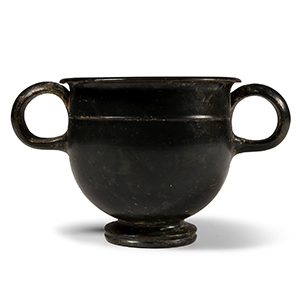
Greek High-Glazed Cup with Handles
5th-3rd century B.C.Estimate: £700 - 900 (‡+bp*)
Opening Bid: £350
The body with an inverted bell shape, foot with channeled sidewall, two loop handles with carinated upper faces; repaired. 96 grams, 12.8 cm wide
Acquired in Europe before 2001. European collection. -
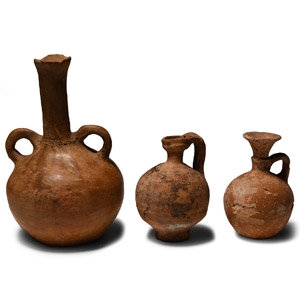
Cypriot Terracotta Flask Group
Middle-Late Bronze Age, 2000-1200 B.C.Sold for (Inc. bp): £104
Comprising: one globular with loop handles to the shoulder, pointillé decoration and funicular mouth; two globular with loop handle and trumpet-shaped mouth. 490 grams total, 9.2-16.5 cm
From a collection acquired on the UK art market from various auction houses and collections mostly before 2000. From an important Cambridgeshire estate; thence by descent. -
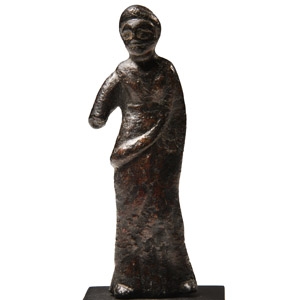
Italic Bronze Statuette of a Woman
3rd-1st century B.C.Sold for (Inc. bp): £98
Modelled in the round, standing with peplos dress and a large stola draped over the left shoulder and arm, extending to the knees; hair dressed in a chignon, transverse band below the breasts; mounted on a custom-made stand. 96 grams total, 86 mm including stand
From a collection acquired on the UK art market from various auction houses and collections mostly before 2000. From an important Cambridgeshire estate; thence by descent.
