
Loading, please wait...
_900x900.jpg "Graeco-Roman Terracotta Figure")
_200x200.jpg "Graeco-Roman Terracotta Figure")
.jpg "Graeco-Roman Terracotta Figure")
LOT 0089
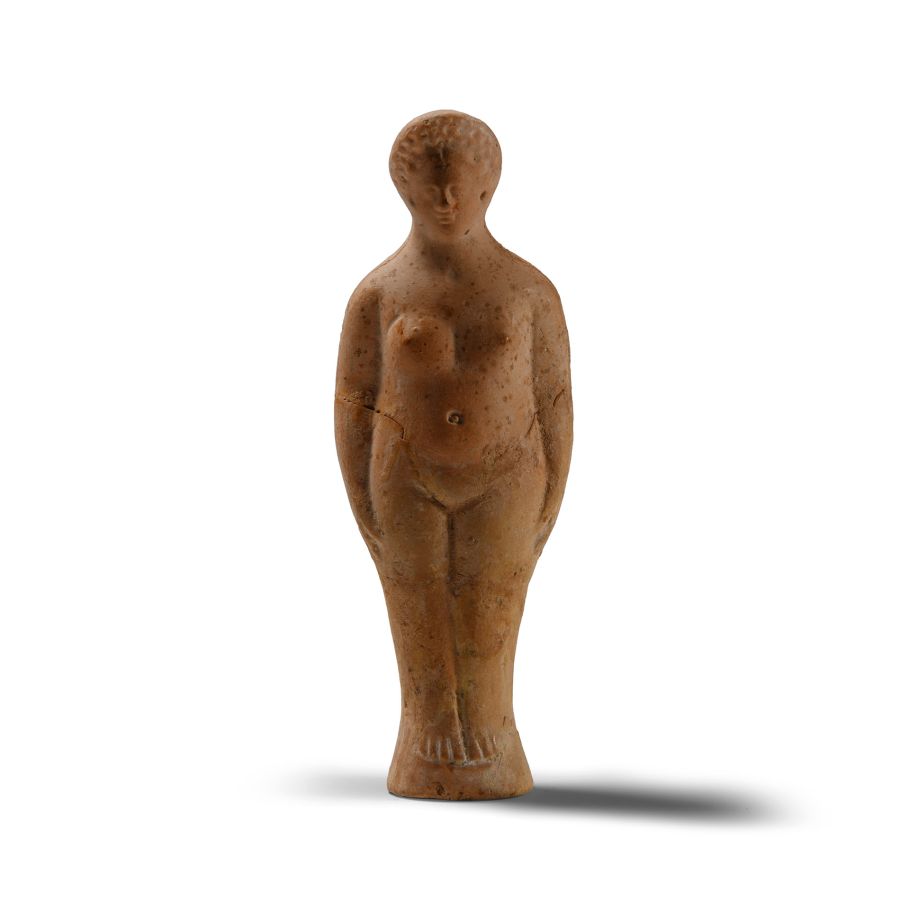
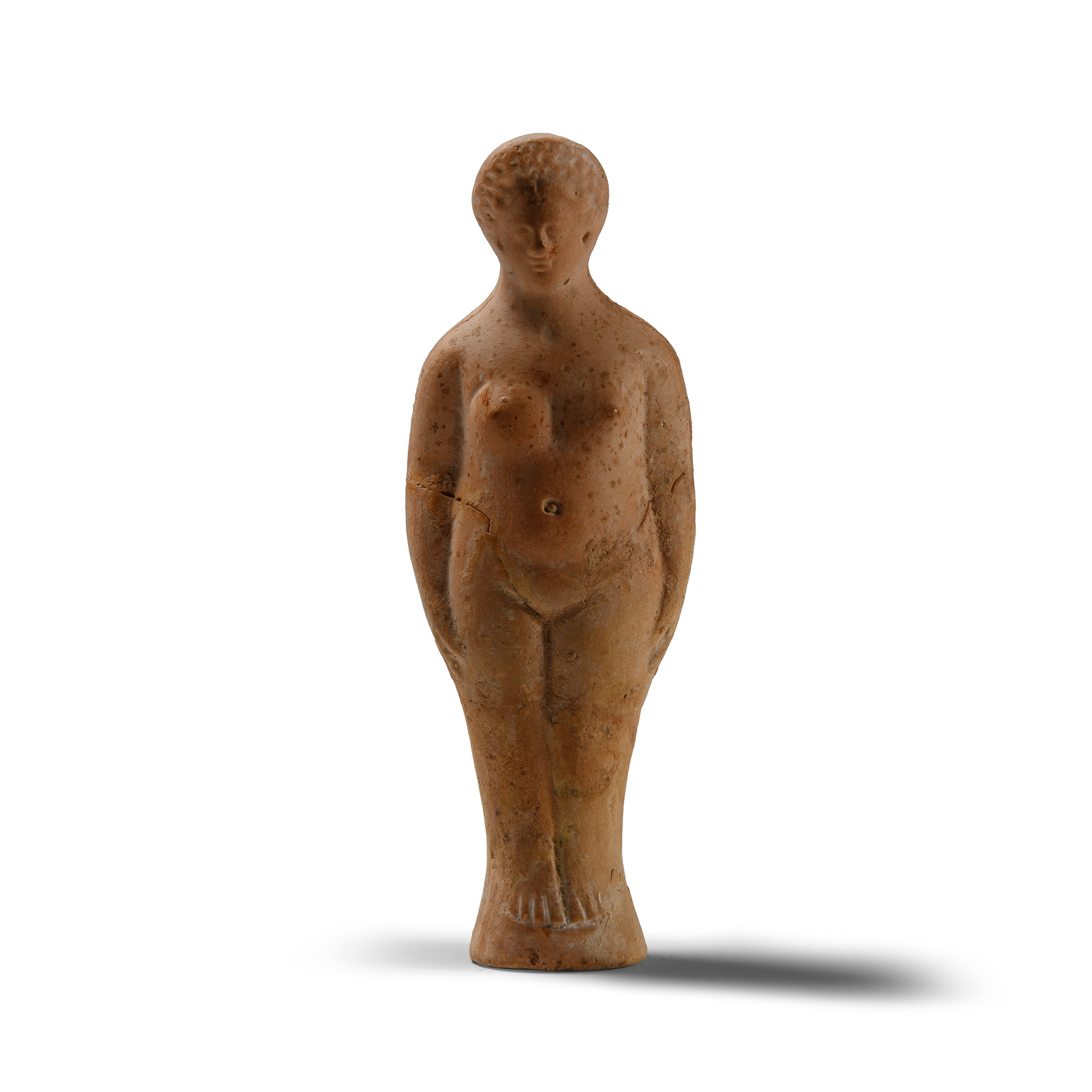
Graeco-Roman Terracotta Figure
2ND CENTURY B.C.-1ST CENTURY A.D.
4 1/2 in. (46 grams, 11.3 cm).
Tanagra-type hollow-formed figurine of a nude female with dressed hair; hole to the reverse and underside; repaired.
ProvenancePrivate collection of Mr S.A., Switzerland, 1990s, thence by descent.
CONDITIONTimeLine Auctions follows a vetting process to ensure the authenticity and legality of all items, reinforcing our commitment to integrity and responsible trading. Each antiquity, antique, and coin lot undergoes thorough examination by a vetting committee of at least ten external specialists, professional trade association members, scientists, and archaeologists: Our Vetting Process
AUCTIONS:
TimeLine is a leading auction house specialising in antiquities, ancient art, collectables, natural history, coins, medals, and books. Our auctions offer museums, collectors, historians, and enthusiasts the opportunity to acquire unique and historically significant pieces.
LOT 0089
Graeco-Roman Terracotta Figure
Estimate £600 - 800€700 - 930 (for guidance only)$810 - 1,080 (for guidance only)
-
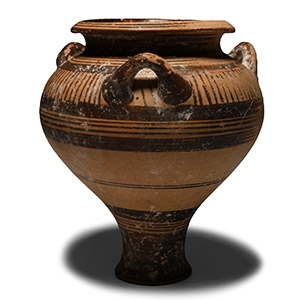
Greek Geometric Terracotta Piriform Jar with Handles
Late Helladic IIIB, 1300-1200 B.C.Sold for (Inc. bp): £1,300
With small flared foot, broad body and rounded shoulder, everted rim and two loop handles to the shoulder; painted bands of linear ornament. 280 grams, 15 cm
Acquired from Gallery Gryphos, Munich, 2000s. European private collection.
Deposits from Mycenae, Korakou and Nichoria are relatively rich in painted jugs, small stirrup and piriform jars. The pattern usually employed on piriform jars preserves a rim decoration of short strokes, neck being solidly painted. Following an usual syntax, a line group appears on the upper shoulder below the neck. Bases are solidly painted, except for an occasional thin reserved area on the lower base edge. -
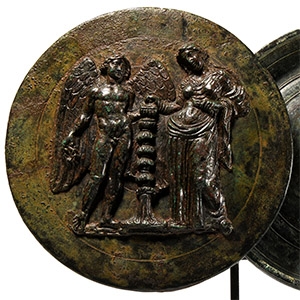
Greek Bronze Mirror with Eros and Aphrodite
Late Classic-early Hellenistic Period, mid-late 4th century B.C.Estimate: £12,000 - 17,000 (+bp*)
Opening Bid: £6,000
A circular box mirror comprising: a lid featuring a hammered sheet repoussé appliqué of Eros and Aphrodite, god and goddess of love, standing on either side of a thymiaterion, or censer associated with religious worship and ritual; Eros with wings outstretched, left hand supporting the top tier of the censer, right hand lowered to his side holding a wreath(?); much delicate incised detailing to his wings indicating a feathered texture; Aphrodite standing to the right, wearing a floor-length woollen tunic or chiton, a pleated himation around her waist and draped over her left arm; right hand held above the top tier of the censer; the scene is framed within an incised circular roundel; the interior of the lid, and the base including its flange, featuring a series of lathe-turned concentric circular mouldings; both halves mounted on a cleverly designed custom-made stand, which reproduces the human act of lifting the lid off the mirror base; museum-quality. 1.17 kg total, 15 cm
Private collection, London, 1975. with Christie's, Rockefeller Plaza, New York, 9 June 2011, no.109. Accompanied by a copy of the relevant Christie's catalogue pages. Accompanied by a copy of the relevant Kallos Gallery catalogue pages where the mirror is published. This lot has been checked against the Interpol Database of stolen works of art and is accompanied by search certificate no.12054-213612.
Handleless mirrors were luxury items that began to be produced in the second half of the 5th century B.C. Themes surrounding Aphrodite were very popular at this time. During the 4th century B.C. Eros was commonly depicted as a slim youth approaching manhood rather than as a child, as he is shown here on our example. Eros and Aphrodite are the two Greek deities most famously believed to induce desire. -
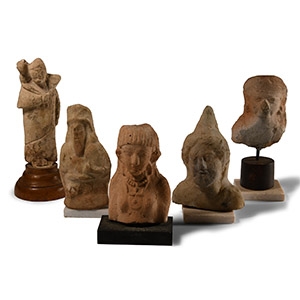
Phoenician Terracotta Figure Collection
Circa 6th-5th century B.C.Sold for (Inc. bp): £1,040
Including standing figure with a lamb across his shoulders, female with disc pendant between her breasts, bearded male bust with pointed headgear and other types, each on a custom-made stand. 690 grams total, 10.5-14.5 cm including stand
From a collection acquired on the UK art market from various auction houses and collections mostly before 2000. From an important Cambridgeshire estate; thence by descent.
