
Loading, please wait...
_900x900.jpg "Graeco-Phoenician Mottled Agate Scaraboid with Three Line Inscription")
_200x200.jpg "Graeco-Phoenician Mottled Agate Scaraboid with Three Line Inscription")
.jpg "Graeco-Phoenician Mottled Agate Scaraboid with Three Line Inscription")
LOT 0090
Graeco-Phoenician Mottled Agate Scaraboid with Three Line Inscription
6TH-5TH CENTURY B.C.
5/8 in. (2.11 grams, 16 mm).
Plano-convex with three lines of incised text to the underside within a hatched border; supplied with a museum-quality impression.
ProvenanceFrom the Fadel family collection, London, UK, 1970s.
CONDITIONTimeLine Auctions follows a vetting process to ensure the authenticity and legality of all items, reinforcing our commitment to integrity and responsible trading. Each antiquity, antique, and coin lot undergoes thorough examination by a vetting committee of at least ten external specialists, professional trade association members, scientists, and archaeologists: Our Vetting Process
AUCTIONS:
TimeLine is a leading auction house specialising in antiquities, ancient art, collectables, natural history, coins, medals, and books. Our auctions offer museums, collectors, historians, and enthusiasts the opportunity to acquire unique and historically significant pieces.
LOT 0090
Graeco-Phoenician Mottled Agate Scaraboid with Three Line Inscription
Estimate £1,200 - 1,700€1,390 - 1,970 (for guidance only)$1,620 - 2,300 (for guidance only)
-
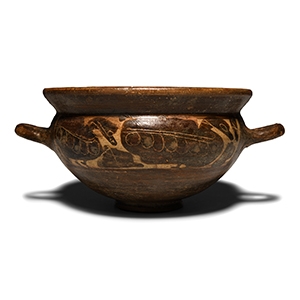
Etrusco-Corinthian Bowl with Painted Ducks
575-550 B.C.Sold for (Inc. bp): £845
Squat skyphos on a low, pared conical base; two small horizontal handles round in section, short flaring everted rim; painted in dark brown with decoration limited to two window-like areas between the handles; on either side of the bowl two large ducks moving to the right with incision and overpaint clarifying the mass of the bodies, wings indicated with two quick horizontal strokes and a row of pendant arcs or scallops with dots of red and white overpaint for a rich, feathered effect; rosettes filling the space around the ducks. 257 grams, 18 cm wide
In the collection of Mr Ulfert Wilke, founding Director of the University of Iowa Museum of Art. Acquired from Ulfert Wilke on 29 May 1968. From the collection of Dr Howard Sirak, Columbus, Ohio, USA. Ex I.M. Chait Gallery, Los Angeles, USA, 14 December 2020, lot 212. Property of a South Australian private collector, with collection reference 20.34. Accompanied by detailed collector's catalogue pages including description and photograph.
The catalogue cites this piece as no. 3.10 from the Wilke Collection and the original sticker is on the base. The catalogue was for the exhibition at the University of Iowa Museum of Art from 17 March to 30 April 1971. -
.jpg)
Etruscan Bronze Statuette with Offering
4th-3rd century B.C.Sold for (Inc. bp): £845
Modelled in the round as a figure of a lar standing with the left hand raised with palm facing forwards, right arm extending forwards and holding a patera in the hand; wearing a close-fitting short-sleeved tunic with a folded and draped mantle above; the face with aquiline nose, lentoid eyes and a small pursed mouth and with a loose-fitting cap retaining the hair; mounted on a custom-made display stand. 295 grams total, 13.3 cm including stand
From a collection acquired on the UK art market from various auction houses and collections mostly before 2000. From an important Cambridgeshire estate; thence by descent.
The gesture is typical for making sacrifice. The curved hem of the garment, which originally could be seen both behind and in front of the left leg, shows that this is a tebenna, a typical Etruscan male dress, distinguished by its semi-circular shape from the rectangular Greek himation. -
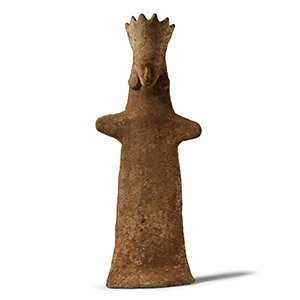
Boeotian Plank Idol of a Goddess
Circa 6th century B.C.Sold for (Inc. bp): £910
Tapering flat-section body with ledge base, stub arms, applied facial detailing, tall polos headdress. 157 grams, 23 cm
From a collection acquired on the UK art market from various auction houses and collections mostly before 2000. From an important Cambridgeshire estate; thence by descent. Accompanied by a thermoluminescence analysis report from Oxford Authentication no.N124d7. This lot has been checked against the Interpol Database of stolen works of art and is accompanied by a search certificate number no.12087-214721.
