
Loading, please wait...



LOT 1806
Gold Saint George Pendant
19TH CENTURY A.D.
2 in. (18.41 grams, 50 mm).
In Byzantine style with wire coils to the outer edge, hinged loop; to the obverse, a repoussé beaded border framing a facing nimbate St George with cloak and akheton holding a spear across the body, 'ΓΟͼΡΓ' (George) inscription; to the reverse, an expanding-arm cross with bulb finials, tendrils below the arms, 'IC XC' above.
ProvenanceFrom the collection of a North American gentleman, formed in the 1990s.
CONDITIONTimeLine Auctions follows a vetting process to ensure the authenticity and legality of all items, reinforcing our commitment to integrity and responsible trading. Each antiquity, antique, and coin lot undergoes thorough examination by a vetting committee of at least ten external specialists, professional trade association members, scientists, and archaeologists: Our Vetting Process
AUCTIONS:
TimeLine is a leading auction house specialising in antiquities, ancient art, collectables, natural history, coins, medals, and books. Our auctions offer museums, collectors, historians, and enthusiasts the opportunity to acquire unique and historically significant pieces.
-
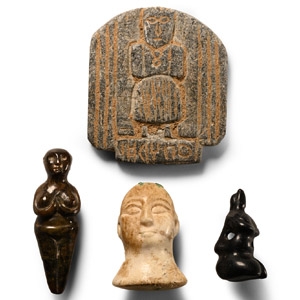
Group of Stone Figurines
20th century A.D.Sold for (Inc. bp): £169
Various types in 1st millennium B.C. style. 41 grams total, 26-45 mm
Collected from 1969-1999. From the collection of the late Mr S.M., London, UK. -

Tudor Jewelled Silver-Gilt Clothes Fastener
16th century A.D.Sold for (Inc. bp): £59
Comprising trefoil domes adorned with filigree flowers each with four petals, central jewelled setting, surrounded by a further ten jewelled settings, repaired hook to reverse. 5.51 grams, 28 mm
Previously acquired in 1989. UK gallery, early 2000s. Old accession number inked to verso: '89.522'. -
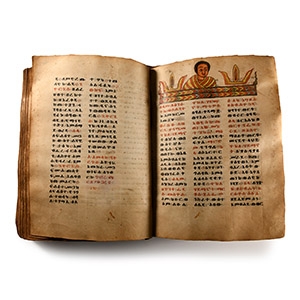
Ethiopian Leather 'Book of Psalms' Codex
17th century A.D.Sold for (Inc. bp): £4,420
Wooden end-boards covered with tooled leather, later reinforced with a new plain leather spine and replaced twine stringers; psaltery with decorated title page in Ge'ez script, red and black ink; parchment pages with dry-point guidelines, black text with red detailing; some pages with decorative polychrome busts, architectural features, etc. 3.5 kg, 32.5 x 24.5 cm
Ex Claudia Belcher, London, until 2005. This lot has been checked against the Interpol Database of stolen works of art and is accompanied by search certificate no.12045-212183.
