
Loading, please wait...
_900x900.jpg "Gnathian Plastic Vase in the Shape of a Woman")
_200x200.jpg "Gnathian Plastic Vase in the Shape of a Woman")
_900x900.jpg "Gnathian Plastic Vase in the Shape of a Woman")
_200x200.jpg "Gnathian Plastic Vase in the Shape of a Woman")
_900x900.jpg "Gnathian Plastic Vase in the Shape of a Woman")
_200x200.jpg "Gnathian Plastic Vase in the Shape of a Woman")
.jpg "Gnathian Plastic Vase in the Shape of a Woman")
.jpg "Gnathian Plastic Vase in the Shape of a Woman")
.jpg "Gnathian Plastic Vase in the Shape of a Woman")
LOT 0104
Gnathian Plastic Vase in the Shape of a Woman
4TH-3RD CENTURY B.C.
12 1/4 in. (1.34 kg total, 31 cm high excluding stand).
Hollow-formed with broad chamfered base, body modelled as the head of a woman supporting the neck in the form of a trefoil oinochoe with a high, curving handle to the rear; moulded head with detailed swept hair hair wrapped in a cloth (sakkos), and stern facial features; circumferential painted band beneath the rim and vertical strokes; supplied with a custom-made stand.
ProvenanceAcquired from Galerie Simone de Monbrison, Rue Bonaparte, Paris, France, 1980.
Accompanied by a thermoluminescence analysis report no.N125e36 from Oxford Authentication.
Accompanied by a copy of French passport no.150924, dated 19 December 2013.
This lot has been checked against the Interpol Database of stolen works of art and is accompanied by a search certificate number no.12666-234641.
This lot has been cleared against the Art Loss Register database, and is accompanied by an illustrated lot declaration signed by the Head of the Antiquities Department, Dr Raffaele D'Amato.
Cf. Beazley, J.D., Charinos: Attic Vases in the Form of Human Heads in Journal of Hellenic Studies 49, 1929, pp.38-78.
CONDITIONTimeLine Auctions follows a vetting process to ensure the authenticity and legality of all items, reinforcing our commitment to integrity and responsible trading. Each antiquity, antique, and coin lot undergoes thorough examination by a vetting committee of at least ten external specialists, professional trade association members, scientists, and archaeologists: Our Vetting Process
AUCTIONS:
TimeLine is a leading auction house specialising in antiquities, ancient art, collectables, natural history, coins, medals, and books. Our auctions offer museums, collectors, historians, and enthusiasts the opportunity to acquire unique and historically significant pieces.
LOT 0104
Gnathian Plastic Vase in the Shape of a Woman
Estimate £8,000 - 10,000€9,280 - 11,600 (for guidance only)$10,800 - 13,500 (for guidance only)
-
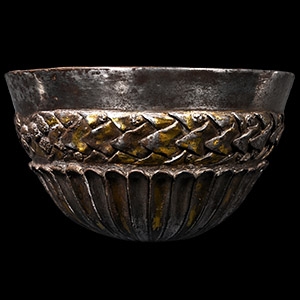
Hellenistic Silver-Gilt Drinking Cup
2nd-1st century B.C.Sold for (Inc. bp): £13,000
A heavy hemispherical vessel with simulated braid beneath the rim and Hercules' knot; the body with lotus-flower ornament. 508 grams, 10.9 cm
Acquired before 1983. Ex London gallery, 1990s. This lot has been checked against the Interpol Database of stolen works of art and is accompanied by a search certificate number no.12661-236259. This lot has been cleared against the Art Loss Register database, and is accompanied by an illustrated lot declaration signed by the Head of the Antiquities Department, Dr Raffaele D'Amato. -
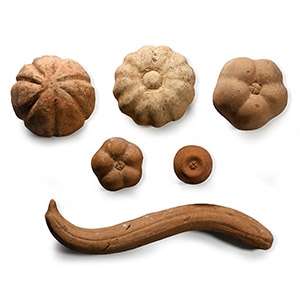
Greek Terracotta Model Fruit and Vegetable Group
4th century B.C.Estimate: £1,000 - 1,400 (‡+bp*)
Opening Bid: £500
Including pomegranates, apples and a gourd. 989 grams total, 4.5-18.7 cm
Estate of Mr Bruno Fellinger (1926-2016), Küsnacht, Switzerland. with Galerie Rhéa, Zurich, Switzerland. This lot is accompanied by an illustrated lot declaration signed by the Head of the Antiquities Department, Dr Raffaele D'Amato. -
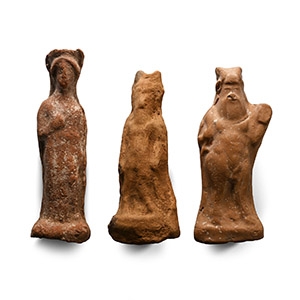
Greek Terracotta Figure Group
3rd-1st century B.C.Estimate: £300 - 400 (‡+bp*)
Opening Bid: £135
Each moulded with plain reverse, some facial and body detailing to obverse with flared foot. 200 grams total, 10.4-11.1 cm
Acquired in the 1990s. Private collection, Switzerland, thence by descent. Private collection, since the late 1990s. This lot is accompanied by an illustrated lot declaration signed by the Head of the Antiquities Department, Dr Raffaele D'Amato.
