
Loading, please wait...
LOT 1903
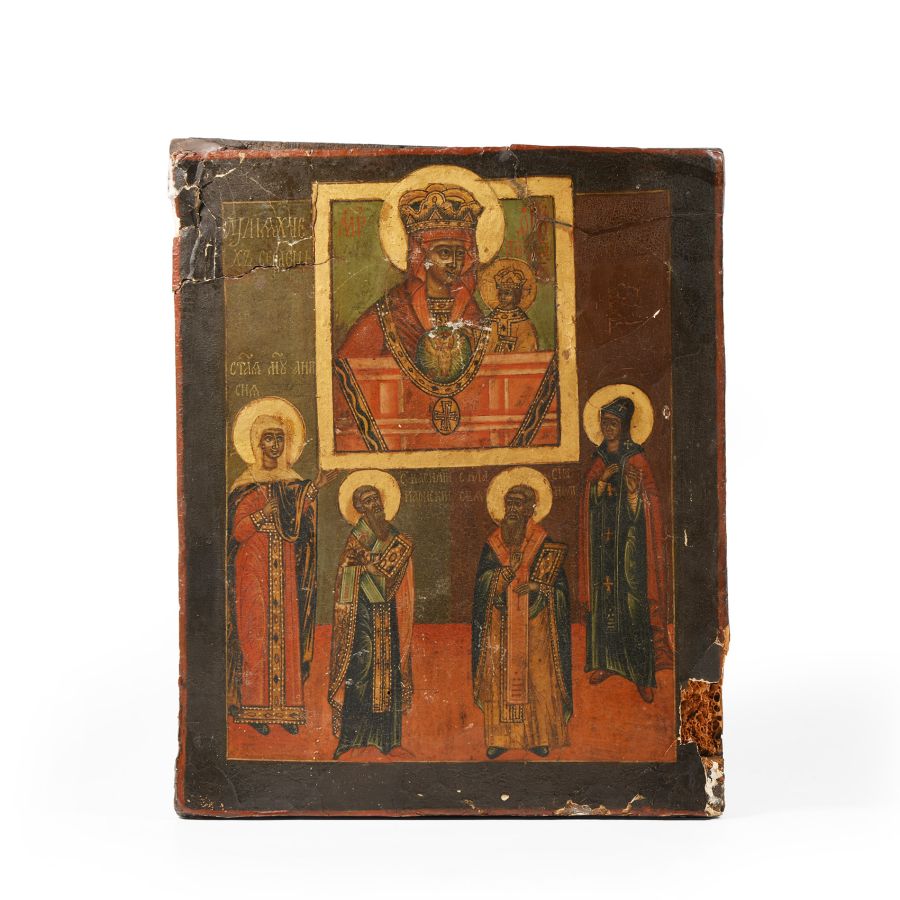
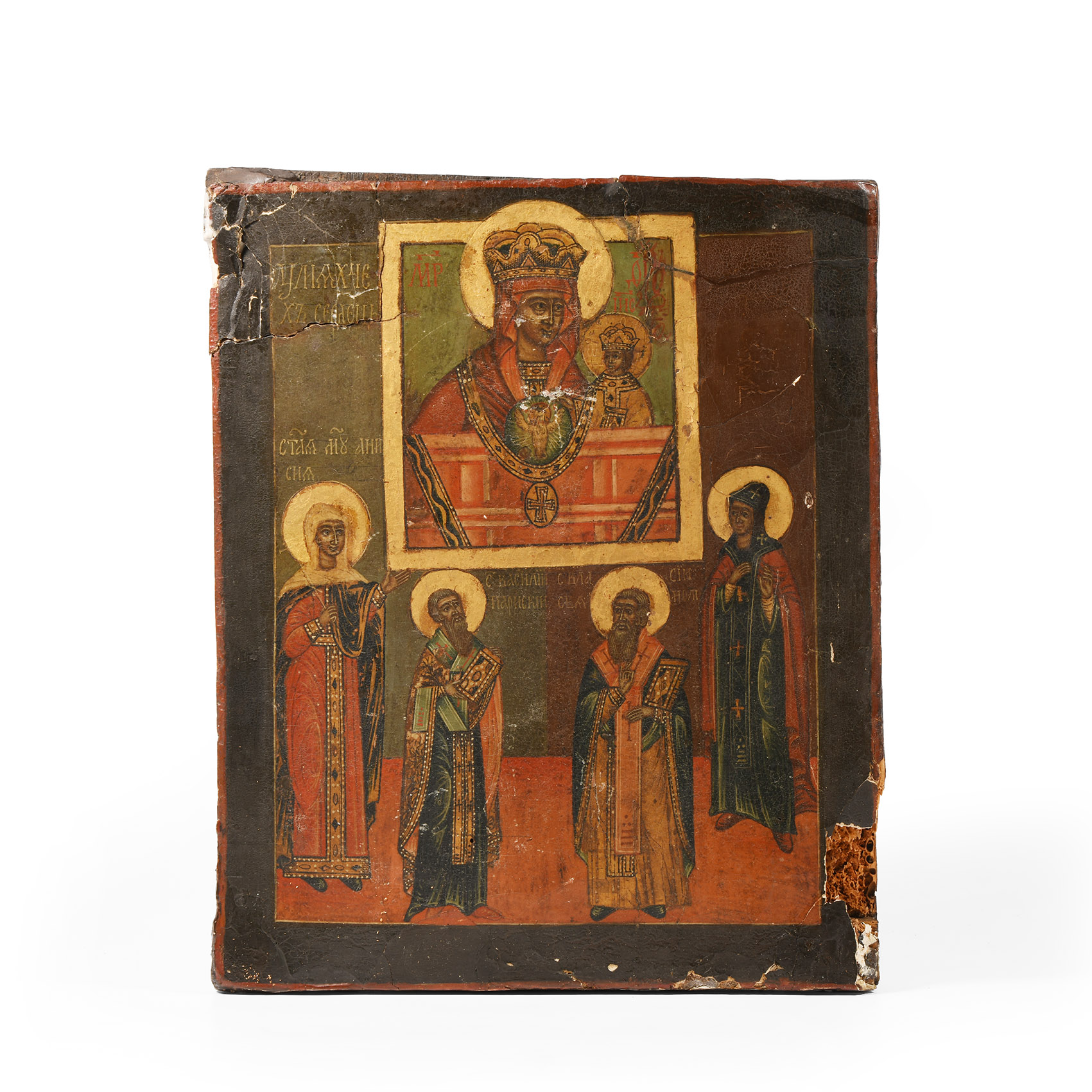
Gilt Painted Wooden Icon Of Virgin and Child
CIRCA 18TH CENTURY A.D.
11 in. (796 grams, 28 cm).
Depicted crowned and nimbate in a central panel, the bust of the Virgin encased in a medallion with a cross pendant, with inside the Holy Spirit under shape of dove and with nimbus, four nimbate figures of Saint Anna, Saint Basil the Great, Saint Simeon and another Saint below; text in the fields.
ProvenanceEx French gallery, Paris.
LiteratureVarious, Katalog, Icons, Archangel Cathedral, Moscow Kremlin, XIV - early XX century, Moscow, 2016, cat.13, p.139; 22, p.169; 32, p.206.
FootnotesThe rare Marian iconographic typology is called ''Mother of God who softens sick hearts', where she carries the Holy Spirit on her breast, represented by a dove emitting rays of light. In particular, it is a variant of the Madonna Odighitria. Both the mother and the child are depicted as the queen and king of the universe: the Virgin wears a crown on her head and holds the Child, who is also blessing with the right hand.
CONDITIONTimeLine Auctions follows a vetting process to ensure the authenticity and legality of all items, reinforcing our commitment to integrity and responsible trading. Each antiquity, antique, and coin lot undergoes thorough examination by a vetting committee of at least ten external specialists, professional trade association members, scientists, and archaeologists: Our Vetting Process
AUCTIONS:
TimeLine is a leading auction house specialising in antiquities, ancient art, collectables, natural history, coins, medals, and books. Our auctions offer museums, collectors, historians, and enthusiasts the opportunity to acquire unique and historically significant pieces.
-

Post Medieval Gold 'No Felicitie to Constancie' Decorated Posy Ring
Late 17th-18th century A.D.Sold for (Inc. bp): £546
Composed of a slender convex hoop engraved with crowned conjoined hearts flanked by birds, in turn pursued by bounding hounds, scrolling foliage and a cross at base; trace remains of enamelling; interior inscribed in cursive script: 'No felicitie to constancie', together with maker's stamp 'IY' in a square cartouche. 1.38 grams, 17.35 mm overall, 15.48 mm internal diameter (approximate size British J, USA 4 3/4, Europe 8.69, Japan 8)
Acquired on the UK antiques market between 1974-1985. Albert Ward collection, Essex, UK.
IY goldsmith's mark possibly for James Young of London, see Jackson, Sir C.J., English Goldsmiths and Their Marks, London, 1921, p.215. In the medieval period many rings bore posy inscriptions in Latin or French, the languages frequently spoken by the affluent elites. Later, inscriptions in English became more usual, although the lack of standardisation in spelling might surprise the modern reader. The inscription is generally found on the interior of the ring, hidden to everyone except the wearer and most of the sentimental mottoes were taken from the popular literature of the time. In fact, love inscriptions often repeat each other, which suggests that goldsmiths used stock phrases. In the later 16th century, ‘posy’ specifically meant a short inscription. A posy is described in contemporary literature as a short ‘epigram’ of less than one verse. George Puttenham (1589) explained that these phrases were not only inscribed on finger rings, but also applied to arms and trenchers. The practice of giving rings engraved with mottoes at betrothals or weddings was common in England from the 16th century onwards, and continued until the late 18th century. Sources suggest that rings could be acquired ready- engraved, or alternatively engraved sometime after their initial production, by a hand other than the goldsmith’s. Joan Evans assumed that posy rings were principally used by/between lovers and distinguished four contexts for the giving of posy rings by one lover to another: betrothals, weddings, St Valentine’s Day and occasions of mourning. Samuel Pepys’ diary makes clear that posy rings might also mark the marriage of a family member, when bearers could even commission their own rings and chose their own mottoes from books. The rings could also function as tokens of friendship or loyalty. -

Gilt Painted Wooden Icon of Saint George
Circa 19th century A.D.Sold for (Inc. bp): £172
Dressed in armour and holding a spear, carrying a shield on his back, quiver of arrows on his hip with bow over arm, and one hand on a sword at his side, against a gilt background; text across left and right field reading 'Свети Георги' (Saint George). 667 grams, 33.2 cm
Ex French gallery, Paris.
Saint George, a Roman soldier of the 4th century, martyred under Diocletian, soon became the emblem of the military saint par excellence, defender of the faith and protector of armies. In the east, his icons and images were often carried into battle or placed on standards of Christian armies; in the West, he became a patron of chivalry. Here he is represented in late Roman armour, according to the style in use in Byzantium between the 14th and 15th centuries. -
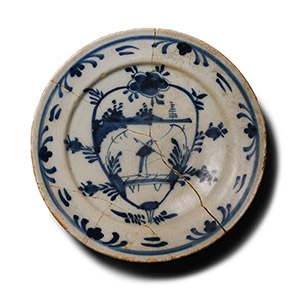
Post Medieval Delft Tin-Glazed Ceramic Plate
17th century A.D.Sold for (Inc. bp): £39
Displaying a figure crossing a bridge within a cartouche, embellished with flowering foliage; repaired. 417 grams, 22.2 cm wide
Acquired 1960s-1990s. Late Alison Barker collection, a retired London barrister.
