
Loading, please wait...
LOT 0227
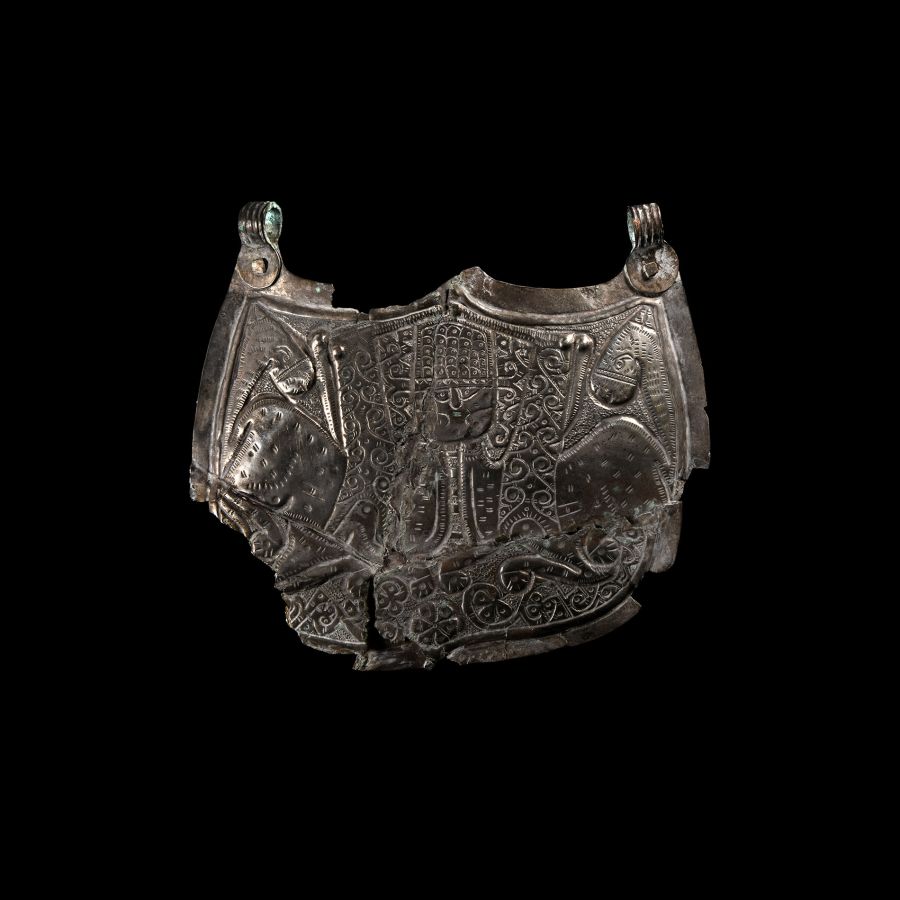
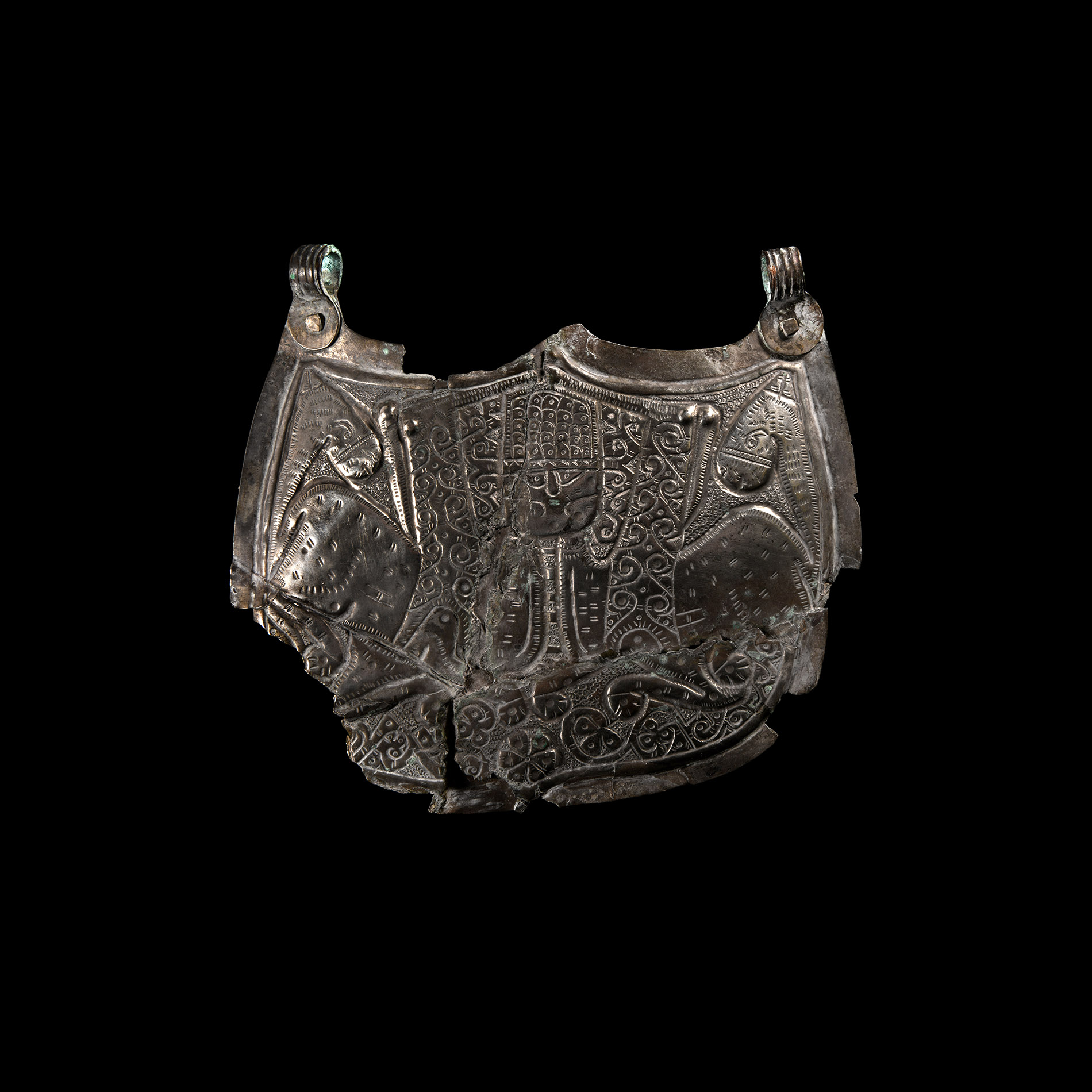
Ghurid Silver Pectoral with Animals
CENTRAL ASIA, 13TH CENTURY A.D.
6 3/4 in. (90 grams, 17 cm).
Featuring curved sides and bottom, scalloped upper edge; median figure in textured hat flanked by two resting camels on a pounced field; applied loop to each upper corner; some old repairs.
ProvenanceLondon, UK gallery 1971-early 2000s.
with Bonhams, London, Islamic & India Art sale, circa 2015, p.45, lot 55.
This lot has been checked against the Interpol Database of stolen works of art and is accompanied by search certificate no.202353.
Ghurid Dynasty metalwork is poorly represented when compared to the architecture of the period, and the majority of surviving pieces are items of jewellery mostly in Russian museum collections. The sculptural nature of the decoration of this repoussé sheet sets it apart from the more usual output of Iran at this time, recalling the fine silversmithing of the Sasanian period.
CONDITIONTimeLine Auctions follows a vetting process to ensure the authenticity and legality of all items, reinforcing our commitment to integrity and responsible trading. Each antiquity, antique, and coin lot undergoes thorough examination by a vetting committee of at least ten external specialists, professional trade association members, scientists, and archaeologists: Our Vetting Process
AUCTIONS:
TimeLine is a leading auction house specialising in antiquities, ancient art, collectables, natural history, coins, medals, and books. Our auctions offer museums, collectors, historians, and enthusiasts the opportunity to acquire unique and historically significant pieces.
LOT 0227
Ghurid Silver Pectoral with Animals
Estimate £2,000 - 3,000€2,320 - 3,480 (for guidance only)$2,700 - 4,050 (for guidance only)
-

Central Asian Bronze Compartmented Seal Matrix
3rd-2nd millennium B.C.Sold for (Inc. bp): £39
Segmented wheel with U-shaped loop; accompanied by an old scholarly note, typed and signed by W.G. Lambert, late Professor of Assyriology, University of Birmingham, 1970-1993, which states: 'Stamp Seal of Bronze. 46 x 48 x 18. This is roughly round, compartmented, and open work except for the central star. There is a largish circle in the middle, a six-pointed star around it. and a band of 11 oblongs around the outer edge. 6 in three pairs matching the points of the stars [sic]. This is a seal from west central Asia, c. 2300-2000 B.C. It is well preserved and a largish example of its kind. There is a loop handle on the back.' 35.5 grams, 47 mm
From an important London, UK, collection, 1970s. Accompanied by a scholarly note by Professor Wilfrid George Lambert FBA (1926-2011), historian, archaeologist, and specialist in Assyriology and Near Eastern archaeology. -
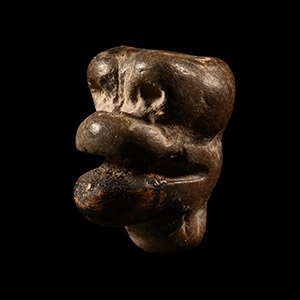
Western Asiatic Stone Pazuzu Amulet Head
8th-6th century B.C.Sold for (Inc. bp): £72
The grotesque face modelled with a gaping mouth and bulging eyes; drilled vertically for suspension. 5.37 grams, 20 mm
with a London, UK gallery 1971-early 2000s. -
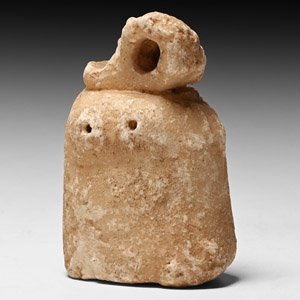
Tel Brak Type Alabaster Eye Idol
Circa 3rd millennium B.C.Sold for (Inc. bp): £234
Anthropomorphic eye idol, possibly of figurative female form, carved with a bell-shaped body, two 'breasts', remains of openwork 'eyes' above. 33.5 grams, 43 mm
Acquired 1969-1999. London collection of the late Mr S.M., thence by descent.
A classic artefact type from ancient Mesopotamia. Likely hand-carved using drills and string cutting. Eye idols were so named in the 1930s by the British archaeologist Max Mallowan. Whilst excavating a mound called Tel Brak, he discovered hundreds of anthropomorphic items of similar form, thus naming the mound 'Temple of the Eyes'.
