
Loading, please wait...
_900x900.jpg "German WWII Stick Grenade Group")
_200x200.jpg "German WWII Stick Grenade Group")
.jpg "German WWII Stick Grenade Group")
LOT 1068
German WWII Stick Grenade Group
1914-1945 A.D.
17 1/2 in. (684 grams, 44.5 cm).
German practice stick grenade group including: a WWII model 24 Stielhandgranate with pierced red-coloured head; together with a restored relic head of WWI date.
ProvenanceAcquired from The Lanes Armoury, Brighton, and Graham Currie Militaria.
The Kusmirek Collection, UK.
Accompanied by copies of the listings.
The brb-code name for Richard Rinker GmbH, was used for training German armed forced during WWII. Its distinctive appearance lead to it being dubbed the stick grenade' or 'potato masher' in British army slang. It used a friction igniter, with a pull cord running through the hollow wooden handle terminating in a porcelain ball.
CONDITIONTimeLine Auctions follows a vetting process to ensure the authenticity and legality of all items, reinforcing our commitment to integrity and responsible trading. Each antiquity, antique, and coin lot undergoes thorough examination by a vetting committee of at least ten external specialists, professional trade association members, scientists, and archaeologists: Our Vetting Process
AUCTIONS:
TimeLine is a leading auction house specialising in antiquities, ancient art, collectables, natural history, coins, medals, and books. Our auctions offer museums, collectors, historians, and enthusiasts the opportunity to acquire unique and historically significant pieces.
LOT 1068
German WWII Stick Grenade Group
Estimate £200 - 300€230 - 350 (for guidance only)$270 - 410 (for guidance only)
-
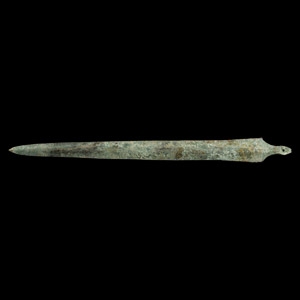
North-West Persian Bronze Sword Blade
Early 1st millennium B.C.Sold for (Inc. bp): £130
Narrow triangular blade with raised median panel, scooped shoulders and short tang with pierced bulb finial. 370 grams, 45 cm
Ex German collection, Cologne, 1980-1990s.
The hilt of this magnificent sword would have originally been made of organic material. The forms of hilt are often replicated on cast metal counterparts. As proved by excavations of sites like Sangtarashan, stones were often used for decorating metal weapons, especially for bronze dagger pommels. -
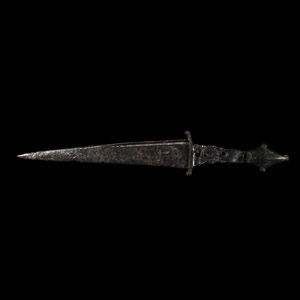
Medieval Quillon Dagger with Bronze Pommel
England or Germany, 16th century A.D.Sold for (Inc. bp): £1,430
Featuring a hexagonal brass pommel engraved with a fleur-de-lis to one side and a dragon to the other; pierced tang, two short quillons inclining towards the blade, terminating in lion head-shaped finials; straight single-edged blade, with side ridges to both faces of the blade, tapering to a fine point. 177 grams, 34 cm
Tang is heavily corroded, trace of employment on the battlefield.
Acquired 1960s-1990s. Late Alison Barker collection, a retired London barrister.
Quillon daggers were predominantly employed as a military weapon. During the 16th century, this dagger continued to be popular, although the hilt no longer resembled that of the contemporary sword, as sword hilts had developed into more intricate forms. -
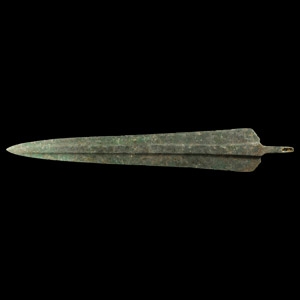
Luristan Bronze Short Sword Blade
Early 1st millennium B.C.Sold for (Inc. bp): £130
Triangular with thick rectangular-section midrib, rounded shoulders, narrow tip, short tang with inserted fixing pin for the organic grip. 472 grams, 42.2 cm
Ex German collection, Cologne, 1980-1990s.
This tanged bronze blade from Luristan belongs to a category of Luristan swords still in use in Achaemenid Period, as proved from a blade with a perished handle (probably bone or wood) of the same type, in the National Museum of Iran (2694/15633). Examples without inscriptions like our model have been classified by Grotkamp-Schepers in the Solingen Museum as pieces from Luristan.
