
Loading, please wait...
LOT 1171
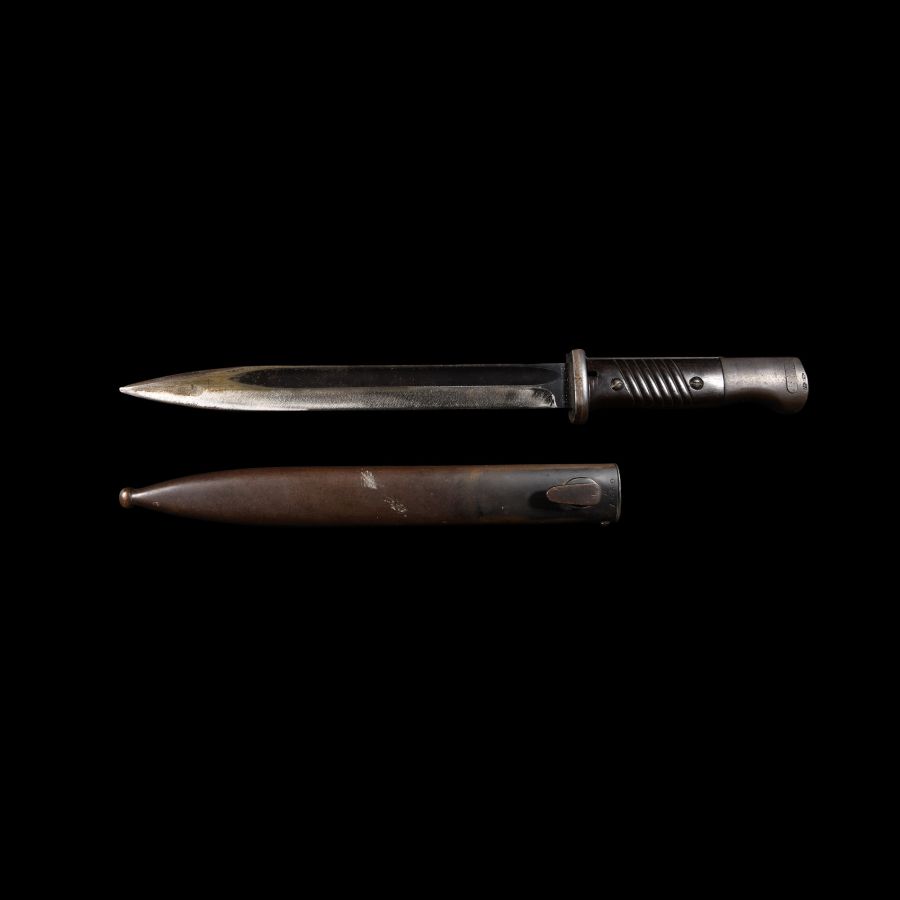
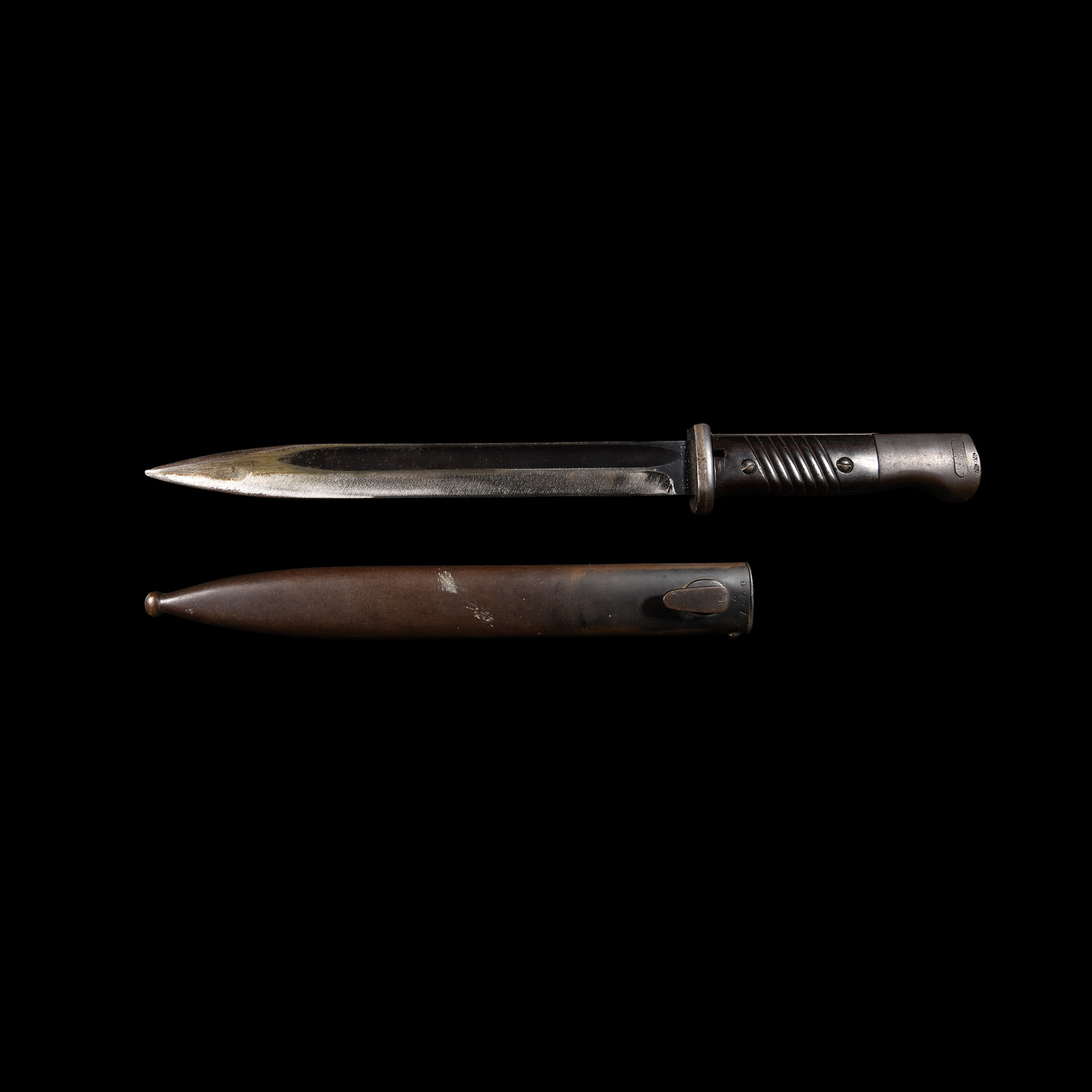
German M1884/98 Third Model Bayonet and Scabbard
DATED 1940 A.D.
16 in. (588 grams, 40.5 cm).
Comprising a knife bayonet for use with the Second World War 8 mm Mauser Kar 98k rifle; fitted with resin grip scales and spring release button; scabbard with original throat and chape. [No Reserve]
ProvenanceProperty of a Luton, UK gentleman, by inheritance.
LiteratureSee Capwell, T., Knives, Daggers and Bayonets, Lorenz, 2009, p.180, for general type and details.
FootnotesThe bayonet offered here is an example of the third pattern of bayonet manufactured in 1927-1930 and again in the period 1934-1935, with this specific example having been produced in 1935. In an attempt to keep their identities a secret, the makers of these weapons stamped the blades with a letter/number code, a practice they repeated for the scabbards. This scabbard bears the code for 1943, although it was double struck. Both blade and scabbard in this instance were produced by E. & F. Horster & Co. of Solingen, and the weapon is apparently a pre-war example that was captured and reworked in eastern Europe, likely Yugoslavia.
The plastic grips such as those used on our bayonet, and typically found on M1884/98 III bayonets, are made from a phenolic resin. Owing to a shortage of such resin in Germany during WWII a substitute moulding compound known as type 41, which contained a much lower percentage of resin, was adopted in January 1943.
TimeLine Auctions follows a vetting process to ensure the authenticity and legality of all items, reinforcing our commitment to integrity and responsible trading. Each antiquity, antique, and coin lot undergoes thorough examination by a vetting committee of at least ten external specialists, professional trade association members, scientists, and archaeologists: Our Vetting Process
AUCTIONS:
TimeLine is a leading auction house specialising in antiquities, ancient art, collectables, natural history, coins, medals, and books. Our auctions offer museums, collectors, historians, and enthusiasts the opportunity to acquire unique and historically significant pieces.
-
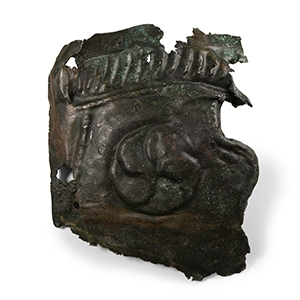
Roman Bronze Military Helmet Face Guard Section
3rd century A.D.Sold for (Inc. bp): £715
From the right side of the face mask, the upper edge with a band of embossed diagonal lines, probably intending to represent stylised hair, embossed spiral to the centre, a symbol clearly connected with the worship of the sun; a hole for the fastening thongs at ear-level which originally linked the face-guard to the bowl. 75 grams, 13 cm high
Acquired 1960s-1990s. Late Alison Barker collection, a retired London barrister.
The spiral decoration of the face-guard is connected with the solar cult. The spiral represents the rotary movement of the sun, and the spiral is probably the oldest known spiritual symbol connected with the sun, together with the swastika or tetragammadion. The connection can also be seen in Celtic art, where the representation of the spiral also follows the path of the sun, describing the movements of the heavenly body over the course of a solar year. The third century was characterised by diffusion of the solar cult, the Sol Invictus, among the Roman soldiers, with its symbols often represented on arms and weapons as an apotropaic element of protection. -
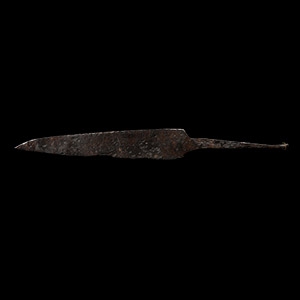
Tudor Period Iron Dagger
16th century A.D. or laterEstimate: £100 - 140 (+bp*)
Opening Bid: £40
Comprising a single cutting edge and tang. 155 grams, 28.5 cm
Acquired 1960s-1990s. Late Alison Barker collection, a retired London barrister. -
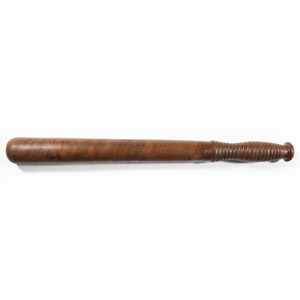
Victorian Police Truncheon
19th century A.D.Sold for (Inc. bp): £124
Composed of a tapering wooden blunt-tipped shaft, waisted grip with raised ribs and 'button' terminal. 309 grams, 43 cm
The Kusmirek Collection, UK.
