
Loading, please wait...
LOT 1135
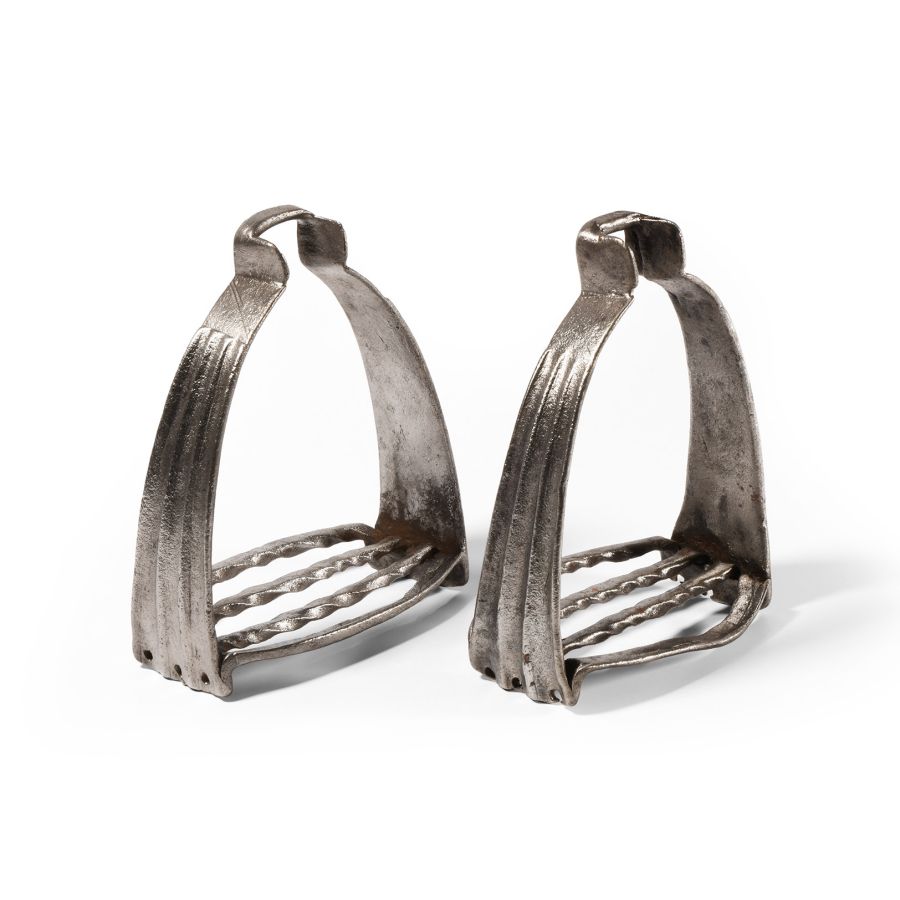
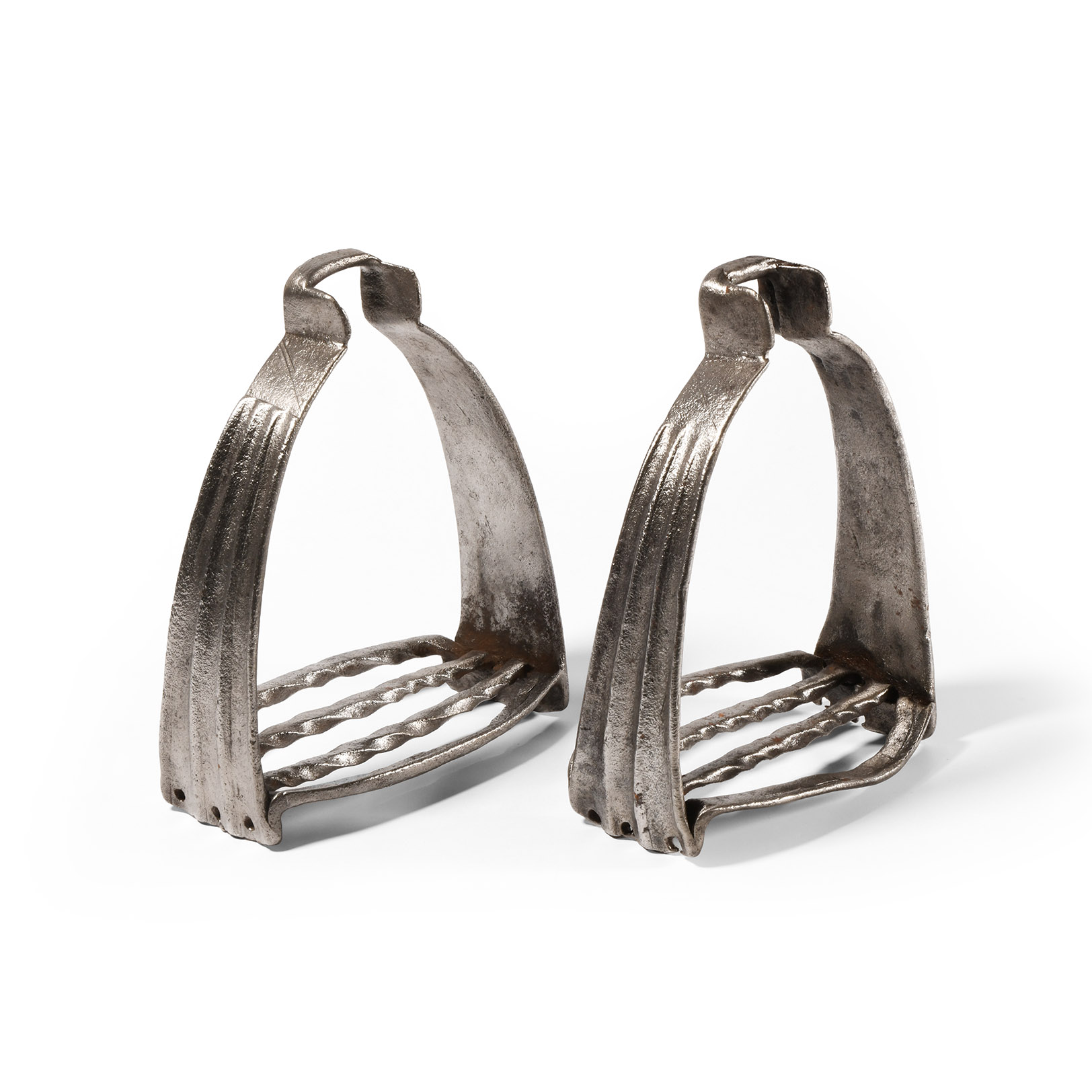
German Iron Stirrup Pair
16TH CENTURY A.D.
6 1/2 in. (780 grams total, 16.5 cm each).
Featuring twisted bar open treads, arched side pieces grooved and connected by a strap bar. [2]
ProvenanceAcquired from Czerny's Auctions, Italy, 2016, lot 313.
The Kusmirek Collection, UK.
Accompanied by a copy of Czerny's invoice and lot details.
TimeLine Auctions follows a vetting process to ensure the authenticity and legality of all items, reinforcing our commitment to integrity and responsible trading. Each antiquity, antique, and coin lot undergoes thorough examination by a vetting committee of at least ten external specialists, professional trade association members, scientists, and archaeologists: Our Vetting Process
AUCTIONS:
TimeLine is a leading auction house specialising in antiquities, ancient art, collectables, natural history, coins, medals, and books. Our auctions offer museums, collectors, historians, and enthusiasts the opportunity to acquire unique and historically significant pieces.
LOT 1135
German Iron Stirrup Pair
Estimate £400 - 600€460 - 700 (for guidance only)$540 - 810 (for guidance only)
-
Luristan Bronze Sword with 'Ear' Pommel
10th-9th century B.C.Sold for (Inc. bp): £585
Comprising a long tapering blade, rectangular-section hilt with raised circular bosses, horned crescent-shaped guard curved to accept the blade and a large bifurcated pommel formed as two ear-lobes with ribbed joining shank. 1.17 kg, 66 cm
Acquired in the early-1990s. Ex Guernsey collection. The Kusmirek Collection, UK.
This kind of sword was entirely made of cast bronze. They were characterised by an 'ear' pommel and raised mid-rib on the blade, square shoulders and rectangular, open guard. The handle was cast on the blade. The square and solid sectioned handle has bossed with reinforcements which allow a better grip. -
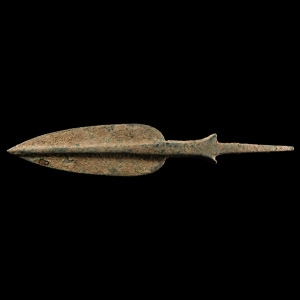
Amlash Bronze Spear Blade
12th-11th century B.C.Sold for (Inc. bp): £208
Leaf-shaped blade with pronounced midrib, square-section neck with flared ends and thick square-section tang. 299 grams, 26.7 cm
Ex German collection, Cologne, 1980-1990s.
The spearhead belongs to the type I of tripartite spears with broad mid-rib, reinforced shaft opening to reveal the tang and rounded shoulders. The blade with curved shoulders, a sharp point and a rectangular mid-rib. Stutzinger dated these pieces to 1200-1100 B.C. -
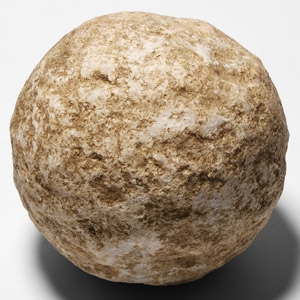
Roman Marble Ballista Catapult Shot
1st-3rd century A.D.Sold for (Inc. bp): £1,430
Suitable for use with an onager or other small catapult-type siege weapon; with roughened, abrasive surface. 682 grams, 79 mm
Acquired 1971-1972. From the collection of the vendor's father. Property of a London, UK, collector.
The operation of the onager (Latin for 'wild ass') is first mentioned in 353 A.D. by Ammianus Marcellinus in his Res Gestae and more fully in Vegetius's Epitoma Rei Militaris probably written in the reign of Emperor Theodosius I (378-395 A.D.).
