
Loading, please wait...
LOT 0418
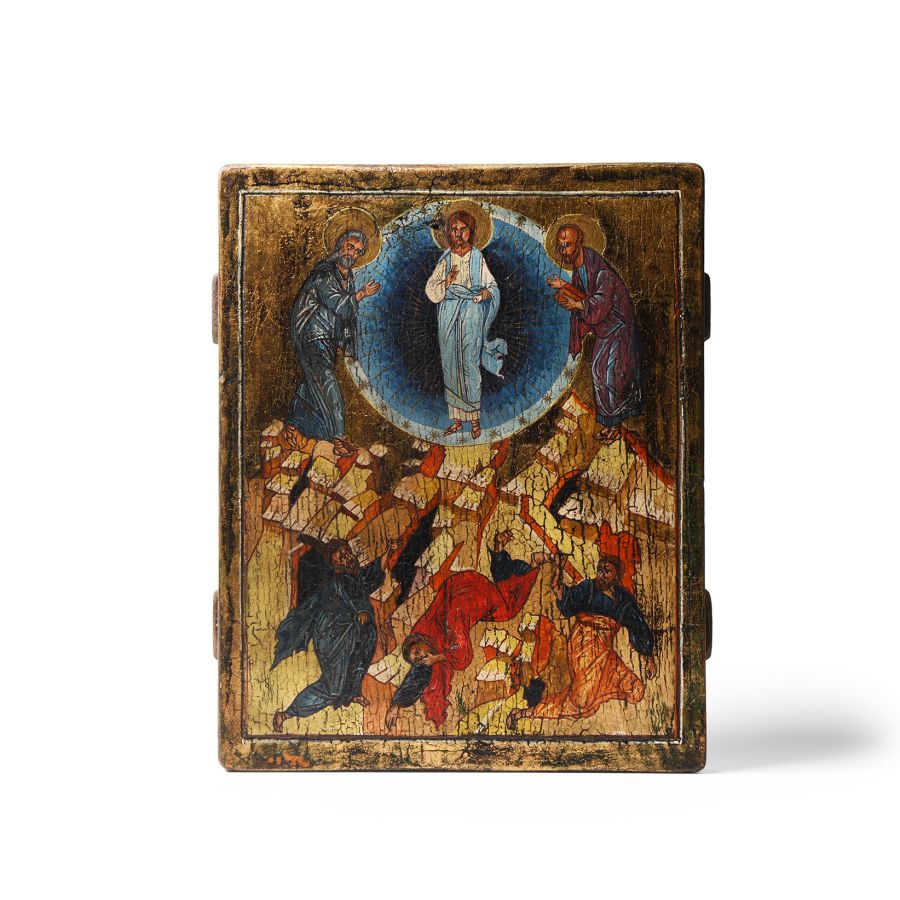
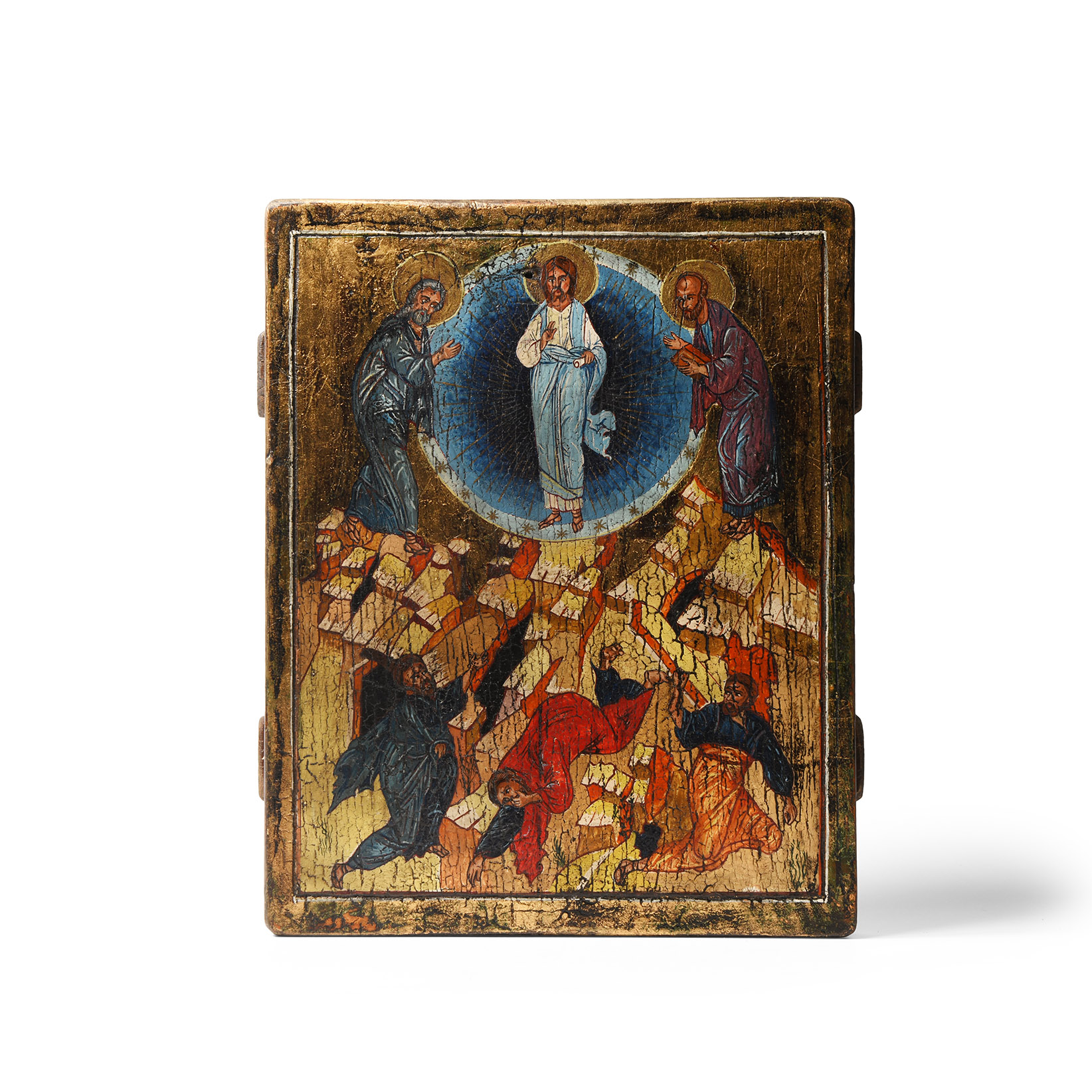
German Gilt Wooden Transfiguration Icon
19TH-20TH CENTURY A.D.
11 3/4 in. (783 grams, 30 cm).
In 13th century A.D. style, Jesus represented in the centre in blue and white light, with shining clothes; to his right Moses, to his left Elijah; the mountain of Tabor represented in rocky fragments below, the disciples John, his brother James and Saint Peter in awe and terrified by the divine event; remains of a wax seal impression to reverse, together with a loop for suspension.
ProvenanceEx French gallery, Paris.
LiteratureCf. Iljina, T.W., Arcydzieła Malarstwa Rosyjskiego w Muzeach ZSRR (Masterpieces of Russian Painting in the Museums of the USSR, in Polish), Leningrad, 1989, p,33 fig.17, for the type.
FootnotesThe icon was realised following the tradition of the Novgorod school of 13th century A.D. A mandorla of blue and white light was usually used in most oriental icons. Not all icons of Christ have mandorlas and they are often used when representing divine light. The mandorla thus represents the ‘uncreated light’ that shines on the three disciples in the icons of Transfiguration. During the Feast of Transfiguration, the Orthodox sing a troparion which states that the disciples 'beheld the light as far as they were able to see it' signifying the different levels of their spiritual progress. Sometimes a star is superimposed on the mandorla, but here the stars are are impressed all around the edge. The mandorla represents the 'luminous cloud' and is another symbol of light. The luminous cloud, a sign of the Holy Spirit, descended on the mountain at the moment of the Transfiguration.
CONDITIONTimeLine Auctions follows a vetting process to ensure the authenticity and legality of all items, reinforcing our commitment to integrity and responsible trading. Each antiquity, antique, and coin lot undergoes thorough examination by a vetting committee of at least ten external specialists, professional trade association members, scientists, and archaeologists: Our Vetting Process
AUCTIONS:
TimeLine is a leading auction house specialising in antiquities, ancient art, collectables, natural history, coins, medals, and books. Our auctions offer museums, collectors, historians, and enthusiasts the opportunity to acquire unique and historically significant pieces.
LOT 0418
German Gilt Wooden Transfiguration Icon
Estimate £800 - 1,000€930 - 1,160 (for guidance only)$1,080 - 1,350 (for guidance only)
-
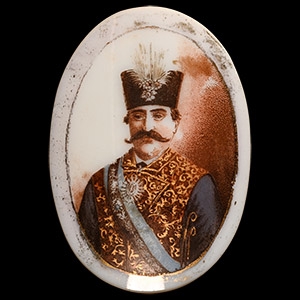
Post Medieval Bone China Portrait of Naser al-Din Shah Qajar
20th century A.D.Estimate: £300 - 400 (+bp*)
Opening Bid: £150
Painted onto bone china in polychrome and gilt, showing the ruler facing, dressed in royal attire. 27 grams total, 64 mm high (82 x 82 mm including box)
Acquired by the vendor's father on the UK art market, before 1990.
Naser al-Din Shah Qajar was the fourth Shah of Qajar, and the third longest reigning ruler in Iranian history. He was assassinated in Tehran on 1st May 1896. He is known for being the first modern Persian monarch to have formally visited Europe and to have written about his travels in his memoirs. -
.jpg)
Post Medieval Iron Bread Stamp Scissors
Circa 16th-17th century A.D.Sold for (Inc. bp): £351
Retaining an articulate press, the interior of one plate with four stamp designs, two larger and two smaller, each depicting the Crucifixion. 4.15 kg, 69 cm
Acquired 1960s-1990s. Late Alison Barker collection, a retired London barrister. -
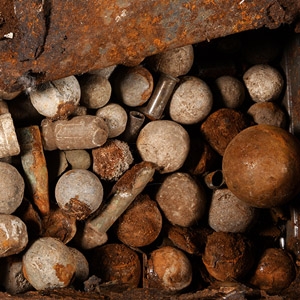
Post Medieval Lead Musket Ball Group
Circa 16th-19th century A.D.Sold for (Inc. bp): £13
Composed of shots of different gauges and dates; together with ammunition of a different type. 2.46 kg total, 8-57 mm (22 x 12 cm including box)
Acquired 1990s-early 2000s. East Anglian private collection.
