
Loading, please wait...
_900x900.jpg "Georgian Silver 'Born to Die' Ring")
_200x200.jpg "Georgian Silver 'Born to Die' Ring")
.jpg "Georgian Silver 'Born to Die' Ring")
LOT 1969
Georgian Silver 'Born to Die' Ring
CIRCA 18TH CENTURY A.D.
1 in. (7.28 grams, 23.96 mm overall, 20.39 mm internal diameter (approximate size British R 1/2, USA 8 3/4, Europe 19.38, Japan 18)).
Substantial hoop with segmented profile, low-relief inscription 'MORTI NATUS EST' to the underside, flowers in the following open field, ellipsoid plaques to the shoulders with facing skull motifs, owl with spread wings on the bezel. [No Reserve]
ProvenancePrivate collection, Arundel, West Sussex, UK, 1975-late 1990s.
LiteratureCf. Mills, N., Medieval Artefacts, Witham, 2003, p.51, NM130, for the type of ring.
FootnotesThe ring belongs to the memento mori (remember you shall die) ring type. Upon the bezel is engraved an owl, an animal symbol for the Other World. The inscription Morti Natus Est, means 'born to die' a reminder of fragility of life.
CONDITIONTimeLine Auctions follows a vetting process to ensure the authenticity and legality of all items, reinforcing our commitment to integrity and responsible trading. Each antiquity, antique, and coin lot undergoes thorough examination by a vetting committee of at least ten external specialists, professional trade association members, scientists, and archaeologists: Our Vetting Process
AUCTIONS:
TimeLine is a leading auction house specialising in antiquities, ancient art, collectables, natural history, coins, medals, and books. Our auctions offer museums, collectors, historians, and enthusiasts the opportunity to acquire unique and historically significant pieces.
-
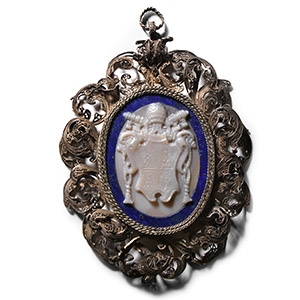
Silver Plaque with Papal Heraldic Cameo
17th-18th century A.D.Sold for (Inc. bp): £936
A carved agate coat of arms within a lapis lazuli plaque, held in a silver canatille frame comprising elaborate filigree foliage and with suspension loop; arms of Pope Alexander VII (1655-1667). 176 grams, 17.5 cm
Private collection, England.
Pope Alexander VII was born Fabio Chigi and took the role of head of the Catholic Church and ruler of the Papal States from 7 April 1655 to his death, in May 1667. He held a number of diplomatic positions in the Holy See, was ordained in 1634, and became bishop of Nardo in 1635. Pope Innocent X elevated him to the role of secretary of state in 1651, and in the following year he was appointed a cardinal. Alexander VII supported various construction projects in Rome, wrote poetry and patronized artists working on the decoration of churches. -
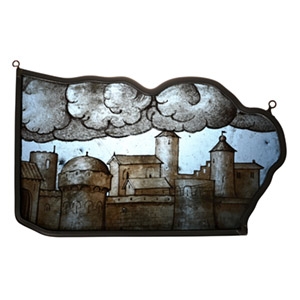
Stained Glass Panel of a City Landscape
Northern France, probably Champagne, circa 1520-1530 A.D.Sold for (Inc. bp): £910
Irregular panel depicting a section of fortified town wall with gate, towers and loopholes, church and other buildings; lowering clouds above; framed with lead cames with two suspension loops. 223 grams, 22 cm wide
with De Baecque Vente Aux Enchere, 5 March 2022, no.52. -
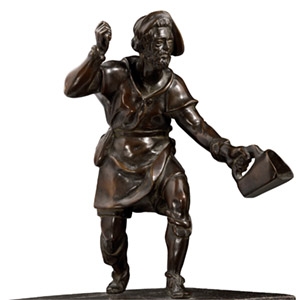
Bronze Figure of a Bird Catcher
18th-19th century A.D.Estimate: £800 - 1,000 (+bp*)
Opening Bid: £400
Clad in garments evoking the Middle Ages, modelled in the round stalking his prey with a cage in one hand and a cudgel or baton held in the other, ready to strike; a number of birds suspended from his belt, together with other pouches; mounted on a veined granite base. 6.2 kg, 29.5 cm
Private collection, England.
Executed in the style of Giambologna (Giovanni da Bologna, 1529-1608), the famed Florentine sculptor whose work was favoured by the Medici family. It is similar to another bronze in the Detroit Institute of Art, where it is ascribed to Antonio Susini, a student of Giambologna.
